The government will start practical trials in fiscal 2018 to utilize carbon dioxide discharged from industrial plants and other facilities, turning it into fuels such as ethanol and synthesizing it into materials for producing synthetic resins.
It will establish about four facilities in the nation for the trials, which will be conducted for five years until fiscal 2022 to examine profitability and other factors.
If the conversion of CO2 is put into practice, it is expected that the nation's CO2 emissions could be drastically reduced. Therefore, it is expected that the conversion system will enable the nation to get closer to its CO2 emissions reduction goal set under the Paris Agreement (see below), an international framework for taking measures against global warming.
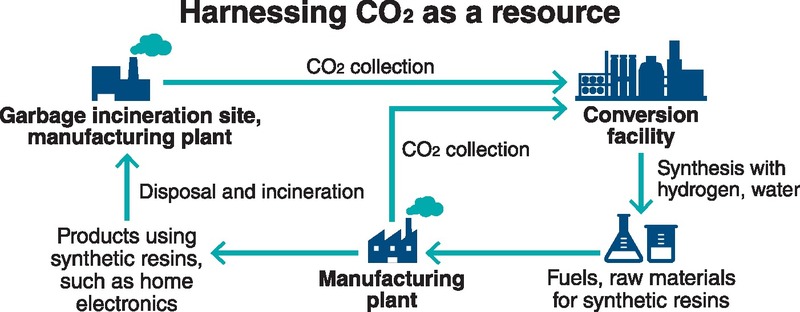
The practical trials will be implemented at two kinds of facilities. At one kind, CO2 discharged from facilities such as garbage incineration sites and manufacturing plants will be utilized. At the other, artificial photosynthesis will be triggered using CO2 already in the air. From April, the government will publicly seek cooperation from entities studying the conversion of CO2 into resources, such as companies, universities and research institutions. The government will then choose trusted contractors from among these groups, with the aim of making the experimental facilities fully operational from fiscal 2019.
The conversion process involves chemical reactions between CO2 and either hydrogen or water using photocatalysts and other tools, and produces organic compounds such as ethanol, methanol and formic acid. The government expects that the organic compounds will be used for the production of fuels for machinery at plants and synthetic resins, which are processed into materials used for various kinds of products.
Such conversion of CO2 has already been successfully achieved by domestic chemical makers and universities in the research and development stage. But tasks remain when it comes to putting the technology to practical use, such as whether it can be profitable. Therefore, in the trials, in which all processes up to the production of the materials will be conducted, the government will examine factors such as costs and the quality of the products so that it can find out whether CO2 conversion can be operated as a business. The government will earmark a total of about 2 billion yen for the trials in its fiscal 2018 budget, and plans to invest about 10 billion yen in total across the five-year period.
Under the Paris Agreement, Japan has set a goal of cutting its emissions of greenhouse gases in fiscal 2030 by 26 percent compared with the fiscal 2013 figure. But many in the government see this goal as difficult to achieve. One government source said, "It is difficult to [achieve this goal] in the current situation where the reactivation of nuclear power plants, which do not emit CO2 when they generate electric power, has made so little progress." By starting this project, the government aims to minimize the consumption of petroleum and other fossil fuels, and to utilize the technology to achieve its emissions goal.
-- Paris Agreement
An international treaty for counteracting climate change. It was adopted in December 2015 and went into effect in November 2016. The agreement aims to maintain a global average temperature increase of well below 2 C above the pre-Industrial Revolution level. The Kyoto Protocol, which had been the previous framework, obliged only advanced countries to cut greenhouse gas emissions. Under the Paris Agreement, at least 190 countries and territories, including developing nations, are meant to submit their respective emissions-cutting goals to the United Nations, and each of them has to make efforts to achieve the goals.
Read more from The Japan News at https://japannews.yomiuri.co.jp/