The Agriculture, Forestry and Fisheries Ministry plans to support the activities of food banks (see clip), which distribute food products to people in need.
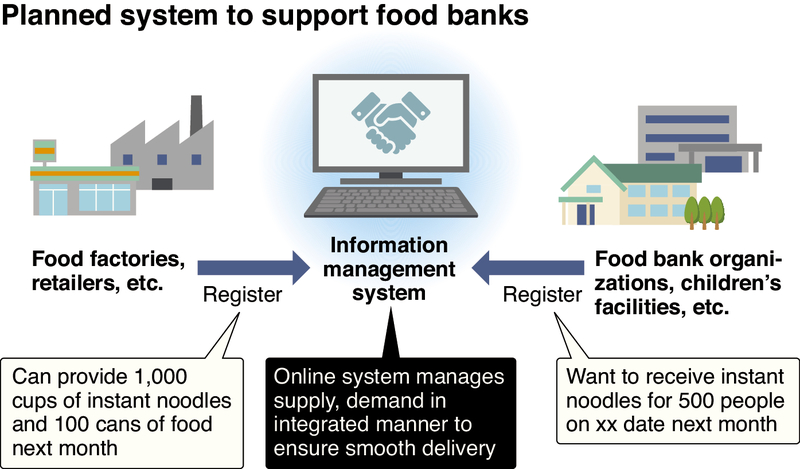
In fiscal 2020, the ministry intends to start testing a system to manage information on demand from recipients and the availability of leftover food from factories, retail stores and restaurants. It hopes its efforts will also help reduce the amount of food that is discarded despite still being edible.
Under the program, companies and other organizations will input into the system information such as how much food they can provide and when. Private organizations, children's facilities and facilities for the elderly will put in such information as how much food they want to receive when and where.
The ministry aims to link supply and demand online to ensure smooth food delivery. It plans to accept applications from organizations to run the system from early next year, and start the trial as early as April.
The necessary costs are set to be covered by funding earmarked for projects to reduce food losses.
According to the national food bank association based in Tokyo, the number of organizations engaging in food bank activities increased to 110 in 2019, up from 19 in 2010. However, the total amount of food handled has peaked at about 4,000 tons a year, posing the challenge of finding more people to support the work.
Food bank activities are also spreading among companies. For example, KFC Holdings Japan Ltd. is donating ready-cooked chicken products, and Lawson Inc. and Mitsubishi Shokuhin Co. are donating expired sweets, canned food and other items to kodomo shokudo children's cafeterias through food bank organizations. Kodomo shokudo provide free or inexpensive meals to local children from low-income families and others.
The ministry hopes the number of participating companies will increase as the system is put into operation.
It also wants the program to lead to the reduction of food waste. According to the ministry, the nation wasted 6.43 million tons of food in fiscal 2016, equivalent to one cup of rice per Japanese citizen per day.
The Food Loss Reduction Promotion Law, which went into effect in October, stipulates a policy to support food banks.
Clip: Food bank
A service in which food that can be eaten safely but cannot be sold for reasons such as damaged packaging or printing errors is donated by companies and provided free of charge to parties including households in need, facilities for the elderly and children's cafeterias. In Japan, food bank activities were started by the private sector around the year 2000. Compared with the United States, which has had food banks for more than half a century, Japan is said to have lagged behind in drafting laws, implementing measures and other steps.
Read more from The Japan News at https://japannews.yomiuri.co.jp/