The education ministry plans to establish a new support system next fiscal year to foster increased opportunities for female researchers at universities and other research institutions, it has been learned.
The Education, Culture, Sports, Science and Technology Ministry intends to provide institutions with subsidies on the condition that they set specific targets to mend the gender gap and strive to boost the ratio of women holding full-fledged professorships and other high-ranking positions, sources said.
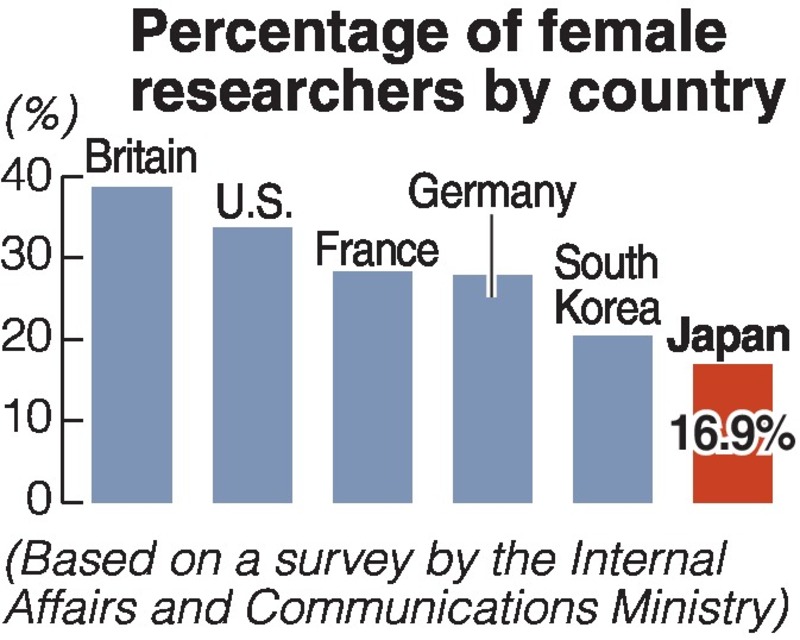
Women's representation in the research community has been remarkably low in Japan compared to international levels.
A study conducted by the Internal Affairs and Communications Ministry found that only 16.9% of research posts across both the public and private sectors in Japan were held by women as of fiscal 2019 -- far below the over 30% seen in the United States and Britain.
This trend has been particularly evident in the natural sciences.
According to the education ministry, women account for 65% of the undergraduate student body in the humanities and 36% in the social sciences, but only 28% in the physical sciences and a mere 16% in engineering. The imbalance has been cited as a cause for concern that may be impinging upon the diversity and overall quality of research in Japan.
In light of such concerns, the education ministry plans to introduce a new system next fiscal year to help universities and national research institutes to boost the percentage of women in university president, vice president, professor and other high-ranking posts above the associate professor level.
With the Fifth Basic Plan for Gender Equality and Sixth Science, Technology and Innovation Basic Plan, the government has set a target of filling 30% of associate professorships with women. It has also stipulated 23% each as the benchmark for professor, vice president and president posts at universities and other research institutes.
Under the new system, the ministry plans to offer annual subsidies of up to 70 million yen to institutions that strive for a ratio higher than the government's targets. The subsidies will be available over a period of five years with the thought that they may be used to help cover some of the personnel costs.
"We want to help create an environment where female researchers can work comfortably by increasing the number of women in leadership positions," a senior ministry official said.
Read more from The Japan News at https://japannews.yomiuri.co.jp/