The controversy over Prime Minister Yoshihide Suga's refusal to appoint six scholars recommended by the Science Council of Japan as its new members was taken up for discussion at an adjournment inspection -- an inspection held while the Diet is not in session -- of the Cabinet Committee of the House of Representatives on Wednesday.
The government emphasized the "lawfulness" of Suga's rejections, but it could not eliminate the impression left by its lack of explanation on the matter. There is even a possibility of the issue evolving into an argument over how the SCJ should look as a whole in future.
-- Denial of 'change in interpretation'
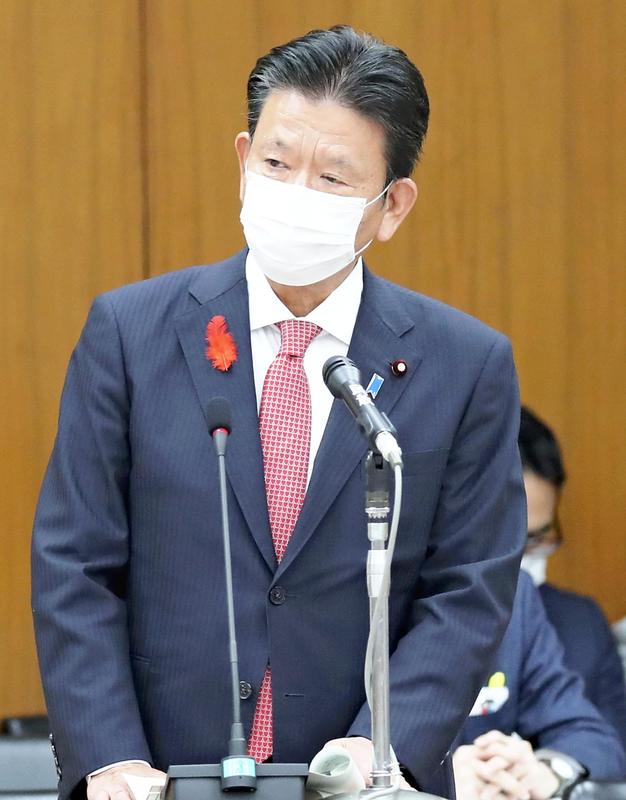
"The prime minister does not necessarily have to appoint nominees recommended [by the SCJ] as its members. His rejections are not illegal." This was said repeatedly by Hiromi Mitsubayashi, state minister of the Cabinet Office.
A succession of voices in the opposition parties questioned whether Suga's decision was consistent with comments made in May 1983 by Prime Minister Yasuhiro Nakasone at a meeting of the House of Councillors' Committee on Education. Nakasone said at the time that "the government's role in the appointments was just a formality."
Citing Article 15, Section 1 of the Constitution, which stipulates that the people have the right to choose their public officials and to dismiss them, Mitsubayashi said that there has been no change since 1983 in that the prime minister assumes responsibility for the people and the Diet over the appointment of SCJ members, who are public servants. He refuted the opposition's claim, saying, "The government has not changed its interpretation of the law." Yoichi Kimura, director of the First Department of the Cabinet Legislation Bureau, also explained that "[the rejection] is consistent with the provisions of the Constitution."
Masato Imai, a lower house member of the Constitutional Democratic Party of Japan, pointed out that the six nominees whose appointments were turned down have voiced opposition to such laws as the security legislation, which enabled limited exercise of the right of collective self-defense, and the revised organized crime punishment law. He then questioned whether the six nominees "have been removed because they rebelled against the government."
In response to Imai's question, Kentaro Sonoura, a member of the ruling Liberal Democratic Party, noted that "among those appointed as new members of the SCJ this time, there are also those who have clearly shown their opposition to a bill related to the legislation." A government official added that the government also made its decision according to the standard that SCJ members "should advance their activities from a comprehensive, birds-eye viewpoint," emphasizing that the appointments "had nothing to do with nominees' standpoints on the [relevant] bill."
Among the 99 newly appointed members, there are at least 10 who have voiced opposition to the security legislation, including Oriza Hirata, a playwright who served as a special adviser to the cabinet under the administration led by Prime Minister Yukio Hatoyama of the Democratic Party of Japan. A high-ranking government official said, "Irrespective of their stance on the government's key policies, the decisions were made comprehensively to secure neutrality, for fear of a lack of balance at the SCJ."
-- 'Not fulfilling duty'
Yet as to why the appointments of the six nominees were rejected, the government side repeatedly took the line that these are individual matters of personnel affairs, saying, "We would refrain from answering." By doing so, the government can hardly be said to have sufficiently responded to criticism that it "has not fulfilled its duty to explain." It is likely to have a tough time in Diet deliberations in the days ahead.
In connection with the refusal to appoint the six, there was even a cautious view within the government that "we will end up consuming a lot of energy politically." But it is said that the decision was made secretly by Suga and Kazuhiro Sugita, deputy chief cabinet secretary, the top administrative official.
Concerning the claim that there has been no change in the interpretation of the law since the government's 1983 comment, Suga said during an interview on Monday, "I have contemplated whether I can follow precedent." On this point, concern has been voiced even within the ruling camp. As a mid-ranking LDP official put it, "As the government has effectively broken with its usual practice of appointing all the nominees, it could be hard for the people to understand."
Read more from The Japan News at https://japannews.yomiuri.co.jp/