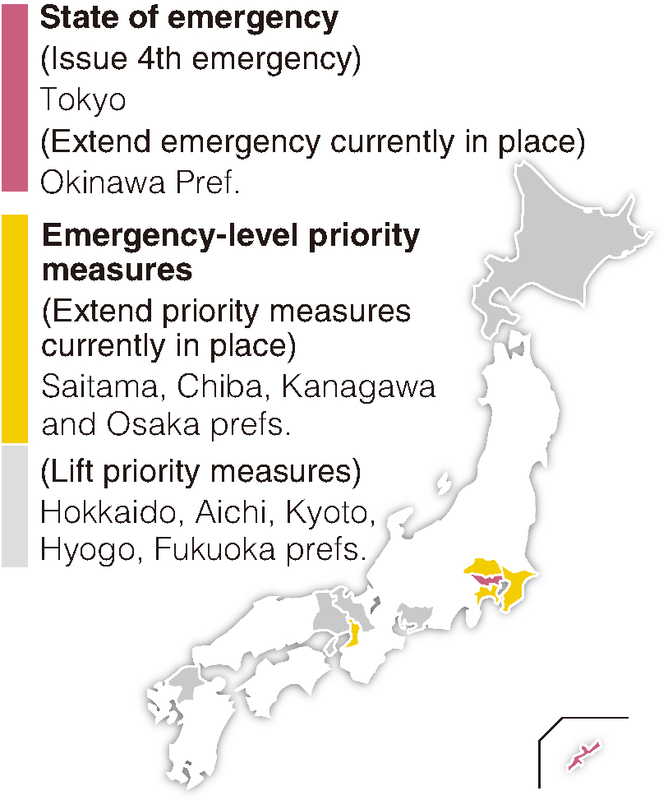
The government is expected to officially decide to declare a fourth state of emergency for Tokyo at a meeting of its special task force against the novel coronavirus on Thursday.
Earlier on Thursday, the government submitted to its subcommittee of experts on basic COVID-19 measures a plan to declare a new state of emergency for the capital, to which priority measures have been applied. The subcommittee approved the plan.
A state of emergency currently in place for Okinawa Prefecture and priority measures taken for Osaka Prefecture and three prefectures in the Tokyo metropolitan area will be extended. The Tokyo state of emergency and the extension of these measures are to be in effect from Monday to Aug 22. This would mean that the Tokyo Olympics, scheduled for July 23 to Aug 8, will be held under a state of emergency in Tokyo.
Prime Minister Yoshihide Suga plans to give a press conference on the matter on Thursday evening.
Yasutoshi Nishimura, the minister in charge of economic revitalization and the government's COVID-19 measures, expressed a sense of crisis at the subcommittee meeting. "The upward trend of the number of new infection cases has become evident in the Tokyo metropolitan area and other major urban areas," he said.
The daily tally of new infection cases reaching 920 in Tokyo on Wednesday was a factor behind the move to return the capital to a state of emergency. In Okinawa Prefecture, where the state of emergency will likely remain in place, the number of new cases has remained at Stage 4, the most serious level.
While the priority measures are planned to be extended in populous Osaka Prefecture and Tokyo's three neighboring prefectures of Saitama, Chiba and Kanagawa, the government plans to end such measures for five prefectures where the infection situation has improved -- Hokkaido, Aichi, Kyoto, Hyogo and Fukuoka -- on Sunday.
The government has set the new period for the state of emergency and priority measures for six weeks until Aug. 22 because infections could spread from metropolitan centers to regional areas during the Bon festival and the summer holiday season.
However, as vaccinations are progressing, the government has included in its revised plan for basic COVID-19 measures the statement, "If the burden on the health care system improves and it is recognized that the measures are no longer necessary, these measures will be canceled even within the designated period."
In Tokyo and Okinawa Prefecture, which are subject to the state of emergency, the government will request eating establishments to stop serving alcoholic beverages and shorten their business hours by closing by 8 p.m. In the areas under the priority measures, prefectural governments will request such business operators not to serve alcohol in principle, according to the revised plan. Under the current priority measures, serving alcoholic beverages until 7 p.m. has been allowed.
To seek cooperation from restaurants and other eateries, the government aims to speed up payments of cooperation money to business operators who respond to the requests. In its revised plan, it refers to the introduction of a system that will enable advance provision of cooperation money.
Read more from The Japan News at https://japannews.yomiuri.co.jp/