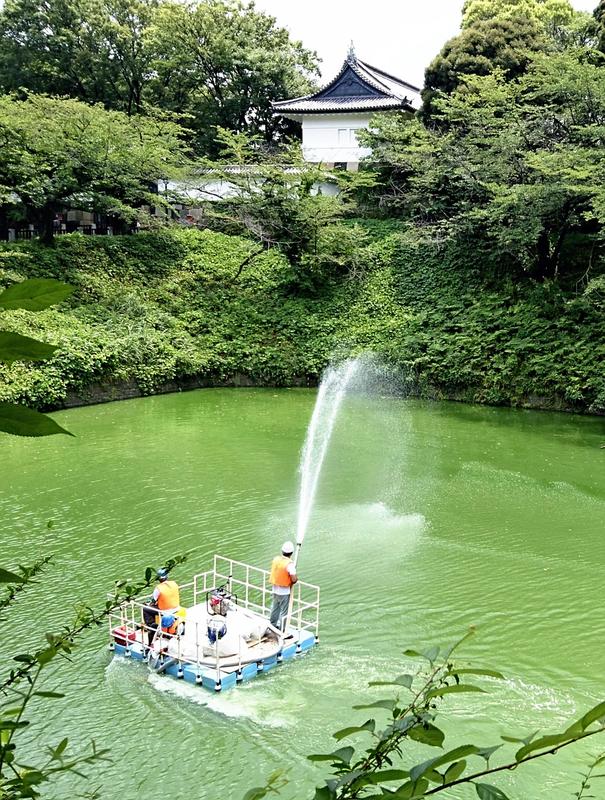
The Environment Ministry embarked on a project this month to prevent the explosive growth of blue-green algae (see below) as part of efforts to improve the quality of water in the moats surrounding the Imperial Palace.
With blue-green algae causing a foul odor and damaging the landscape, the ministry will try four removal methods in fiscal 2018 and 2019, in cooperation with companies experienced in algae management.
The government and private-sector companies are joining hands to tackle the algae problem in the moats in preparation for the 2020 Tokyo Olympic and Paralympic Games.
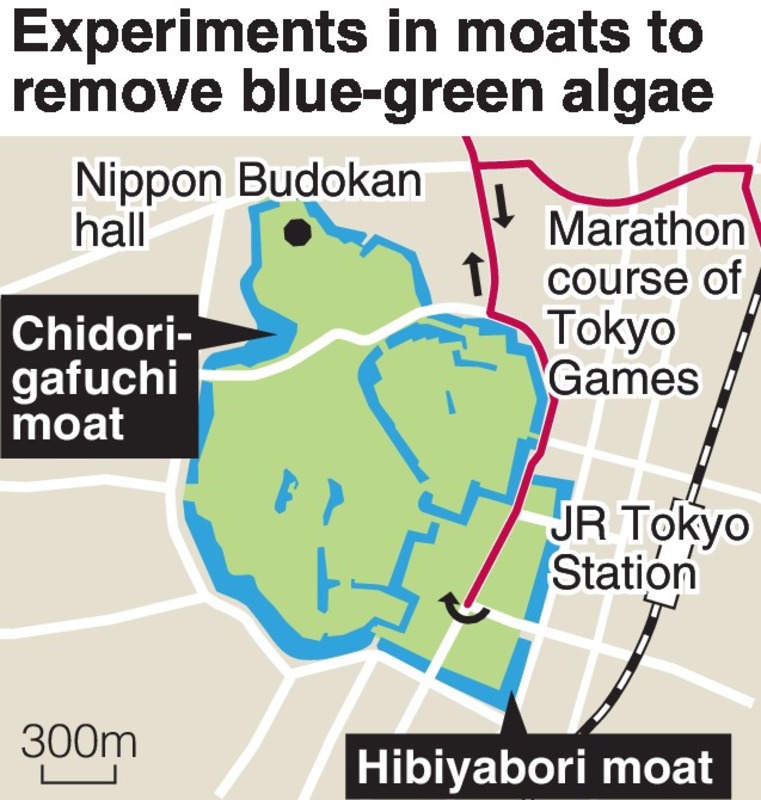
The courses for the marathon and race walking events of the Tokyo Games include roads along the moats. In addition, judo and other events will be held at the Nippon Budokan hall, which is surrounded by the moats.
Although an explosive growth of blue-green algae has yet to be confirmed this year, it is highly likely that both athletes and spectators will be impacted by the bad odor should algae blooms appear during the Games.
While the ministry and private firms have cooperated to improve the water quality of the moats by installing water processing equipment, there have been periods of explosive growth of the algae in August and September in recent years.
To address the situation, the ministry decided to launch the program to develop a new technique that is highly effective to prevent the spread of algae.
The government and firms are conducting experiments in Chidorigafuchi and Hibiyabori moats between July and September, and will examine their effectiveness in autumn or later.
In the Hibiyabori moat, water purifying company Willstage, based in Kusatsu, Shiga Prefecture, has been testing its technique to dissolve algae using bacteria, after scooping up the sludge at the bottom of the moat. It is expected to prevent the algae from growing by cutting its flow of nutrients.
In Chidorigafuchi moat, the Water Reuse Promotion Center, based in Chuo Ward, Tokyo, has been conducting an experiment in which plankton that causes algae blooms become fixed to powdered minerals that sink to the bottom of the moat
"As a chemical agent is not used in this technique, we can purify the water quality without destroying the ecosystem," said President Shinichi Mori of Lumilite Japan Co., which developed the technique.
"In preparation for the Olympic Games, which will attract worldwide attention, we would like to have as many effective measures as possible," a ministry official said.
-- Blue-green algae
Blue-green algae forms in ponds and moats and causes a green scumlike film to coat the water's surface. Algae blooms tend to occur in summer, emitting a strong musty odor. The blooms can cause a lack of oxygen in water, negatively impacting fish and other wildlife.
Read more from The Japan News at https://japannews.yomiuri.co.jp/