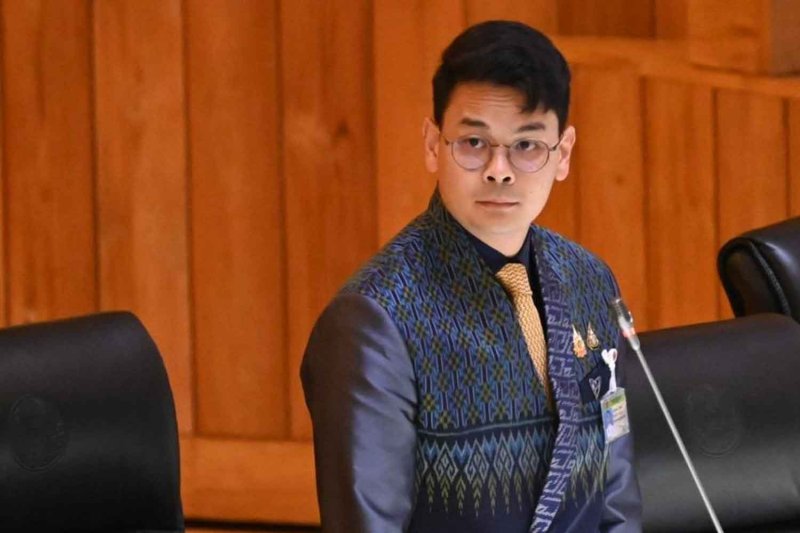
The determination of rookie politician Chaichanok Chidchob, Minister of Digital Economy and Society (DES), to push ahead with the TH-AI Passport scheme by granting premium AI access to five million Thais with a budget of 1.6 billion baht has backfired, turning the initiative into a new political flashpoint for the Anutin government.
The so-called TH-AI Passport is being promoted as a scheme to expand citizens' access to AI technology and help the country keep pace with digital innovation.
However, the DES-led project has attracted criticism on several fronts, including budget allocation, cost efficiency and the procurement process. Critics, led by opposition parties such as the People's Party and the Democrat Party, have questioned the scheme's terms of reference and a bidding process they fear could favour certain companies over others. So far, Mr Chaichanok has failed to provide clear answers.
Mr Chaichanok is becoming the latest political fall guy, not simply because he is the DES minister. The 35-year-old political newcomer is also secretary-general of the Bhumjaithai Party. More importantly, he is the son of Newin Chidchob, the patriarch of the Buriram political dynasty and a key strategist behind the party.
It is therefore natural that he is under intense scrutiny. The public and political commentators want to know — and Mr Chaichanok must prove — whether he has the mettle of a leader or is merely another beneficiary of nepotism.
The TH-AI Passport has dominated headlines and drawn heavy criticism over the past two weeks. The People's Party has seized on the issue, relentlessly attacking the 1.6-billion-baht scheme and is preparing to file a complaint with the National Anti-Corruption Commission (NACC). It is also almost certain to make the project a key issue in the upcoming no-confidence debate.
Mr Chaichanok, however, has chosen to weather the storm. Despite mounting criticism and negative headlines, he insisted this week the TH-AI Passport would proceed because "the DES has done nothing wrong".
Such determination reflects the government's confidence in its parliamentary strength. The Bhumjaithai Party dominates the Lower House and is believed to enjoy good relations with a majority of senators. In simple political terms, the Bhumjaithai-led coalition has enough support to withstand opposition challenges and censure debates.
At the same time, the Anutin government is relying on so-called "helper" policies to ease public frustration. A notable example is the Thai Helping Thai Plus scheme, designed to subsidise household expenses under a 60:40 formula over four months. Such measures may buy the government time, at least until the DES minister can offer a stronger explanation and a better strategy for the controversial TH-AI Passport project.
Although the controversy has largely benefited the opposition, it has yet to inflict serious political damage on the DES minister.
The opposition is not without its own vulnerabilities. When People's Party list MP and firebrand politician Rukchanok Srinork questioned links between the project's winning bidder and the Bhumjaithai Party by posting photographs of the businessman alongside figures in the Buriram political network, counterattacks quickly followed.
Images of the same businessman posing with two key ideological figures in the People's Party — Thanathorn Juangroongruangkit and Piyabutr Saengkanokkul — soon surfaced on social media and went viral. The swift response left the People's Party on the defensive.
Despite the setback, the Anutin government could remain in power for a full term as long as corruption investigations and parliamentary checks and balances remain sluggish.
In terms of parliamentary arithmetic, the Bhumjaithai Party remains rock solid, enjoying a majority in the Lower House and strong ties with senators in the Upper Chamber, which exerts influence through appointments to independent agencies. The only notable exception is the Constitutional Court, where Senate-appointed dominance has yet to be fully consolidated.
Yet many political analysts believe Bhumjaithai has its own blind spot. Olarn Thinbangtieo, a political scientist at Burapha University's Faculty of Political Science and Law, told me that the party has yet to secure genuine popular support.
"Much of its electoral success came from nationalist sentiment — particularly anti-Cambodian sentiment — rather than enduring public trust," he said.
If the government fails to heed public concerns and continues to push ahead with costly and high-risk projects, such as the proposed one-trillion-baht Land Bridge, public backlash could intensify. Should political stability begin to unravel, the elite that has backed Mr Anutin may look for new leadership. After all, in Thailand's fluid political landscape, leadership is only a tenuous possession.
In such a scenario, Mr Olarn said Deputy Prime Minister and Foreign Minister Sihasak Phuangketkeow could emerge as an alternative prime ministerial candidate.
Mr Sihasak already has a strong track record. His public image could improve further if he delivers tangible progress in resolving maritime disputes with Cambodia in Thailand's favour following the scrapping of the MoU 44 agreement. Like Mr Anutin, he is also listed among Bhumjaithai's prime ministerial candidates.
Such a scenario would not represent a break from the current Bhumjaithai system. Rather, it would be a pragmatic, feedback-driven adjustment — Thai-style politics designed to preserve political continuity.