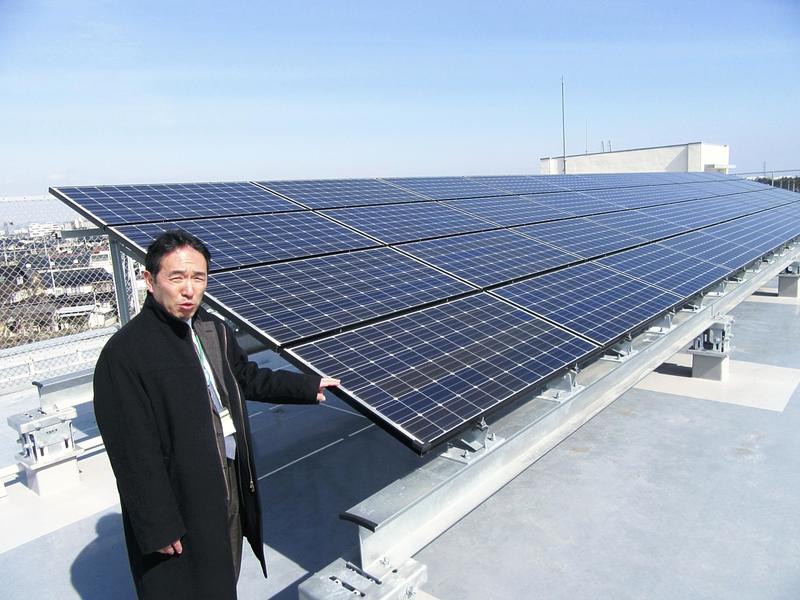
The government plans to set up a new subsidy program to install both renewable energy power generation facilities like solar panels and electricity storage batteries at schools, hospitals and other facilities that are used as evacuation centers, government sources said.
The purpose of the program is to strengthen measures against power outages in the event of a disaster. The program will be included in a new economic package to be compiled as early as Thursday.
The Environment Ministry is working on the amount of subsidies to be provided, arranging to include it in the government's fiscal 2019 supplementary budget. The new subsidies will cover public school buildings, municipal offices and hospitals.
The move, which comes after a series of large-scale power outages caused by recent typhoons and torrential rains, is designed to improve the stability of power supply in public facilities and hospitals that are used during such disasters. The government will urge public facilities to intensively install these systems by next summer, when the number of typhoons approaching Japan is expected to increase.
The government plans to require each public facility to install both power generation facilities and storage batteries as a condition for the subsidy because this will not only increase the power supply availability but also the electricity storage capacity. Storage batteries are expensive and difficult for each facility to purchase on its own.
The government also plans to require each facility to cut their power consumption by half before power generation facilities can be installed. This power-saving method would make them similar to ZEB (Net Zero Energy Building), which is an energy-saving building that realizes energy "self-sufficiency."
The ZEB standard does not include the deployment of storage batteries. However, the government requires the introduction of storage batteries because they could store electricity generated by solar panels, and allow stable power supply even in bad weather or at night.
A large-scale blackout was caused in almost all areas in Hokkaido by a powerful earthquake in September 2018. However, in a company in Sapporo where ZEB was being used, employees were able to use electricity internally without any problems. "I was relieved that I was able to charge my cell phone. Large storage batteries are expensive, however, we will be better equipped with a government subsidy system," an official of the company said.
Read more from The Japan News at https://japannews.yomiuri.co.jp/