An additional economic package approved by the Cabinet shows that the government has decided to continue with massive fiscal stimulus.
While the package aims to shift focus toward structural changes to society and the economy for after the pandemic, there are concerns that a course correction may be needed depending on how the novel coronavirus spreads.
-- Ruling bloc takes lead
"A fund in the 10 trillion yen range is sought as soon as possible," reads the text of the additional stimulus package released Tuesday, giving a clear numerical target for a fund to support university research and development. The third supplementary budget for fiscal 2020 and treasury investments and loans for fiscal 2021 amount to about 4.5 trillion yen, with the goal to reach 10 trillion yen in stages.
Last week, a draft economic policy package distributed by the Liberal Democratic Party's executive committee only included the abstract phrase "[a fund] on the scale of others around the world." Led by Akira Amari, chairperson of the LDP's Research Commission on the Tax System, who conveyed the support of Prime Minister Yoshihide Suga, the wording was changed at the last minute before the Cabinet decision.
A senior Finance Ministry official expressed disappointment, saying: "Ten trillion yen is different by an order of magnitude. [Normally] the annual budget is 100 trillion yen, but we're going off the rails."
-- Fiscal discipline
Discussions on additional economic stimulus and a third supplementary budget began in mid-October within the government and ruling parties. The Finance Ministry envisioned limiting the supplementary budget to a few trillion yen, as in most years.
However, after a level period, the number of infections in Japan began rising in late October. Once November came around, daily records were being broken regularly.
Around that time, arguments for increasing the third supplementary budget began gaining steam in the ruling parties, with those calling for "10 trillion yen to 15 trillion yen" becoming dominant.
Noting that the shortfall in domestic demand grew to 34 trillion yen in the July-September period, LDP Policy Research Council Chairman Hakubun Shimomura asked Suga at the end of November for "a large supplementary budget that will come close to filling that in."
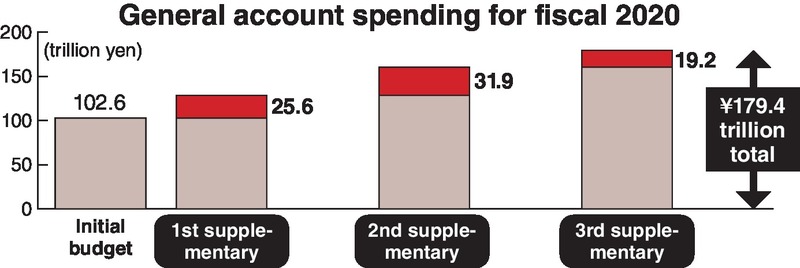
The final figure ended up at 19.2 trillion yen. With about 25.6 trillion yen from the general account in the first supplementary budget and 31.9 trillion yen in the second, expenditures for fiscal 2020 will approach 180 trillion yen when the third supplementary budget is included.
This is 1.8 times the original budget, and there is growing concern about deteriorating fiscal discipline from issuing more bonds to finance it.
-- Tug of war
Through a series of economic measures, the scale of projects up through the second supplementary budget for fiscal 2020 will reach 233.9 trillion yen. The additional economic measures are about 60 percent of Japan's gross domestic product, a high level among major countries.
Suga's attempt to give the impression of bolstering midterm measures in the environmental and digital fields, which he is emphasizing in preparation for the post-pandemic world, also helped swell the budget.
The Finance Ministry employed some gimmicks to deal with the pressure for increased spending from the ruling parties.
One was focusing on a new five-year plan for "national resilience" aimed at disaster prevention and mitigation that has been a focal point for LDP Secretary General Toshihiro Nikai.
The ministry thought that if the amount for the first year, which was to be included in the fiscal 2021 budget, was brought forward to the third supplementary budget for fiscal 2020, it would make the budget appear larger and help win the approval of the ruling bloc.
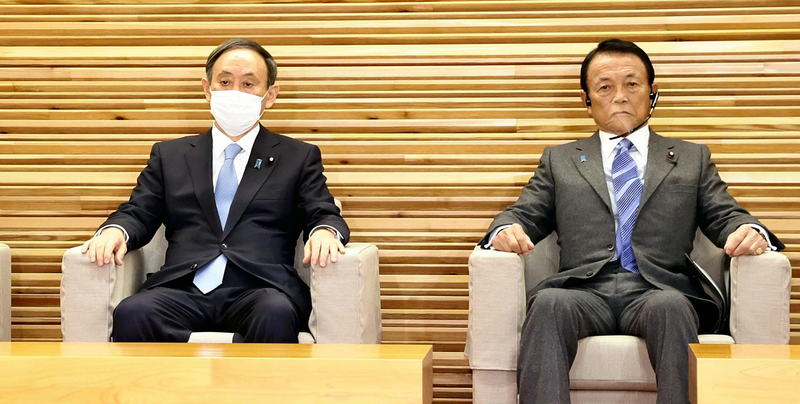
"There is a natural limit to what can be accomplished under the leadership of the government. I'm looking forward to the private sector taking the lead," Finance Minister Taro Aso said at a press conference after Tuesday's Cabinet meeting.
However, corporate capital investment in the July-September period was down 10.6% from the same period last year, the second quarter of double-digit drop in a row.
Discussions of the fiscal 2021 budget are already in full swing among the government and ruling parties. The tug-of-war over the size of projects and fiscal expenditures is expected to depend largely on the fluctuations in number of infections.
Read more from The Japan News at https://japannews.yomiuri.co.jp/