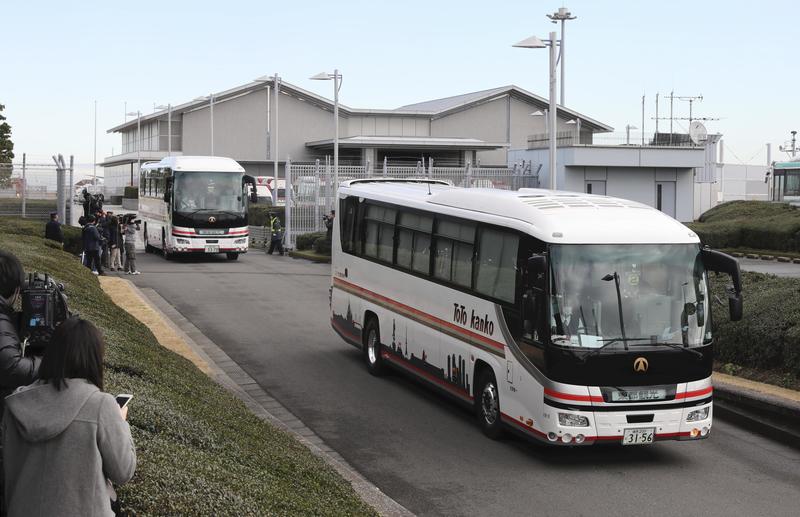
The first flight bringing home Japanese from Wuhan, China, due to the spread of the infectious new type of coronavirus arrived at Haneda Airport on Wednesday. But now the government is in a bind: While the extent of infections caused by the new virus remains unclear, how do authorities prevent the evacuation and return of these Japanese from causing further spread of the disease? Drawing up a response to this situation was a tough task.
Prime Minister Shinzo Abe insisted Wednesday that steps were in place to prevent the Japanese who returned on the flight from spreading the coronavirus.
"The health condition of each individual will be carefully checked," Abe said at the House of Councillors Budget Committee meeting. "They'll be asked to stay at home or elsewhere and refrain from going outside for two weeks."
While the government was considering its plan to evacuate Japanese residents from Wuhan in Hubei Province, the biggest problem was how to handle returnees who showed no symptoms of the coronavirus. On Tuesday, the government decided to classify pneumonia caused by the virus as a "designated infectious disease" under the Infectious Diseases Law. The designation will take effect on Feb. 7.
This will enable authorities to forcibly hospitalize people suspected of being infected with the coronavirus. However, this does not cover people who do not show any symptoms of the disease.
Information about the infectivity of the new coronavirus has been lacking. According to a senior official at the Health, Labor and Welfare Ministry, the World Health Organization says it is unclear how easily the virus spreads from person to person. However, there have been reports in China of people being infected despite not showing symptoms such as coughing or a fever. Furthermore, a bus driver in Japan confirmed Tuesday to have contracted the coronavirus reportedly had not been in contact with anybody who displayed symptoms of the disease. This revelation has amplified concerns among the public.
According to government sources, some attendees at a meeting of officials from relevant ministries and agencies suggested that "all residents who return to Japan should be kept in isolation for a set period." A senior government official also concurred with this view, reportedly saying, "I think the returnees also would worry they might develop symptoms and they could face discrimination or prejudice, so maybe it would be better to accommodate them somewhere."
However, a senior health ministry official emphasized such an option would be problematic. "Under the law, people who do not show symptoms cannot be forced to stay in quarantine. It would become a human rights issue," the official said.
2 returnees refused tests
In the end, the government decided its approach would be to ask even returnees who showed no symptoms to undergo voluntary virus checks and stay at home or accommodation facilities provided by the government until it was confirmed they had tested negative. The government also took the extraordinary step of providing vehicles exclusively for transporting the returnees to their homes, medical institutions and accommodation facilities to prevent them from coming in contact with members of the public.
Despite this, two passengers on the first flight who showed no symptoms of the coronavirus refused to undergo any tests, which highlighted the limits of the government's response. Requests to refrain from going outdoors also cannot be enforced, raising the risk that the returnees might go outside if they decide to do so.
Some other countries will place compulsory restrictions on the movement of residents who return from China. On Wednesday, Australian Prime Minister Scott Morrison announced a plan to quarantine evacuees from Wuhan on the Australian territory of Christmas Island – an Indian Ocean island about 1,500 kilometers from mainland Australia – for up to two weeks for observation. The French government also plans to quarantine returnees in facilities for two weeks.
At Wednesday's meeting of the ruling Liberal Democratic Party's task force dealing with the coronavirus outbreak, an attending lawmaker suggested the government should adopt a tougher approach. "Japan will host the Olympic Games this summer, and the world is watching how we deal with a crisis. Why can't Japan do what other countries are doing?" the lawmaker asked.
A senior government official admitted grappling with the coronavirus issue had been difficult.
"The government's response was a decision based on data and logic. Some people might say we have been too strict, and others might say we didn't go far enough," the official told The Yomiuri Shimbun.
Read more from The Japan News at https://japannews.yomiuri.co.jp/