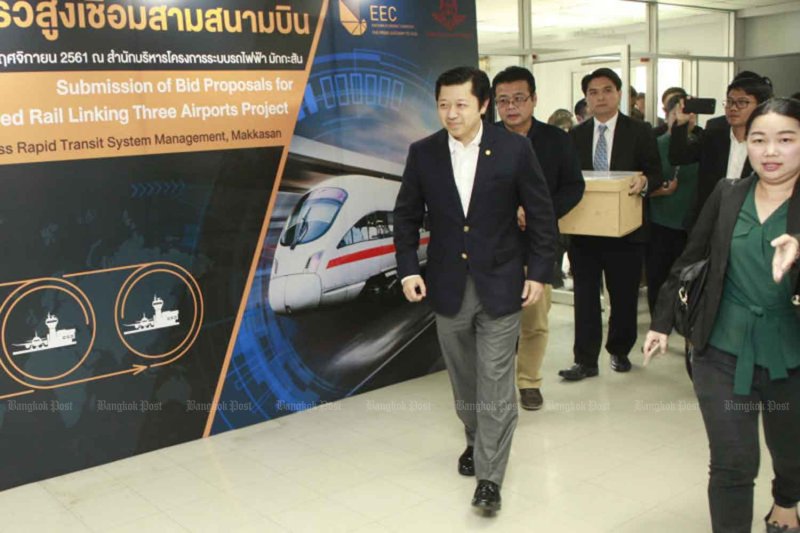
The government and Asia Era One are seeking a joint solution to move forward with the 220-billion-baht three-airport high-speed rail project amid unresolved contract issues.
Prime Minister and Interior Minister Anutin Charnvirakul recently said the government was keen to ensure the contract is implemented according to agreed terms, public procurement regulations and the law.
He noted the agreement is between the State Railway of Thailand (SRT) and the private concessionaire, meaning both parties are legally bound by their obligations.
Asked whether the project remains necessary, Mr Anutin said it is still a critical infrastructure investment. Altering contract conditions after an agreement has been signed would be difficult, he added, as bidders accepted the terms before entering the contract. Allowing revisions, he warned, could affect all other government contracts.
Responding to reports that Asia Era One Co, the consortium led by CP Group that won the concession, may seek to terminate the agreement, the prime minister said state contracts cannot be cancelled unilaterally. Any termination would require mutual consent and would carry significant legal consequences.
Mr Anutin said that if the concessionaire abandoned the project, it could face blacklisting as a contractor, forfeiture of performance guarantees, and potential liability for damages if the government were forced to re-auction the project. The most appropriate solution is for both sides to honour their contractual commitments, he said.
Deputy Prime Minister Pakorn Nilprapunt has approved a draft law aimed at strengthening measures against contractors that fail to fulfil government contracts, allowing authorities to act more quickly and with greater legal certainty, he added.
Meanwhile, Eastern Economic Corridor (EEC) secretary-general Chula Sukmanop said the issue will be submitted to the contract administration committee and the EEC Policy Committee for consideration in August.
He said if the private consortium ultimately decides to end its participation, the public-private partnership agreement would be terminated and negotiations with the SRT would follow.
He added the EEC has prepared contingency plans to ensure the project can continue.
Asia Era One president Sarit Jinnasith insisted the consortium never intended to abandon the contract.
However, he said the project has been hindered by unresolved obstacles, particularly delays in land handovers and legal restrictions affecting construction. He said prolonged delays in site delivery have also complicated the project's financing.
Mr Sarit said Asia Era One's priority remains finding solutions with the government rather than terminating the contract.