The government plans to revise the Basic Law on Natural Disasters to facilitate a wide-area evacuation system under which people can flee to places other than their own municipality at a time of emergency, it has been learned.
Under the revised law, the central government can instruct neighboring local governments and public transportation operators to provide assistance to such evacuees.
When Typhoon No. 19 hit Japan last autumn, some municipal governments gave up on encouraging residents to evacuate from their own administrative areas, because train services had already been suspended or they could not secure places for people to go outside their municipalities.
The government plans to submit a bill to revise the law to the ordinary Diet session next year, according to sources.
The idea of a wide-area evacuation system was first added as a form of evacuation when the law was revised in 2012, the year after the Great East Japan Earthquake forced many residents to flee from their own municipality. In 2016, the year after the Kanto and Tohoku regions were hit by torrential rains, the government's Basic Disaster Management Plan stipulated that local governments should secure places for people to evacuate to in neighboring areas.
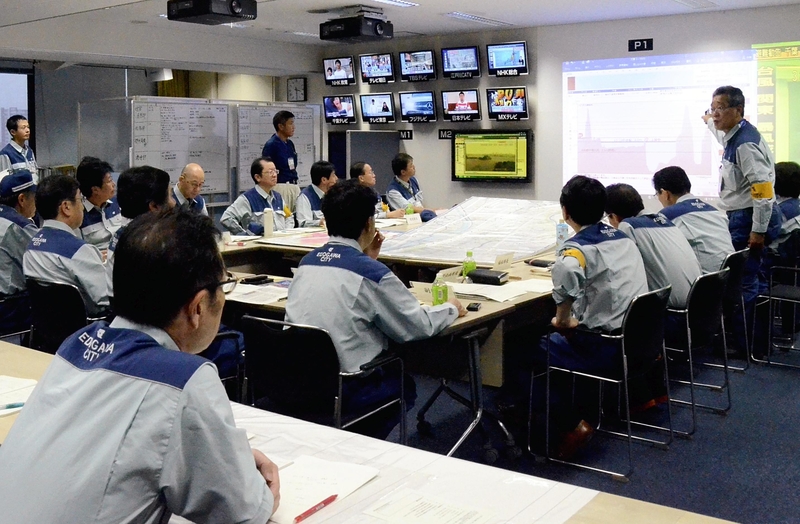
When Typhoon No. 19 caused havoc in October, the governments of five wards located along the Ara River in the eastern part of Tokyo -- Sumida, Koto, Adachi, Katsushika and Edogawa -- considered evacuating as many as 2.5 million residents to nearby prefectures.
However, the plan was eventually shelved because many railway companies in the Tokyo metropolitan area had already decided to suspend their operations, and the five ward governments could not secure places for people to shelter in neighboring areas.
Last month, a panel of experts of the Central Disaster Management Council, which has been studying the government's response to typhoon damage, concluded that wide-area evacuations should be handled by ward, city, town and village governments "in principle." At the same time, the panel also called for the government "to play certain roles."
This conclusion prompted the government to evaluate its measures.
When the prime minister establishes a major disaster management headquarters at the Cabinet Office under the basic law, the central government can instruct public transportation operators and local governments to implement necessary responses. However, the law stipulates that such a headquarters should be established only after a major disaster occurs.
The government plans to revise the law to allow it to set up a major disaster management headquarters in advance when a typhoon is forecast to approach Japan, or coasts are likely to be hit by tidal waves. This revision will enable the government to instruct railway and bus operators, among other entities, to help residents evacuate.
The government will also be able to instruct municipalities that neighbor those expected to be hit hard by a disaster to set up shelters, and to provide them with relief supplies.
There will be no penalties when municipalities disobey these instructions, but the government believes that the revised law will encourage them to abide by the instructions from the viewpoint of the public interest, according to the sources.
Read more from The Japan News at https://japannews.yomiuri.co.jp/