WASHINGTON _ Barreling toward an all but certain government shutdown, the Senate on Friday said it would reject a House bill to fund President Donald Trump's border wall as leaders reopened negotiations with the House and White House.
"There is no path forward for the House bill," said Sen. Jeff Flake, R-Ariz. "The only path forward is to a bill that has an agreement between the president and both houses of Congress."
With about a quarter of government agencies scheduled to run out of funds at midnight EST, House Majority Leader Kevin McCarthy, R-Calif., sent House members home for the night, virtually guaranteeing at least a brief shutdown.
Senators and representatives leaving the Capitol indicated they were promised 24 hours' notice before the next vote.
Senate leaders agreed Friday afternoon that no plan would get a vote in the Senate until Trump and the top Republicans and Democrats in both the House and Senate had signed off on it. Lawmakers hoped that pact to avoid meaningless votes would smooth the process of getting a bill that could pass both chambers and be signed by the president.
Lawmakers acknowledged that there was no clear pathway to resolve the standoff unless Trump drops his demands about the wall. To get through the Senate, any bill would need the support of nine Democrats, who have unanimously rejected money for the wall.
Trump has demanded $5 billion for wall construction. Senators have previously agreed on $1.6 billion that could be used to upgrade existing border fences, but not to begin construction of a new border wall. In talks Friday, White House officials spoke with lawmakers about a possible package that would include the $1.6 billion. It was unclear what other elements might be included.
Senate Republicans were visibly frustrated earlier Friday that Trump whipsawed them this week on whether he would insist on funds for a wall on the U.S.-Mexico border. They had agreed to a spending bill earlier this week that didn't fund the wall with the understanding that Trump would sign it. Then, the House approved $5.7 billion for the wall after Trump reversed course and demanded the money.
"It would have been great if they had told us they wanted this fight, because we would have started working on it on Wednesday," said Sen. Marco Rubio, R-Fla., who supports the border wall funding. "They now have made that clear."
"The key here is we have to get clarity from the president on what his priorities are," said Sen. Thom Tillis, R-N.C.
Senate Majority Leader Mitch McConnell, R-Ky., who rarely speaks to reporters in the Capitol hallways, even paused to show off a campaign button for the "Senate Cranky Coalition."
"This is the unanimous position of the Senate Republican conference at the moment," McConnell said of the pin. Within hours, half a dozen other senators were wearing the same button.
Days before Christmas, lawmakers were visibly frustrated that they were stuck in Washington over a partisan dispute that would do little more than fund the government for seven weeks, a mere kick of the can.
Democratic Sen. Brian Schatz flew home to Hawaii only to turn around and fly back to Washington to vote down the wall proposal.
The one step the Senate agreed upon was a procedural vote that would allow the chamber to move forward on a funding measure. It passed 48-47 _ after Vice President Mike Pence cast the tie-breaking vote.
"Since any eventual solution will require 60 votes here in the Senate, it's been clear that from the beginning that two things are necessary: the support from enough Senate Democrats to pass the proposal at 60, and a presidential signature," McConnell said.
Flake said the roll call on the procedural vote, which was held open for nearly six hours _ significantly longer than a typical 15-minute vote _ was needed to "demonstrate that not all Republicans would be for the House bill either."
The agreement to continue negotiations came after Pence, Trump's son-in-law and senior advisor Jared Kushner, and budget director Mick Mulvaney met separately with Senate Minority Leader Charles E. Schumer, D-N.Y., and House Republican leaders.
The holiday season closure of affected agencies would, among other things, temporarily block the paychecks of hundreds of thousands of federal workers.
A shutdown could also exact a political cost: Polling has clearly indicated for years that most voters don't like the idea of shutting down the government over policy disagreements.
But the polls also show that the two sides have different audiences with different demands. Though a large majority of voters overall don't like shutdowns, most Republican voters support the idea of a fight over the border wall.
In a poll earlier this month by Quinnipiac University, for example, overall voters by almost 2 to 1 opposed the idea of shutting down the government over money for a border wall. And, by 51 percent to 37 percent, voters said that if a shutdown happened, they would mostly blame Trump and the Republicans.
But Republican voters disagreed. By 59 percent to 33 percent, self-identified Republicans said they supported shutting down the government over the wall.
Trump has tried to shift blame to Democrats, an effort he renewed Friday. He praised House Republicans for approving the money he asked for and accused Democrats of obstructionism.
"It's really up to the Democrats _ totally up to the Democrats as to whether we have a shutdown," he said at the White House. "It's possible that we'll have a shutdown. I would say the chances are very good, because I don't think the Democrats care very much about this issue."
It's a departure from what Trump told Democratic leaders in a televised meeting in the Oval Office last week.
"I'll tell you what: I am proud to shut down the government for border security," Trump said then to Schumer and House Democratic leader Nancy Pelosi, adding, "I will be the one to shut it down _ I'm not going to blame you for it."
Trump on Friday also pushed again for McConnell to change Senate rules and eliminate the 60-vote threshold needed to pass most legislation, a change so dramatic that many people refer to it as a nuclear option.
"Mitch, use the Nuclear Option and get it done! Our Country is counting on you!" Trump tweeted.
McConnell and many other Republican senators have repeatedly rejected that idea, and a few Republicans reiterated Friday that it is not an option. The filibuster is designed to protect the minority party. It also prevents dramatically different policies from becoming law each time a different party takes control of the Senate.
In another tweet, Trump predicted that a shutdown, if one comes, "will last for a very long time."
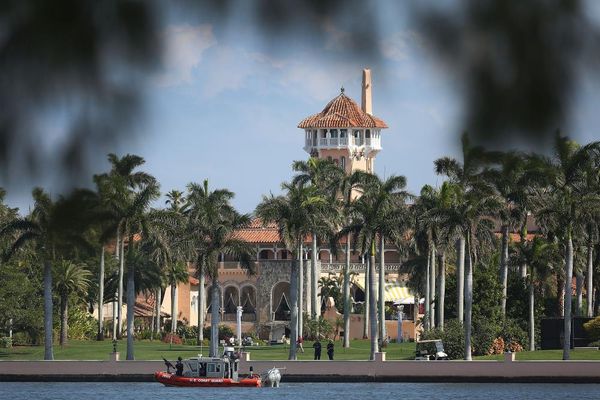
He scrapped plans to leave Washington on Friday afternoon for a holiday vacation at his Mar-a-Lago resort in Palm Beach, Fla., and a spokesperson confirmed that Trump will remain in town in the event of a shutdown.