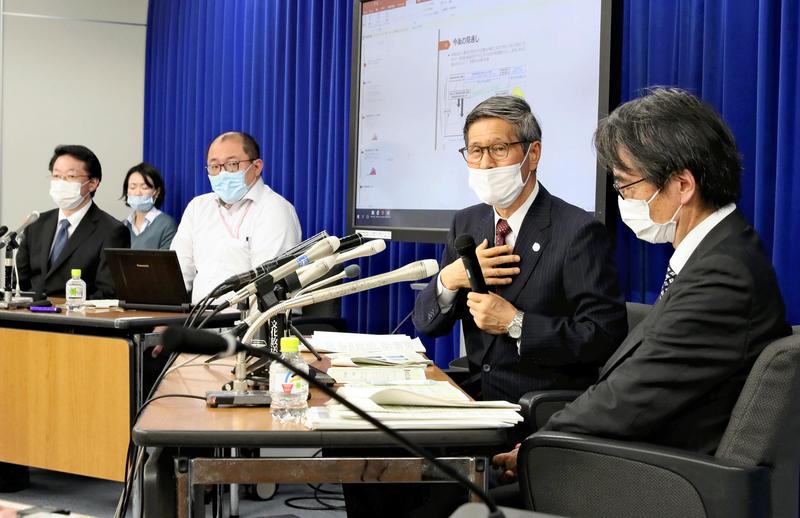
A government panel of experts studying measures to combat the new coronavirus concluded on Friday that despite the fact that the number of newly infected people has decreased under the state of emergency, the decline is still insufficient.
The number could increase again even after it has decreased. Taking that into consideration, the panel concluded there was no choice but to "request for thorough behavioral change" to combat the pandemic and called for the public to change their way of life so the situation could be dealt with over a long period of time.
"The speed of convergence was not as fast as expected," said Shigeru Omi, vice chair of the panel and a former director for the World Health Organization's (WHO) Western Pacific regional office, at a press conference after the meeting, explaining the need to continue with the current measures.
According to a package of proposals compiled by the panel, the number of daily new infections approached 700 nationwide around April 10, but recently there have been some days when it hovered around 200.
When the effective reproduction number, or the average number of secondary infections by a single person, is below 1, the number of new cases decreases. The panel estimated that the figure, which stood at around 2 in mid to late March, fell to 0.7 nationwide and 0.5 in Tokyo as of April 10.
However, the panel also said the decline in the number of new patients was insufficient, and the number of seriously ill patients who require ventilators is increasing. Once a patient is hospitalized, it takes them two to three weeks to be discharged, placing a continuous burden on medical facilities.
In the absence of vaccines and medicines to cure COVID-19, the most effective way to reduce the number of newly infected people is to lessen person-to-person contact, which the government has set a target of 80% reduction.
The panel reanalyzed the degree in which contact has been reduced in its latest proposal. The frequency of daytime contacts in areas around Tokyo's Shibuya Station and Osaka's Nanba Station on April 24 decreased only by 49% and 29%, respectively, from Jan. 17.
This decrease is thought to be mainly because working remotely is not widespread enough and as a result, people still commute to work. The analysis also revealed that people still commute between prefectures.
The panel has been urging companies and other business operators to promote telework.
"There is a limit to what can be done by requests alone," said Hokkaido University Prof. Hiroshi Nishiura, an expert on theoretical epidemiology who estimated the figure, indicating the need to take strong measures.
"The situation we're in now would be just like the bottom of the first inning in baseball," said International University of Health and Welfare Prof. Koji Wada, an expert on public health, who participated in the panel's discussions, describing the fight against the virus as only a prologue. Some say the pandemic could last for at least a year.
The panel calls for the continuation of teleworking in its latest proposal and stated that careful consideration must be made regarding large-scale events, keeping postponements and cancellations as viable options.
On the other hand, the panel urged the government to consider easing restrictions on schools, parks and other places where social needs are high. As of April 22, 95% of elementary and junior high schools and 97% of high schools nationwide were temporarily closed. It said the government should consider resuming schools on the condition that the risk of infection is reduced.
Read more from The Japan News at https://japannews.yomiuri.co.jp/