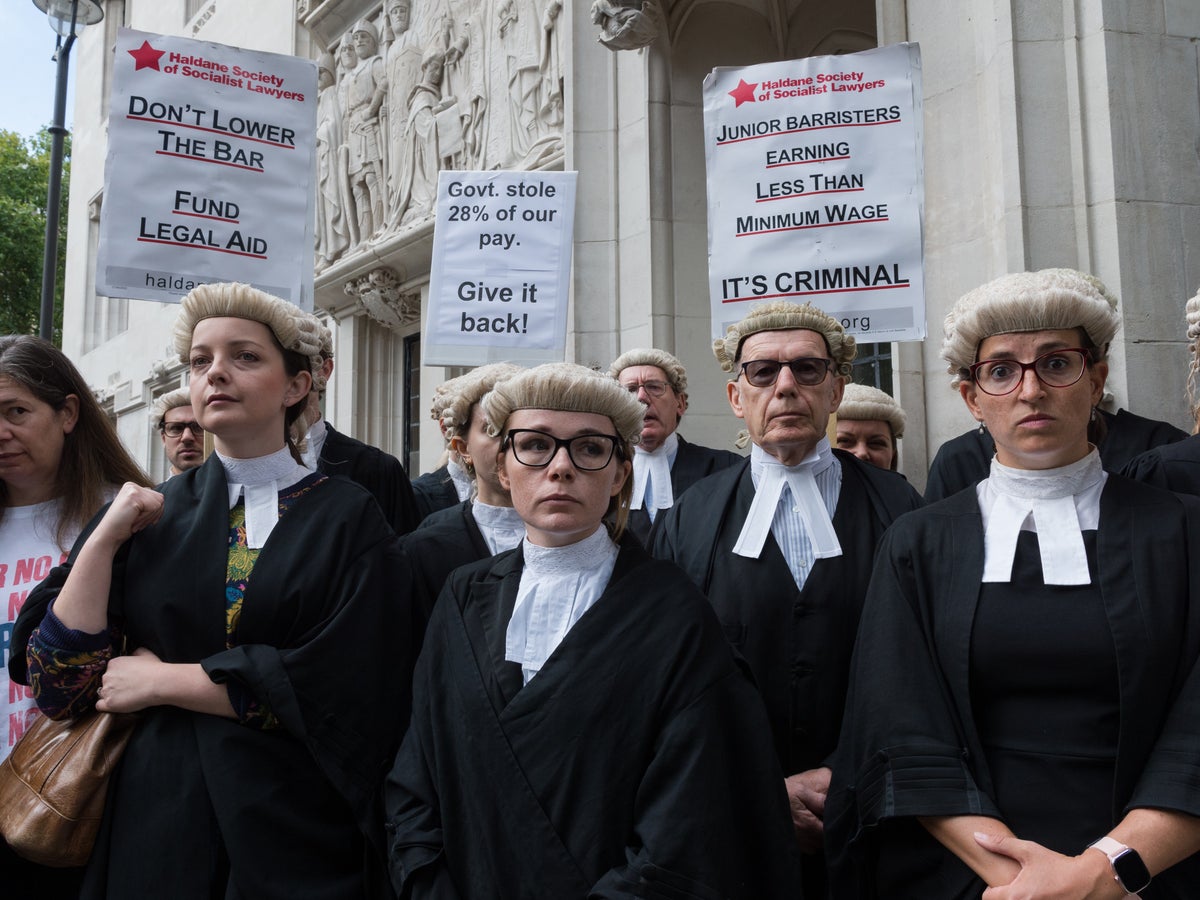
People awaiting delayed trials for violent and serious crimes must be released from custody unless the government resolves the barristers’ strike by the end of November, the High Court has ruled.
Several judges have refused applications to extend custody time limits - which govern how long defendants can be held in prison before trial - on the basis that lengthy delays caused by court backlogs and the Criminal Bar Association’s industrial action are not a lawful reason to keep people in jail.
The High Court ruled that judges in two cases, in Manchester and Bristol, had made “errors of law” in releasing alleged violent offenders on bail.
Dame Victoria Sharp KC, president of the King’s Bench Division, and Mr Justice Chamberlain found that trial days currently caused by the barristers’ strike can constitute a “good and sufficient cause” for extending custody time limits for short periods not above three months.
“In every case, judges should consider whether the public interests served initially by remanding the defendant in custody can now be served by stringent bail conditions. If so, this should be the preferred course,” their ruling added.
But it warned that following a months-long dispute over legal aid payments to defence barristers that escalated into an all-out strike in August, “this will not remain the position for long”.
“If the CBA action continues, there will shortly come a time when the absence of representation in the context of the current dispute can be considered chronic and routine,” the judges said.
“Defendants who have the benefit of existing custody time limits, including those whose time limits have already been extended, will have to be released.”
The High Court ruled that the threshold will be crossed in the last week of November, which will be three months since the CBA announced its indefinite all-out strike.
It warned of a “large number of cases” where defendants will soon hit their custody time limits and said the situation could not be resolved by the courts.
Judges said the government could choose to change the law on custody time limits and extend the current crown court period of 182 days.
The move has been considered previously, with former courts minister James Cartlidge, who quit Boris Johnson’s government in July, writing in his resignation letter that officials had “worked intensively through the winter to successfully avoid having to extend custody time limits”.
Court backlogs that were worsened because of government cuts to court sitting days and exacerbated by the pandemic have rocketed since the CBA started industrial action in June, with numerous trials being scheduled into 2024.
The dispute hit a stalemate after the former justice secretary Dominic Raab refused to meet barristers and they rejected a 15 per cent rise to criminal legal aid rates.
The increase will only apply to new cases from the end of this month, meaning that fees for thousands of cases stuck in the backlog are paid at old rates.
Mr Raab’s successor, Brandon Lewis, met the head of the CBA last week and the association said “constructive talks” were ongoing.
But no formal negotiations on barristers’ have been announced by the Ministry of Justice and protests continued outside courts on Wednesday.