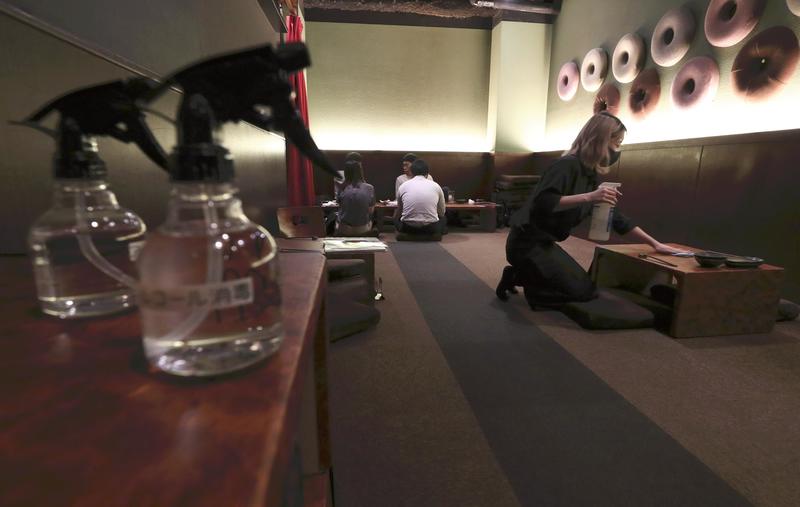
With Go To campaigns boosting demand for travel and dining out, the government has identified seven situations in which there is a risk of coronavirus infections spreading and is urging caution.
Since Oct. 1, Go To Travel discounts have included Tokyo, which had initially been excluded from the campaign, and Go To-linked events are also set to start from the middle of this month.
A government subcommittee on the novel coronavirus compiled the list and the government hopes that it will encourage people to adopt measures to prevent the spread of infections.
First on the list is social gatherings where alcohol is consumed, because of the tendency for people under the influence of alcohol to raise their voices when speaking and for such events to be held in confined spaces for long periods of time.
The subcommittee also warns against dining in large groups late at night for the same reason.
The committee urges the wearing of masks because of the risk of airborne droplet transmission when people have in-person conversations.
Working in offices with effective infection control measures has not been identified as a problem, but the committee wants people to be mindful of situations during breaks and after work when coworkers tend to socialize.
The list also warns about the potential risks associated with living in dormitories.
Exercising in confined spaces should be avoided if it involves heavy breathing, according to the subcommittee.
Finally, people should also be mindful if they are traveling to an outdoor event by car and dining out before or after the event.
While attending outdoor activities such as sports events does not increase the risk of infection, the committee urges caution if an activity involves spending long periods in vehicles or dining in restaurants with insufficient virus measures in place.
The resumption of tourism and events, as well as demand-boosting campaigns such as the Go To Eat initiative, will mean more people traveling around Japan.
However, the subcommittee has concluded that as long as people are careful about their behavior, if the number of infected cases in various locations is small, the spread of infection can be controlled even with more people traveling.
The seven situations were identified based on the first wave of infections and the results of a survey on the causes of cluster outbreaks in summer.
Read more from The Japan News at https://japannews.yomiuri.co.jp/