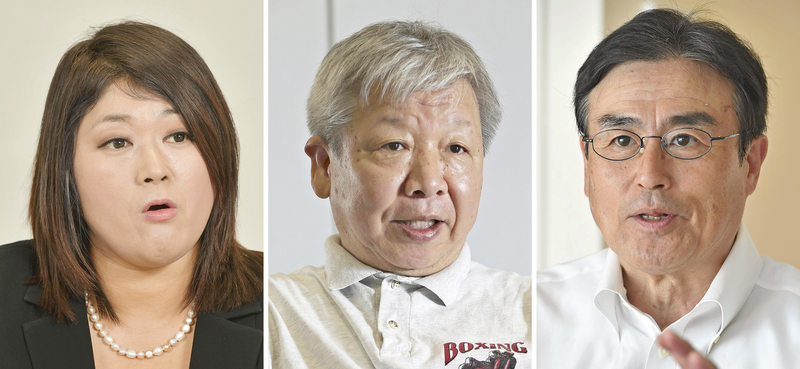
Wrestling, American football, boxing -- scandals keep popping up one after another in the sports world. In boxing, it has reached the point that Akira Yamane has resigned as chairman of the Japan Amateur Boxing Federation. What is going on with governance in sports organizations? What has happened to the amateur boxing world, and what must be done in order to prevent future scandals? The Yomiuri Shimbun spoke with three experts. The following are excerpts from the interviews.
(From The Yomiuri Shimbun, Aug. 28, 2018)
Incorporate the business perspective into sports
For sports organizations, management's ability and competitiveness of the sport are two sides of the same coin. Being capable of collecting funds to improve the performance of athletes means that organizations have management capability. Many of these types of organizations have strong governance, and their athletes produce tangible results.
On the other hand, if you look at organizations that have problems now, many of them lack management power, and it is difficult for athletes to develop in such cases.
Raising the performance level of sport requires money. However, from the perspective of people outside Japan, it seems that the contributions of companies to sports are too small, considering how much capital Japanese companies have. There is no way to explain this other than to conclude that sports organizations are failing to offer good proposals to companies. There are many sports organizations working to establish their brand, but they fail to take an approach of offering companies ways to utilize the sport for the benefit of the companies.
Even minor sports organizations can do such things as make a sales sheet and say, "We can create this sort of sponsorship program for your company." However, many people in command -- who are former athletes themselves -- lack that sort of knowledge and experience.
It's an old story, but I was once told by a woman who belongs to the U.S. governing body of synchronized swimming (now artistic swimming), "I obtained an MBA at Harvard University, but I can't swim." Those sorts of people working together for governance, just like fitting pieces of a puzzle together -- I think that is one type of ideal for moving towards a more business-like paradigm. If each sports organization does not increase its business savviness, they will likely be unable to move to the next level, which is to prepare grounds for governance.
If support is received from companies and other outside parties, there will also be demands for transparency regarding how the money is spent. Companies may also take part in monitoring the flow of money. If such things happen, people involved in the sports business will be more likely to join sports organizations, leading to the further reinforcement of governance.
The organizations in which problems have surfaced recently lack the viewpoint of outsiders. The question is how to change the awareness and strategies of executives of sports organizations and coaches. This is the most important issue, and it's where everything must begin.
What is the aim of organizations? Is it for the benefit of those managing and controlling the organization? Or is it for the sport itself? I urge people of organizations to think about this once again. We are now in the midst of a major turning point of physical education becoming sports, and sports expanding into a business. However, if people don't change, nothing else will change either.
Regarding Olympic sports organizations, the Japanese Olympic Committee is able to suspend qualifications and expel organizations from the committee. However, fundamentally, this is reliant on the organizations' own efforts to reform themselves.
However, the JOC should show the organizations more specific procedures and educate them during their reform process, in order to make them solid organizations.
-- This interview was conducted by Yomiuri Shimbun Senior Writer Tomoo Ota.
-- Munehiko Harada / Waseda University Professor
Harada, 64, studies and analyzes sports from the business perspective. He serves as chairman of the Japanese Association for Sport Management and the Japan Sport Tourism Alliance.
Lack of transparency in selection of athletes
The recent string of scandals simply involves things that hadn't been brought to light before -- they had long been part of the sports world. The "athletes first" trend ahead of the 2020 Tokyo Olympic Games has distorted the old way of things, and now the pus is spilling out everywhere.
The All Japan Judo Federation was reformed in 2013, as a result of the violent behavior of coaches. In just five years, the environment in the sports world has changed dramatically. At that time, the 15 female judoka who filed a complaint against their coaches didn't make their names public, nor was the video and audio that backed up their stories released. Now, trying to hide things just results in it being released over social media.
However, the management of sports organizations don't have that kind of understanding. They have a strong sense of hierarchy, with subordinates expected to follow orders in a top-down fashion. This seems particularly true in the case of martial arts like judo, where there's an overwhelming hierarchy based on dan grade. It's an old-fashioned pyramid-shaped society in which connections and money are more important than effort. Far removed from common sense, the people involved believe they're following the internal rules. They prioritize that inner logic over compliance. They don't realize there's a generation gap between them and the athletes, and also don't pay attention to the wide distance between them and social norms.
Against the backdrop of the ongoing scandals, I think there is also an issue with transparency regarding athlete selection, for example, in judo and wrestling. Some athletes are different from ordinary students in terms of their advancement to higher education, including entrance and graduation, and their employment differs as well. For this reason, people who can act as an intermediary find it easier to seize control.
Without advancing to strong teams at schools or organizations, athletes are at a disadvantage in securing matches or good practice environments. They're also in a weaker position when it comes time to select representatives for large events. In particular, the past selection processes of athletes for the Olympics led to serious problems, and I've seen many athletes who keep their distance from associations and federations due to these problems.
The organizations assign personnel based on their performance during their athlete days, tending to split into heretical and orthodox groups. In a structure in which the competition for leadership continues after retirement, athletes are the victims.
In France, individuals who possess a national certification for business management take up posts in associations for judo, golf and other sports every few years. I want to propose establishing a system also in Japan to train professionals who have studied sports-related laws and governance, and have them serve as executive directors at each organization. Since there are some organizations that are managed like private businesses even today, even if problems occur repeatedly, there is still an attitude of sharing subsidies (given to a particular athlete). Legislation is necessary, but there should also be a third-party inspection organization that conducts evaluations and applies the results to subsidies.
All the coaches in my generation feel a sense of urgency regarding what will happen after 2020. Currently the public shows high interest in the Olympics and budgets are provided to sports organizations, but what will happen after the Games?
If these organizations cannot fully remove the pus now, they would miss opportunities for reform. The sports world has a tendency to exclude heretical factions, but the heretics are the ones who can break away from the old structure. This is a problem at the root of Japanese society, so changes in the sports would surely win the sympathy of the public and lead to giving back benefits to society.
-- This interview was conducted by Yomiuri Shimbun Sportswriter Tomoko Katsumata.
-- Noriko Mizoguchi / Judo Silver Medalist at Barcelona Olympics
Mizoguchi, 47, won a silver medal in the 52-kg class of women's judo at the 1992 Barcelona Olympics. She served as a coach for the French women's judo team at the 2004 Athens Olympics. She is a trustee of the All Japan Judo Federation, and a professor at the Japan Women's College of Physical Education.
Dictatorship prevailed despite 'athletes first' claim
I know both Yamane and many of the people who've made complaints against him, and I've always felt that this sort of thing could happen in the amateur boxing world.
Even before Yamane's reign, there were many at the top who displayed strong leadership in the Japan Amateur Boxing Federation, and people below would follow these leaders.
I think this sort of thing happens in other sports organizations as well, but the chairmen in boxing in particular have always had a lot of power. Yamane followed the same path, solidifying authority by positioning yes men around him.
Having watched as one dictator left and another filled the post, I asked a senior reporter who has observed the boxing world for a long time, "Has the amateur world been like this traditionally?"
He replied, "In this organization, if you don't have enough power, you can't keep things under control." In that sense, a democratic system involving making decisions through discussion may have never existed to begin with.
In this case, the "Nara decision" -- boxers from Nara Prefecture, Yamane's home area, were given preferential decisions -- has been in the news, but there have been plenty of "XX decisions" in the past.
Yamane tried to completely change what the previous chairman did in the name of "reform." He did some good things, such as welcoming media coverage, and established a collaborative relationship with the professional world.
When he became chairman in 2011, Yamane claimed, "Athletes, not senior members of the federation, are the main players." But ultimately the scandal came to light. It seems that his way of doing things was just wrong.
Concerning the charges of misappropriating subsidies, I don't think Yamane actually feels they did anything wrong. Maybe he could not intuitively accept that 2.4 million yen should be handed to only one person. He didn't understand the purpose of the subsidy.
He went too far in declaring himself "permanent chairman." An unprecedented number of medals were won by Japan at the 2012 London Olympics, so Yamane was set up as a hero. It's strange that those around him didn't say anything to him. It's truly a case of the emperor's new clothes.
This time, I think there was a move in the boxing world to get rid of Yamane. The change from annual boxing events at national athletic meets to biannual ones has caused great dissatisfaction among related people. Compared to the situation before the London Olympics, at which Japan got medals, there has been little progress in strengthening athletes' abilities.
Many people didn't want to go into the 2020 Tokyo Olympics under the leadership of Yamane, and that sense of urgency might have led to the actions this time.
It's unfortunate that this incident has harmed the image of boxing as a sport. I want the new leadership to establish an organization that takes into account various opinions based on the "athletes first" policy. I want to think that this scandal is an opportunity for the boxing world to change.
-- This interview was conducted by Yomiuri Shimbun Senior Writer Shuichi Arai.
-- Makoto Maeda / Former Chief Editor of Boxing Magazines
Maeda, 69, is a former chief editor of Boxing Magazine, World Boxing and Boxing Beat. He writes a column for the sports graphic magazine Number.
Read more from The Japan News at https://japannews.yomiuri.co.jp/