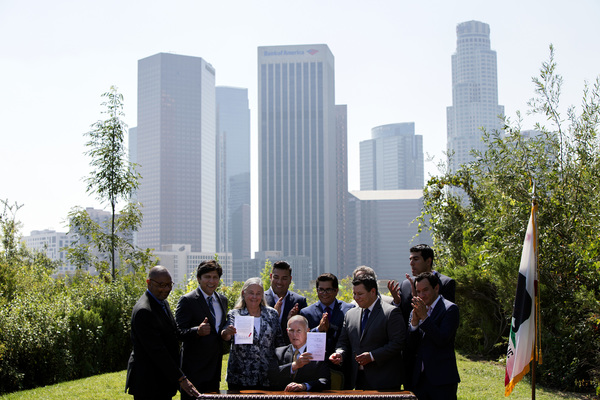
LOS ANGELES _ Gov. Jerry Brown and legislative leaders embarked on a new era in California's effort to combat climate change Thursday when the governor signed a law committing the state to some of the most drastic greenhouse gas emission reductions in the world.
"What we're doing here is far-sighted, as well as far-reaching," Brown said at a signing ceremony at Vista Hermosa Natural Park in downtown Los Angeles. "California is doing something that no other state has done."
The legislation, passed after a difficult political battle in the Capitol, cements the legal framework for California's climate policies for years to come. While previous law required the state to reduce emissions by 2020, the new measure, SB 32, sets a new, more aggressive target for 2030.
Under the law, the state must reduce its greenhouse gas emissions to 40 percent below 1990 levels, a goal that will likely involve significantly more electric cars, additional renewable energy and drastic cuts in emissions from dairy farms and other key industries.
A second measure signed Thursday by the governor, AB 197, shifts the trajectory of the state's environmental policies. It creates a legislative committee to oversee regulators, giving lawmakers more say in how climate goals are met. It pushes the state to take stronger steps to curb local pollution, rather than simply seeking a statewide reduction in emissions.
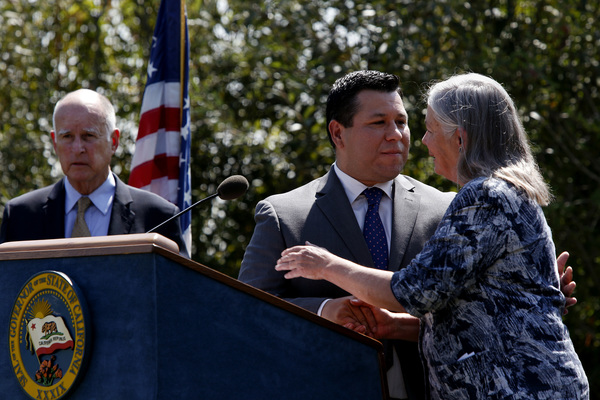
"Our climate change policies today represent a turning of the page as it relates to focusing on people," said Democratic Assemblyman Eduardo Garcia, who wrote AB 197.
The new climate policies were opposed by the oil industry and some manufacturers, who raised concerns about rising costs and giving regulators too much power over Californians' lives.
But other businesses rallied to support the legislation, telling lawmakers that it would help create new clean-energy jobs in their districts.
California has often set benchmarks for environmental programs, and state leaders said they hope other places around the country follow their lead on climate.
"What California does matters," said Democratic state Sen. Fran Pavley, who wrote SB 32.
The legislation does not specifically address the future of the cap-and-trade program, the centerpiece of California's climate agenda. The program requires companies to buy permits to release emissions into the atmosphere, creating a financial incentive to clean up operations.
Cap and trade has raised billions of dollars in recent years, but revenue from the program has slowed to a trickle, and it's facing legal uncertainty from a years-long legal battle over whether the program amounts to an unconstitutional tax.
After the new legislation was approved by lawmakers last month, Brown said he would have additional leverage to persuade businesses to support an extension of cap and trade. Otherwise, he said, the state would have to rely on more drastic policies to reach its emissions goals.
"They're going to plead for a market system," the governor said.