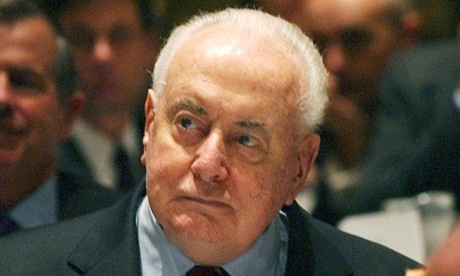
The ABC has remade its schedule in the wake of the death of the former prime minister Gough Whitlam, with rolling TV coverage on ABC News 24 and special editions of ABC News and 7:30.
The passing of Australia’s 21st prime minister has sparked blanket coverage across all media outlets, including Guardian Australia, which has full coverage here.
Nine News will open with a lengthy special tribute to Whitlam from political editor Laurie Oakes and A Current Affair and 60 Minutes are still finalising plans.
ABC News will present special coverage during the 7pm news presented by Chris Uhlmann from Canberra.
On 7.30, host Leigh Sales will conduct a live interview former prime minister Paul Keating, who will reflect on Whitlam’s contributions.
ABC News 24 continued with rolling coverage throughout the day, including the condolence motions from parliament.
The Drum, hosted by Steven Cannane, will be simulcast at 5.30pm on ABC and ABC News 24 and will feature a panel of insiders including Annabel Crabb discussing Whitlam’s legacy.
With serendipitous timing, series four of Crabb’s Kitchen Cabinet series, featuring another former prime minister, Bob Hawke, cooking at home, premieres on Tuesday at 8pm.
At 8.30pm, ABC TV will rescreen an acclaimed two-part documentary called Whitlam: The Power and the Passion, narrated by Judy Davis.
The film examines the Whitlam era through interviews with people who worked with him or knew him along with fresh footage and dramatic reconstructions.
But not everybody has been paying their respects to the great man. Australia’s most prolific and popular columnist, News Corp’s Andrew Bolt, posted this blunt assessment on the Herald Sun online: “Our 21st prime minister is dead at 98.
“Whitlam explored the gulf between seeming and doing, and tumbled into the chasm.
His legacy endures. The Abbott government is even today dealing with the costly consequences and culture of entitlement bequeathed by Whitlam’s decisions to give free universal medical care and university education. We are also dealing with the terrible legacy of Whitlam’s decision to end the assimilation project - both for Aborigines and immigrants.”
Because Whitlam was in his late 90s and had been unwell for some time, many media outlets had obituaries ready to go. Two of the pieces, in the Australian and in the Sydney Morning Herald, were written by great political journalists who have since retired.
Former Fairfax and News Corp journalist Mike Steketee wrote the obituary in the Australian and the much-loved Herald writer Tony Stephens wrote the one in the Herald.
The Herald’s news director, Marcus Strom, remarked on Twitter that Whitlam had in fact commissioned his own obituary, insisting that Stephens, who was a great friend, write it despite his retirement.