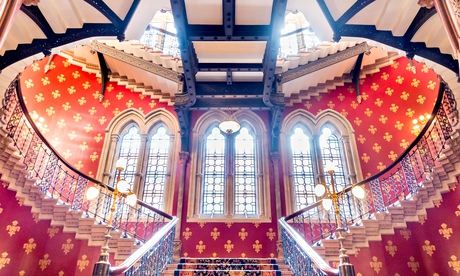
The most poignant story in this book concerns its subject’s son, also called George Gilbert Scott, also an architect. Having abandoned his father’s gothic for the Queen Anne style, and his Anglican faith for Catholicism, he later left his wife and children for a mistress in Rouen until, suffering from alcoholism and mental disorders, he was sent to a hospital in Northampton, where his father had designed the chapel. He was, finally, forcibly confined to the Midland Grand hotel at St Pancras station, also by his father, and amid its polychromatic, foliated, quasi‑medieval wallpapers, died.
George junior’s experience stands for anyone who lived in the great asylum of Victorian England, for whom the architecture of George senior was inescapable. Gavin Stamp’s book tells us that he worked in all the counties of England and Wales, except Cardigan. He was (and still is) present in almost every English cathedral, which he restored with varying degrees of respect for the original. Whitehall is dominated by his Foreign Office building. He designed the quintessential ejaculation of morbid Victoriana, the Albert Memorial, and the place that would crush Oscar Wilde, Reading Gaol.
He did churches, both new ones and restorations of old ones, in the hundreds, in (for example) Swindon, Ramsgate, Rugby, Stoke and Halifax, in Spalding, Lincs and Worsley, Lancs. He worked abroad. He created the colossal Nikolaikirche in Hamburg, whose spire was for a short time the tallest building in the world, and, although he never himself left Europe, his designs were realised in Bombay, Shanghai, Newfoundland, New Zealand and South Africa.
He was, as the book’s title says, a creation of the steam age, his incredible productivity and geographical range being made possible by the ability of railways to take him all over the country. (Although he launched his practice, in his 20s, in the stagecoach era, dashing about the country to secure commissions to design workhouses, trains evidently amplified a pre-existing dromomania.) He also thrived off the wealth created by industry, and the desire to convert it into stone-carved piety. He was a new kind of architect, with unprecedented output, who at the same time wanted to revive the handbuilt craftsmanship of the middle ages.
History has been begrudging to him, which Stamp wants to put right. He attracted the criticism aimed at prolific architects ever since, including Norman Foster now, that he couldn’t possibly have given all his projects the attention they required. Anecdotes support this view: he admired a church he saw from a train and had to be told that it was one of his; he started issuing instructions on the site of another which turned out to be by a different architect, Scott’s project being along the road.
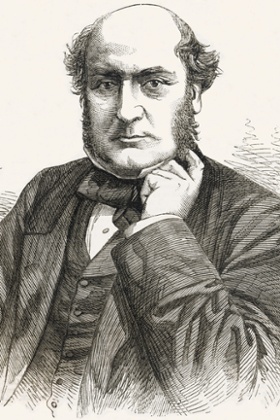
He was accused of being, in effect, too middlebrow, insufficiently daring or original. There were other Victorian architects who played more excitingly with the gothic style. Above all he was repeatedly attacked for his restorations, by William Morris and others. He was said to be too interventionist, too willing to remove old work that didn’t fit his view of what a church should be, and to insert his own versions of medieval architecture. It is probably for these reasons that a biography like Stamp’s hasn’t appeared until now.
Stamp defends him on the grounds that originality is overrated in architecture and that stolid professionals like Scott deserve credit. He argues that Scott was more sensitive to the fabric of old buildings than the critics allowed, and that his extensive rebuilding was sometimes necessitated by the poor state of the churches, and sometimes because of the demands placed on Scott by his clients.
He sketches a complex character, generous, sometimes self-aggrandising, with a prickliness possibly owing to his lack of the university education that his brothers had, but Scott seems to have worked too hard and to have been too upstanding a citizen to make a really juicy subject for a biographer. The interest in Scott, and in the book, lies mostly in the professional and cultural phenomenon that he represented, rather than in his personal life, although one informs the other.
Stamp’s book performs a valuable role, and offers a glimpse into a world which in the scale of constructional production prefigures our own, but in other ways seems utterly arcane. It was a time when limitless passion could be expended on the choice of one kind of gothic over another, or on the arrangement of church furniture, representing as they did one shade of Christianity against another. Limitless vitriol could be exchanged between adherents of different views on these matters.
By these lights Scott’s most powerful building, what is now called the St Pancras Renaissance hotel, was one of his more corrupt, it being considered questionable to lavish the nobility of gothic decoration on what is, in effect, a commercial building’s advertisement of itself. Scott himself had doubts on the matter. But, really, the countless churches can be too pious and dutiful: it is the hotel’s honest vulgarity that makes it good.
To buy Gothic for the Steam Age: An Illustrated Biography of George Gilbert Scott for £24 click here