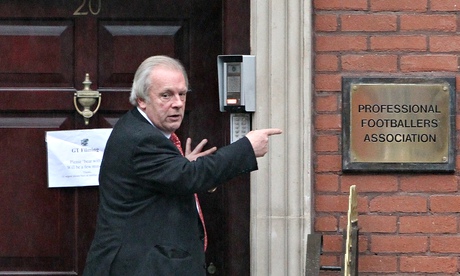
As Gordon Taylor toured the nation’s radio stations and TV stations on Friday morning to apologise for his crass comparison between the situation in which the convicted rapist and former Sheffield United striker Ched Evans finds himself and that of the families who lost loved ones in the Hillsborough disaster, there was one word on his mind. To the irritation of his critics inside and outside the game it was “sorry” rather than “resign”.
By mid-afternoon the chief executive of the Professional Footballers’ Association had been forced into an apology for his initial apology.
Not for the first time in a week that was to become just the latest to drag football’s image down further, the entire farce might have been scripted by Brass Eye satirist Chris Morris. It would be funny if it was not so serious.
Professor Phil Scraton, the Hillsborough expert and one of the driving forces behind the process that led to the formation of the Hillsborough Independent Panel review and a new inquiry into the deaths of 96 men, women and children, pointed out that Taylor’s initial effort failed to understand the key reason the comparison was offensive.
“The main reason that the case is ‘totally different’, as he puts it, is that Ched Evans was found guilty by a jury in a court of law for a grave offence – rape – and was convicted,” Scraton, who is acting as an adviser to the families during the continuing inquests in Warrington, told the Guardian.
“Whatever the vilification endured by those who died and survived Hillsborough none of them was charged with any offence – it is not that they ‘believe’ they were ‘innocent’ of any crime, they are and always have been innocent. By fudging this clear distinction in his qualified apology Gordon Taylor compounds his initial comments.”
Taylor went on to try to explain a comparison he should never have made, seemingly failing to grasp that most understood the point he was making about possible miscarriages of justice but felt it to be highly inappropriate all the same.
So Taylor, well practised in facing the media as the public face of his organisation during a string of controversial incidents affecting his members down the years, was forced to issue a fresh statement through the PFA website. “I would like to apologise unreservedly for linking the Hillsborough case with the situation involving Ched Evans,” he said. “The last thing I intended to do was to upset anybody connected to the Hillsborough tragedy. I can only apologise.”
As so often, it was the Hillsborough families who emerged with quiet dignity: resolutely refusing to fan the flames of a media storm, while registering their distaste for a thought process in which Taylor seemed to put giving emotional ballast to his case for Evans above respect for what they went through.
“There is no comparison and I did find it offensive because you cannot compare what we went through with Ched Evans,” said Margaret Aspinall, the chair of the Hillsborough Family Support Group, who lost her 18-year-old son James in the disaster. “I don’t think he meant it, I think he didn’t put his brain into gear. He’s apologised now and I think we should leave it at that.”
As with Steve Bruce’s backing for Evans’s return to the game, Taylor’s stance appears to echo a confidence in the former Sheffield United player’s camp that the rape conviction will be overturned. But unless and until that happens he remains a convicted rapist, released on licence after serving two and a half years of a five-year sentence.
Taylor, who survived the most serious threat yet to his 33-year reign at the helm of the PFA last year when he rode out a storm involving claims he had racked up substantial gambling debts, has always been an acquired taste.
While it is easy to understand why he felt the need to stand by Evans, many have found it less easy to appreciate why he did so quite so vehemently and with so little apparent empathy for the victim. And to cap that support with the Hillsborough comments was a grimly fitting end to a week when football’s authorities have too often appeared out of step with the modern world. For all the money that has poured into the game since 1992, many of the men involved – and their attitudes – seem rooted in earlier decades.
Opposition to Taylor, the best-paid union official in Britain, who takes home a seven-figure salary for a job he has done since 1981 and has clung to despite a series of controversies, is by no means universal. There are those in the game who think he is past his sell-by date, sitting on top of an organisation no longer fit for purpose. But there are others, some of them former players who have fallen on hard times and been helped out by the PFA’s benevolent funds, who are broadly supportive of their well-remunerated representative and say that most of its best work goes unseen.
“The vast majority of work he does is unbelievable. Keeping the union strong, keeping the players well backed and doing the best for his members,” says Pat Nevin, the former Chelsea and Everton winger who was PFA chairman for five years. “It’s an organisation that takes care of its members when they hit hard times. There are ex-players that are helped, pension schemes.”
On the PFA website there is a lavish interactive feature detailing the year-by-year history of the organisation from its formation by Billy “the wiz” Meredith in 1907 to the present day. But there is no transparency about Taylor’s salary.
And to his critics, his Hillsborough gaffe was just the latest manifestation of his inability to see the wood for the trees when it comes to defending his members come what may – a tactic minted in a necessarily more confrontational age that can too often fail to take into account the wider world.
The Hillsborough comparison, all the worse for appearing to be a premeditated line of argument, between a convicted rapist who protests his innocence and is hoping that the CCRC will reopen his case and a group of families who against all the odds have fought for the truth over 25 long years was ill-judged at very best.
Some in the game feel that in too many of the areas where the PFA should be active, it is found wanting. Providing advice to minors between the ages of 16 and 19 should be natural territory for the players’ union but tends to be left to agents who are able to get their claws into young players for good or ill.
When defending Evans, Taylor has occasionally mentioned in passing the work the PFA does in educating young Academy players in how to live their lives. At other times he has talked up the work it does with the Sporting Chance clinic in helping those with issues with problem gambling or substance abuse.
Both are worthy areas of work. But given its resources, which include around £18m a year from the Premier League’s TV riches (albeit much of it pre-allocated for designated uses) as well as its income from members, could it be doing more?
Taylor is now so embedded in the organisation that, rather like Sepp Blatter at Fifa, he has become indivisible from it. When challenged over his gambling issues last year, his management board backed him unequivocally.
Taylor keeps his friends close and his enemies at arm’s length but too often it can seem that his interests – and certainly those of his members – override all other considerations.
Once again, it has not been a great week for those who speak for the national game and those who play it.
While Taylor went in to bat for the right of Evans to return to work to the exclusion of all else, the Football Association has been conspicuous by its absence from the debate until Friday’s belated intervention from the chairman, Greg Dyke, that sought to explain its silence.
Not every player is concerned only with his pay packet and whether he will start the next game by any means. Many more, once they retire, gain a different perspective. Gary Lineker wondered aloud on Friday whether it was not time for the players’ union to draw up its own code of conduct by which its members should abide.
At the height of the Evans furore the former Wimbledon and Liverpool defender John Scales tweeted: “There’s many of us that despair at the lack of morality, ethics and respect still so alarmingly prevalent in the game.”
If the organisation that represents them wants to reassert its relevance, it could do worse than beginning to work out ways to address that.