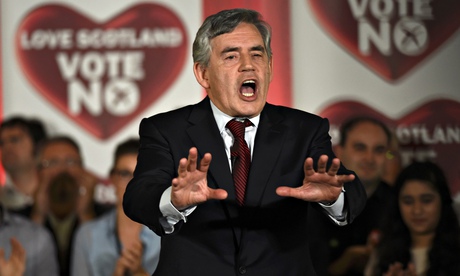
The idea of politics without Gordon Brown, never mind Gordon Brown without politics, takes some getting used to. With the exception of his brilliant saving-the-day cameo during the Scottish referendum campaign in September, the former prime minister has been out of the spotlight for more than four years now. Yet there are few modern politicians who have spent so many hours of every day of every year doing politics as he. For 40 years he was the Labour party’s equivalent of Dylan Thomas’s Organ Morgan, except that with Brown it was “Labour Labour” not “organ organ” all the time. It used to feel as if Brown had been like this from about the age of six.
Nevertheless in May, by which time he will be 64, Brown says he will be gone. On Monday he announced he would be leaving the House of Commons after a 32-year stint in which he has rarely been off the frontbenches, whether in opposition or in government. Yet Brown is still a relatively young man, and he is certainly still a big figure, both at home and abroad. It is hard to imagine that he will simply retreat to Dunruling and write his memoirs – though this man of parts could write one of the great political memoirs in British letters if he took the time and the trouble to do it properly.
So what will Brown do now? If this was America, there would be a well-planned and choreographed path through the post-power years – a substantial pension, burnishing the museum and library, representing the nation at ceremonial occasions, enjoying a place of public honour and dignity.
In Britain, though, there are few conventions or career paths of this kind. One of the exceptions, though probably not one to Brown’s taste, is the chance of spending his twilight years in the House of Lords. For more than a century, a former prime minister could expect the offer of an hereditary earldom – Harold Macmillan in 1984 was the last to receive such a title. Later prime ministers have been offered life peerages, though neither Sir John Major nor Tony Blair, Brown’s two immediate predecessors, has taken one, and Brown would be unlikely to want to differ from them. It seems improbable that he would take a knighthood for the same reason. Anyway, it’s not Brown’s style.
What a former prime minister does after leaving office is very much down to their own choices and circumstances. Former PMs get a retirement salary and a pension these days, plus money to finance an office, though Brown has not made use of these entitlements while he has been an MP. As a former prime minister with school-age children, and as a rooted Scot, he may well choose to remain in his constituency home in Fife, though Edinburgh may eventually prove irresistible. Distinguished Scottish institutions will be queueing up to bid for his services.
All of which leaves the question of an international job. Brown could continue to prosper on the international lecture circuit if he chooses. But he is the sort of restless intellect who wants something more. He certainly coveted the possibility of becoming head of the International Monetary Fund when the post fell vacant in 2011. Brown’s passion for international development and for education mean that he could find a role as a UN high commissioner if he pushed for one. His fractious relations with the European Union as chancellor and prime minister mean he is unlikely to find his way to Brussels. But if ever a man was qualified to head a commission on the reform of international football’s governing body Fifa, it is the Raith Rovers-supporting former premier. On a less epochal scale, an American university post would surely be his for the asking.
The golden resolution for departing politicians – though often honoured in the breach – was the one proffered by the former Conservative prime minister Stanley Baldwin, who said as he left Downing Street in 1937: “Once I leave, I leave. I am not going to speak to the man on the bridge, and I am not going to spit on the deck.” Yet Brown surely has one last service to perform for his party. He won’t be running in May 2015. But the Labour party in Scotland is facing the toughest general election in its history.
The new Scottish Labour leader, who will be elected later this month, has less than six months in which to turn the polls around and stop the SNP from decimating Labour’s strength north of the border. Who better to help lead the campaign than Brown, inspiring the troops, and driving his followers them on to some last work of noble note, like some insatiable Caledonian Ulysses or the latterday El Cid of Kirkcaldy.