Google is planning to launch its own mobile phone network, the software and search firm has confirmed, as it plots a major business shift that will see the company move into supplying broadband connections across the planet.
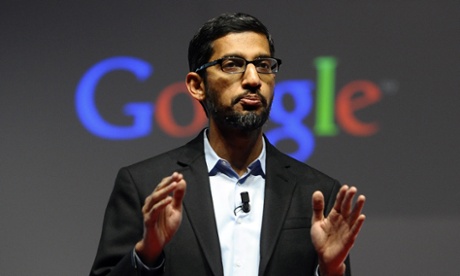
The plans for what Google insiders are calling “Project Nova” were unveiled by Sundar Pichai, recently promoted to senior vice president of product and second in command to co-founder Larry Page, at the Mobile World Congress trade show in Barcelona.
Subscribers of Google’s ”virtual network” will be able to switch seamlessly between mobile phone and WiFi signals, and between the masts of competing mobile phone networks, as their phones will seamlessly switch between the best signals.
Dropped calls may also become less of a nuisance, as phones will automatically try to redial the number should the communication be cut mid conversation.
Nova, which will begin life as a US project, is part of a wider move by Google from software into networks, and the company’s ultimate goal is to beam internet connections to the earth’s remotest reaches, where four billion people have poor internet connections or simply live offline.
“We are creating a backbone so we can provide connectivity,” said Pichai. “We will be working with carriers around the world so they can provide services over our backbone. We want to focus on projects which serve billions of users at scale and which make a big difference in their every day lives.”
Leaks in January suggested Google had already signed agreements for Nova with Sprint and T-Mobile in the US. Google will not put up its own masts but will buy airtime wholesale from networks and repackage it for Nova subscribers. The model is known as MVNO, or mobile virtual network operator. It is used by services such as Tesco mobile and would be relatively simple to expand into Europe and further afield.
Pichai claimed Google’s intention was not to compete with existing operators like AT&T, but to improve their performance by demonstrating what was possible.
He said the project would follow the same model as Google’s Nexus devices, low cost but high performance phones and tablets which are made in partnership with manufacturers such as Samsung and LG.
“We don’t intend to be a network operator at scale,” said Pichai. “All innovation in computing happens at intersection of hardware and software. That is why we do Nexus devices. We do it at enough scale to achieve impact. We are at a stage now where it is important to think about hardware software and connectivity together.”
Pichai set out plans to bring four billion people online. The company is experimenting with three methods of reaching remote or poorly served areas. With Project Link, Google is building a high speed fibre-optic network, which internet resellers can use to offer services to homes and businesses, in the Ugandan capital Kampala. Pichai said Link would now be rolled out to other parts of Africa.
Project Loon, in which helium-filled balloons are beaming out superfast 4G mobile internet, is nearing a commercial launch scheduled for 2016. Pilots are under way in Latin America with Telefonica, in New Zealand with Vodafone and in Australia with Telstra.
Pichai revealed Google’s balloons were now able to remain airborne for up to 200 days. When the project began two years ago, keeping the balloons airborne for more than five days was a challenge.
As many as 80 Google balloons were in the air at any one time in November, the company said, but numbers are increasing with 10 new balloons launched each week.
Finally project Titan, for which solar-powered glider planes developed by a US company acquired by Google last year will be able to beam out broadband to wide areas. The planes would be particularly suited to bringing emergency broadband to disaster zones.
“We think we can bring first-world connectivity to many rural areas,” said Pichai. “You can imagine planes and balloons which we can stitch together to create this mesh of floating cell towers. It sounds like science fiction at first but we’ve made tremendous progress.”