
What you need to know
- Google introduces WeatherNext 2, an AI-powered weather forecasting model surpassing its predecessor in accuracy.
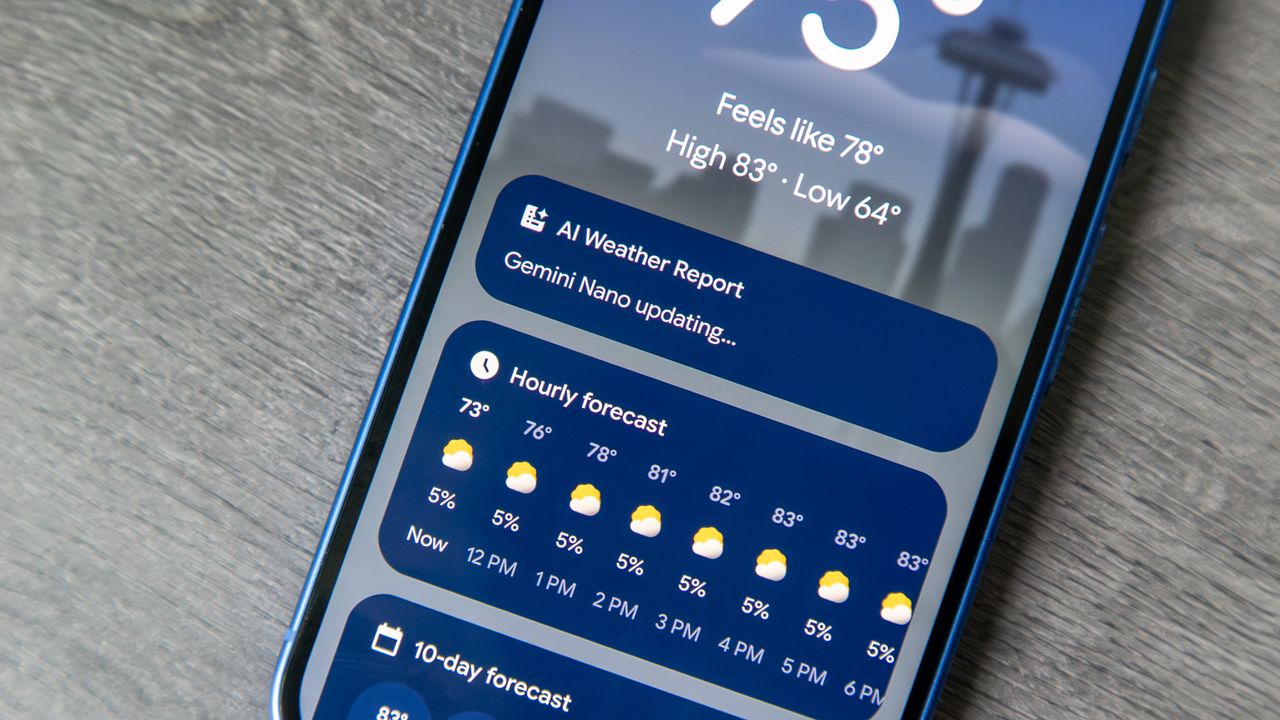
- WeatherNext 2 generates forecasts eight times faster, improving services like Google Search and Pixel Weather app.
- Utilizing Functional Generative Network, WeatherNext 2 maintains realistic predictions while enhancing existing Google weather data.
Enjoy our content? Make sure to set Android Central as a preferred source in Google Search, and find out why you should so that you can stay up-to-date on the latest news, reviews, features, and more.
Google has unveiled WeatherNext 2, an AI-powered forecasting model that outperforms its predecessor in 99.9% of weather variables. This revolutionary tool promises faster, more accurate predictions for applications like Search and Maps, enhancing users' weather experiences across the platform.
Google is calling it the company's "most advanced and efficient forecasting model." It's now eight-times faster at generating weather forecasts and has a resolution time of up to one hour. Like the WeatherNext 1 model it replaces, WeatherNext 2 generates four six-hour weather forecasts daily, with lead times of up to 15 days for future predictions.
While WeatherNext 1 models are remaining available for reference and research purposes, WeatherNext 2 is the future for Google weather forecasting. It surpasses the original on 99.9% of variables, according to Google, including temperature, wind speed and direction, precipitation, humidity, and pressure.
WeatherNext 2 can quickly and efficiently predict weather scenarios from a single starting point, Google says. The predictions are completed in under a minute using a TPU, whereas it would typically take hours to complete on a supercomputer using physics-based models.
How Google is using AI to make weather forecasts
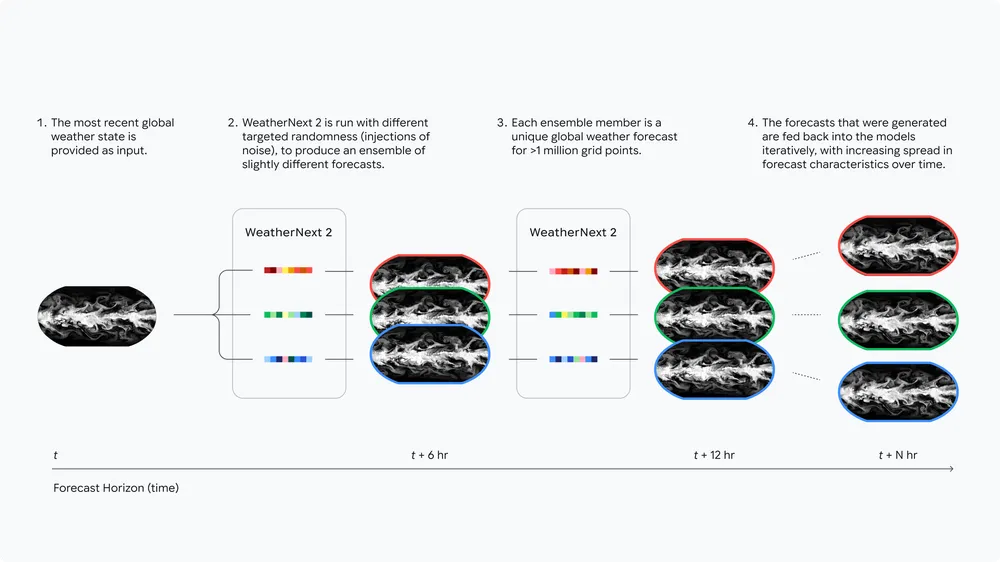
WeatherNext 2 uses a Functional Generative Network (FGN), which is a new AI modeling approach that replaces the Graph Neural Network (GNN) and Conditional Diffusion model used in WeatherNext 1. Google explains the FGN "injects 'noise' directly into the model architecture so the forecasts it generates remain physically realistic and interconnected."
WeatherNext 2 is widely rolling out for developers, researchers, and users. It's available in Earth Engine and BigQuery, as well as Vertex AI as part of an early access program. It's also powering upgraded weather forecasts in Search, Gemini, Pixel Weather and the Google Maps Platform's Weather API.
WeatherNext 2 will also handle Google Maps weather data in the coming weeks.