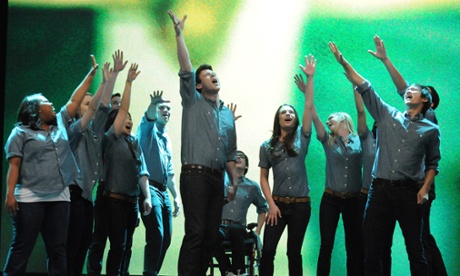
When Ryan Murphy’s surrealist musical sitcom about a high school choir first arrived on screen, it burned brightly but also quickly. It launched amid hysteria, attracting a mixture of huge acclaim and massive ratings that only occurs a few times in a generation. Yet it fell from TV’s prom queen to Sandra Dee remarkably quickly, as storytelling was pushed aside for musical theme weeks. After the show reaches its conclusion on US screens this weekend, few will mourn its passing.
But many, myself included, will miss it. This tale of misfits feeling their way into adulthood via the medium of popular song had me at “hello”. And the clues to Glee’s quiet subversion were there from the off; Ohio’s William McKinley High sharing its name with schools in The Wonder Years and Freaks and Geeks – two of US TV’s other great documents of teen angst.
The things that many saw as flaws, for me, made Glee such a tonic: here was a world that wasn’t necessarily expected to make coherent sense – it was a technicolour pageant where you were never far away from the next sight gag or the next song. That’s before you consider two of the finest comedy creations of recent years in sociopathic PE teacher Sue Sylvester (“You think this is hard? Try consuming your own twin in utero. That’s hard!”) and ditzy cheerleader Brittany S Pierce (“We both know that blondes are born with magical powers, like doing the splits or turning Swedish.”)
Glee had that magical power of being both hilarious and saccharine in the same beat. And it also had bite. Murphy, who unapologetically spins polemic into all corners of his work, used the show to highlight LGBT representation and rights. It can be easy to blase about how important that can be, but the telling of these stories about young people still had an impact. Kurt’s coming out provided the emotional backbone of the first year, and carried the story all the way through to his homophobic bully attempting suicide out of gay shame. Pointedly, the recent lesbian wedding episode saw the characters forced to hold nuptials in the neighbouring state of Indiana.
Most recently, there’s been fun to be had with the unashamedly jockish “post-modern gay” ((c) Sue Sylvester) Spencer, and the story twist that saw the show’s adorable heart, Coach Bieste, undergo reassignment surgery and emerge as Sheldon. “Pumpkin, it’s where you’re outsides don’t match how you feel on the inside,” he told young protege Sam on his last day at work as Shannon. Confused, Sam wondered if this meant she were a lesbian, and was left even more perplexed at the notion that she was choosing to be a gay man. “This is not about who I want to go to bed with, it is about who I want to go to bed as. This may seem sudden to you, but it doesn’t to me.” This is all still powerful stuff to be going out on primetime Fox.
Six years feels like a fairly long run for a show like Glee in any circumstances, but it seems unlikely that the untimely death of Cory Monteith didn’t have at least some bearing on the decision to bring it to a close. In July 2013, Monteith was found dead in a Vancouver hotel room from a mixture of heroin and alcohol. The show wrote in the character’s sudden death in the devastating episode The Quarterback, which saw a cast, still raw from the death of their friend, working through their grief by by playing out that of their alter-egos in almost real time. When real-life and on-screen girlfriend Lea Michele sang, her voice cracking from all-too-real pain, it was almost impossible to watch.
Glee’s A-story had always been the Finn and Rachel romance, which left it going through a sometimes clunky transformation as the show shifted its focus to being a slightly odd flatshare drama about the New Directions alumni and their furthers adventures in New York. This final 13-episode run, yet to air in the UK, represents a welcome arrival full circle to the show’s early charm. A humiliated Rachel has returned to Lima after a disastrous TV stint in LA and has vowed to revive the McKinley Glee Club, and the season’s soundtrack has ranged from Mike and The Mechanics to Meet Me in St Louis to Clean Bandit via a whole episode based around Carole King’s Tapestry.
Few, save the most ardent fans, are going to find themselves with a Glee-shaped hole left in their lives now the show has come to the end. It will likely fade into a vague memory of something that once happened, like the pages of a high school yearbook. But I probably won’t be alone in that memory being of a programme that made the world just a little bit more lovely.