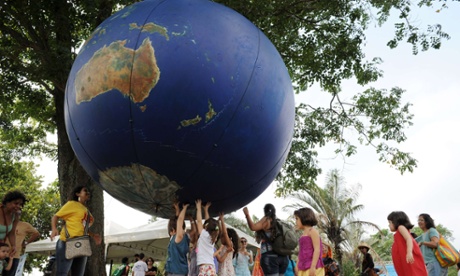
This weekend the sustainable development goals (SDGs) will be formally adopted at the UN’s sustainable development summit in New York. Heads of state, the pope and Shakira have got together to discuss inequality, poverty, climate change and celebrate a new era of development. The 17 goals, including 169 targets, are due to be ratified on Friday by the 193 United Nation member states, in order to frame their agendas and policies until 2030.
The goals will be particularly relevant to the work of public leaders and governments seeking to create long-term social improvements.
Why is it happening now?
The eight millennium development goals (MDGs) set in 2001 are due to run out this year so the SDGs will effectively follow on from them. It’s taken almost three years of discussion to reach the proposed SDGs, and finally the goals will be agreed upon. But the most important part is yet to come: how the goals will be measured. In March next year, indicators to monitor progress will be decided.
Where does governance fit in?
Despite the UN describing the MDGs as the most “successful anti-poverty movement in history”, there were some important factors missing. They didn’t include what many believe to be the root causes of poverty, including human rights and gender equality. Importantly, they didn’t tackle governance.
In the post-2015 agenda, however, good governance has been acknowledged as a fundamental element of long-term development. In these goals, peace, security and policy-making are seen as vital to sustainable development and poverty eradication on a global level.
How will it be measured?
Goal 16 of the SDGs hopes to “promote peaceful and inclusive societies for sustainable development, provide access to justice for all and build effective, accountable and inclusive institutions at all levels”.
Of all the SDGs, goal 16 has the reputation of being one of the most complicated because it has the highest number of targets at 12, and the lowest means of implementation. The tricky question is: how can governance quality be measured, and how do you define “good governance”?
What is particularly interesting about this goal, says David Hulme, director of the University of Manchester’s Global Development Institute, is that while it “can be called the governance goal, if you look closely, it only uses the word ‘governance’ once”.
Hulme adds: “If you look at this goal and the idea of governance, there are so many different things there: is it about peace, conflict, human rights, magistrates, or is it about the laws themselves?” They are also difficult to assess.
For example, target 16.7 aims to “ensure responsive, inclusive, participatory and representative decision-making at all levels”, but how can this be measured on a global scale? Goal 16 is about processes rather than a specific target, such as to reduce maternal mortality, which is technically easier to measure provided you have the statistics.
Hulme’s research shows there are obvious conceptual and methodological problems in achieving goal 16: the collection of data is particularly difficult, whether that’s using official data or generating other data sets. The current data sets used to measure governance, for example the World Bank, are based in developed countries, particularly the US.
There are also political barriers, Hulme says, including the risk of western countries imposing their ideas of good governance on low-income countries, the challenges of overcoming corruption, and the difficulties in comparing what are bound to be varying interpretations of the goals by different countries. He believes the indicators will also be hotly contested.
But the important thing is that governance has got into the goals. “Goal 16 is a Pandora’s box, but the box is open now,” he says.
Will it work?
While it’s unlikely the goals will lead to immediate improvements, it provides opportunities at national and international levels to talk about data, put pressure on institutions, and encourage conversations.
Global goals evolve slowly, so the big judge will be how well countries are governed in 2030.
Sign up here for your free weekly Guardian Public Leaders newsletter with news and analysis sent direct to you every Thursday. Follow us on Twitter via @Guardianpublic