Macquarie Group Ltd., the Australian bank better known for infrastructure investing like highways and airports, is emerging as the largest bank in commodities, ousting Goldman Sachs Group Inc. from a position the Wall Street bank enjoyed for almost three decades.
The shift comes as Goldman Sachs suffers its worst performance in commodities since its initial public offering in 1999 and highlights how banks from resource-rich nations such as Australia, Brazil and Canada are expanding in commodities at the expense of traditionally dominant U.S. and European lenders.
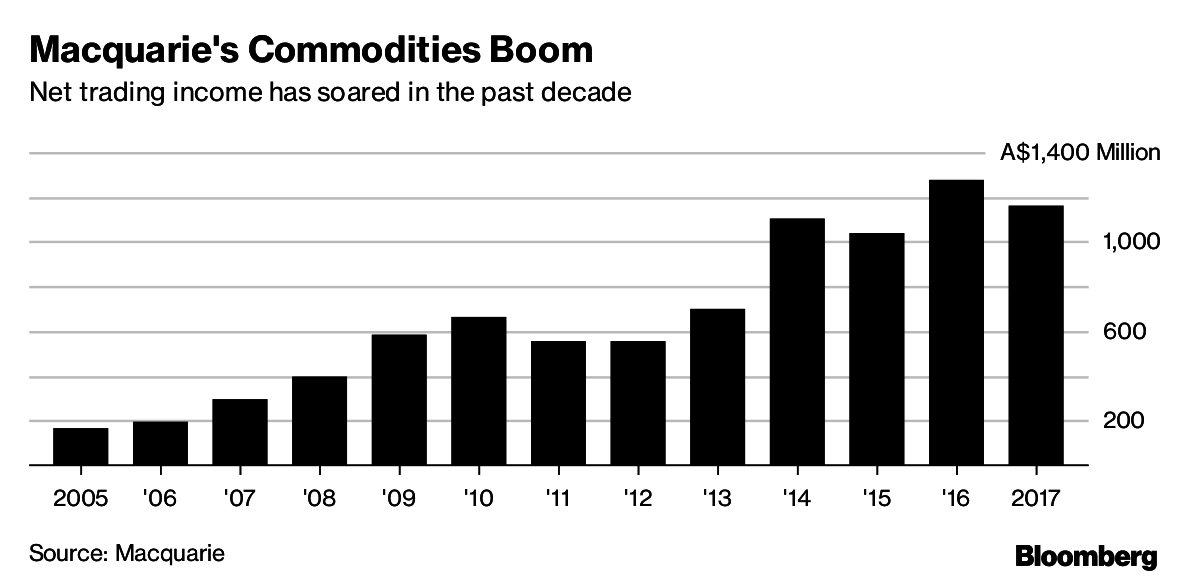
Macquarie, which faces less regulation in the U.S. than its Wall Street rivals, has become dominant in natural resources and ranks second in natural gas trading in North America as other banks cut back. Its revenues from the commodities have grown fourfold in a decade, and in a presentation this month, the company highlighted “opportunities to grow commodities business, both organically and through acquisition.”
Goldman, on the other hand, is struggling to reinvent the business. Low volatility, a lack of investor interest, and wrong-way trades have hurt profitability, and the bank this month said its global head of commodities is leaving. The unit brought in about $95 million of net revenue in the first quarter, Bloomberg reported last month. On a comparable basis, Macquarie’s commodities revenue was between $150 million and $200 million, according to a person familiar with the matter who asked not to be identified because the figures aren’t public.
Diverging Fortunes
Since then, the performance has diverged further: Goldman was barely positive in the second quarter and has continued to struggle in the third, Bloomberg reported, while Macquarie said in a presentation this month that “client hedging and trading opportunities remained steady across the commodities platform” in April to June.
It’s increasingly likely that Macquarie will overtake Goldman to be the largest bank in commodities by revenues this year, industry executives and consultants said. Macquarie declined to comment.
Macquarie is not the only bank to have overtaken Goldman, which for years was so dominant that it was known as a “Wall Street refiner.” Coalition Development Ltd, an analytics firm, said in a report on Friday that Goldman had dropped out of the top three in commodities during the first half of the year -- for the first time on record. Citigroup Inc., Morgan Stanley, and JPMorgan Chase & Co. all performed better over the period, Coalition said.
Macquarie’s rise is part of a broader trend. U.S. and European investment banks’ share of overall commodities revenue fell to 72 percent last year from 81 percent in 2014, according to Coalition.
"Regional banks that have corporate lending relationships can translate that corporate flow into their commodities business," said Amrit Shahani, research director at Coalition. "We see them challenging the global banks."
Physical Commodities
Macquarie’s commodities business dates back to the 1980s and has expanded in physical trading in recent years. The U.S. unit is classed as a representative office of a foreign company and isn’t subject to the same regulations as American banks.
While Goldman’s commodity revenues have fallen more than two thirds from a peak of $3.4 billion in 2009, Macquarie’s commodities business has been moving in the opposite direction. It reported net commodities trading income of A$1.16 billion ($920 million) for the year ending March 2017, four times its level a decade ago.
Macquarie started trading physical natural gas with the acquisition of Cook Inlet Energy Supply LLC in 2005 and is second only to BP Plc, according to Natural Gas Intelligence. It exchanges more than 7.5 million tons of physical metal products a year, according to its website. The bank also owns stakes in grain traders Lansing Trade Group LLC and Quadra Commodities SA, as well as sugar trader Czarnikow Group Ltd.
The business is continuing to grow. Macquarie bought oil, natural gas and power businesses from Cargill Inc. this year, and is among bidders for Noble Group Ltd.’s oil trading business, Bloomberg reported last month.
"We see a historical opportunity for continued growth and customer engagement across the energy spectrum," Nick O’Kane, head of commodity markets and finance at Macquarie, said in a June statement announcing the deal to buy Cargill’s gas business.
To contact the reporter on this story: Jack Farchy in London at jfarchy@bloomberg.net.
To contact the editors responsible for this story: Will Kennedy at wkennedy3@bloomberg.net, Lynn Thomasson, Carlos Caminada
©2017 Bloomberg L.P.