French playwright Eugene Scribe is virtually forgotten. Yet, as both dramatist and opera librettist, he had a huge influence on 19th-century theatre: Ibsen directed 21 of his plays in Bergen. Watching Anthony Curtis's elegant translation of this 1828 piece, one's chief impression is of a hesitant moralist posing as a boulevard entertainer.
Poligni is an ex-Napoleonic officer on his uppers. His friend, Dorbeval, has a talent for making money, while his painter chum, Olivier, is the darling of the salon. But Poligni finds himself in a pickle. Should he marry the impecunious, widowed Mme de Brienne, to whom he has long been devoted, or Dorbeval's vacuous ward, who comes with a hefty dowry?
Like Noël Coward, Scribe hides a message under gift-wrapped froth. He implies that marrying for money leads only to a life of comfortable desolation. And any well-trained Marxist could find in the play a withering portrait of the Bourbon bourgeoisie who profited hugely from the new law of indemnity, allowing people to make inflated compensation claims for property lost during the revolution.
What stops Scribe being a first-rate artist is that he never follows the logic of his own argument: he administers a slap on the wrist where one craves explicit condemnation of corruption. And he is more interested in plot than character. There is a very good scene in which a love letter to Dorbeval's wife is altruistically claimed by Mme de Brienne as being addressed to her. But, while Scribe shows how this leaves Poligni devastated, he fails to explore the hollowness of the Dorbevals' marriage.
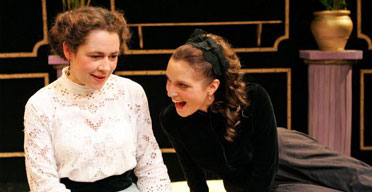
Allowing for the play's evasions, Robert Gillespie's production is suitably stylish. Claire Spooner's set, on a presumably modest budget, implies parquet-floored luxury. Max Digby plays Poligni, quite rightly, as a consummate ditherer, and there is sprightly support from Oliver Chopping as an open-hearted artist and Fliss Walton as the moderately merry widow. The final impression is of encountering a lost historical document, a 19th-century boulevard diversion with unexplored depths suggesting that Scribe, if more than a hack, was less than a genius.
· Until October 22. Box office: 020-8680 4060