Steve Gerrard, Gerrard, he slipped on his … well, everyone knows how it goes by now. So sing it up, belt it out, get it out of your system while you can. He’s off in a minute. And when these slightly bewildering levels of rage, schadenfreude and snark subside, everything will snap into focus soon enough. History will be kind to Gerrard.
Sure, he will never hold a Premier League winner’s medal and you don’t have to be a psychologist to realise how that will boil his soul for all eternity. Hopefully he’ll find a little inner peace; it really shouldn’t matter that much. Ryan Giggs has 13 of the things? Well, Phil Neal has eight, plus four medals for the European Cup. Shiny discs aren’t exactly the most reliable measure of greatness. Tom Finney never took home so much as a bronze centime, yet people are still in awe of the Preston Plumber 60 years down the line. Gerrard hasn’t done too badly. His legacy is assured.
Not many players have an FA Cup final named after them, for a start. Not even poor old Stan Mortensen, and he scored three goals in one. There remains a school of thought that marks down West Ham as unlucky and unjust losers of the 2006 FA Cup final, robbed by a freak late strike from nowhere, victims of cruel fate; Hungary’s golden team, Cruyff’s Holland and Bayern Munich circa 1999 rolled into one.
West Ham’s three goals again: the first put into his own net by Jamie Carragher, the second a tap-in after an appalling goalkeeping fumble, the third a shanked cross that redefined the rules of geometry. Gerrard, by contrast, scored two belters and set up Djibril Cissé with a diagonal 40-yard quarterback slingshot. Liverpool deserved their medals that day, and Gerrard made damn sure they got their hands on them.
Even fewer players personify a particular European Cup final. George Best maybe manages it in 1968. Eusebio in 1962 perhaps, though the mists of time are not his friend. Ferenc Puskas and Alfredo Di Stéfano only get to share their signature moment, the famous Hampden exhibition of 1960. But Gerrard – rightly or wrongly, and we’ll get to that – usually gets the credit for Liverpool’s astonishing turnabout in the 2005 Champions League final all to himself.
Putting your name to an FA Cup and a European Cup final: that’s quite some going.
His second goal in Cardiff is almost certainly, in terms of pure visceral rush, the greatest he ever scored, nudging out the ya-beauty belter against Olympiakos, his youthful surge in the 2001 Uefa Cup final, that astonishing half-volleyed curler against Middlesbrough, the famous heat-seeker against Manchester United. All of those were better than the header he scored in Istanbul. But none of them changed everything like the header in Istanbul.
It was seismic. The header heard all around the world. All goals, by their very definition, change the balance of matches to some extent but this one was off the scale. It didn’t so much alter the mood as bend the mind. To realise its full perception-warping psychedelic effect, spool back 90 seconds or so, to the 52-minute mark of what was threatening to turn – no, had already turned – into a rout.
That’s when Djimi Traoré, standing in the centre-circle, let a simple pass roll under his boot. Hernán Crespo made off with the ball, scampering gleefully like a cartoon character coming out of a shop with a large bag of sweeties. Yoinks, now for a feast! Milan were already three goals up and cruising. Crespo slipped the ball to Kaká, who turned on the jets to burst down the inside-left channel.
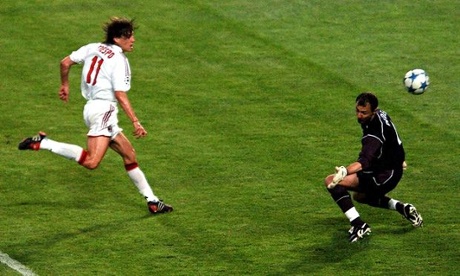
Kaká sashayed past the last man, Sami Hyypia, only to be sent crashing to the ground by defender. By any definition, it was a red-card offence but though a free-kick was awarded, Hyypia wasn’t even booked. The referee Manuel Mejuto González was ultimately to blame for bottling the big decision but Milan were their own worst enemies, too. Hyypia, with puppy-dog eyes, pleaded for mercy. “Please, please,” he begged Kaká, holding the Brazilian’s shoulders gently. Kaká, a good God-fearing lad, did what good God-fearing lads do. He forgave Hyypia, turning the other cheek, quietly walking away from the scene. Most other players would have been right up in the referee’s grille, ensuring the flourishing of the red card.
Andriy Shevchenko creamed a low free-kick towards the bottom-right corner, and it would have crept in were it not for Jerzey Dudek’s strong left arm. Liverpool cleared the resulting corner, swept upfield, and … well, let’s pause the action just there for a moment. Because up to this point in time, Liverpool were still the panicked shambles of the first half. All over the shop since the restart. As well as Shevchenko’s free-kick, Dudek had been forced to shovel away an oscillating Cafu cross down by his right-hand post; Hyppia busied himself in the area to block both Cafu and Crespo; and Shevchenko very nearly took a midfield ricochet under control to get a shot away. Liverpool’s second-half revival is often credited by the cognoscenti to Dietmar Hamann’s half-time arrival but his impact was not immediate. He had yet to establish any authority.
That would come, and quickly, but it required Gerrard’s intervention first. At which point Liverpool should have been down to 10 men, and losing by four goals. This is how much a single goal changed everything.
And it was a simple goal. From the corner resulting from the Shevchenko free-kick, Paolo Maldini uncharacteristically shanked a pass across the face of the Liverpool area. It allowed them to sweep upfield. John Arne Riise tried to burst down the left but was stopped by Gennaro Gattuso. He turned back, allowing Gerrard, Xabi Alonso and Hamann to shuttle the ball around before threading it back out to him on the wing. Riise crossed. Cafu blocked. Riise crossed again. This time it made the area, where Gerrard, on the penalty spot, guided a periscopic header into the top-right, past a dismally flat-footed Dida.
A good goal, if not a brilliant one, but that wasn’t really the point. The atmosphere at the Ataturk Stadium changed abruptly. Defiance, relief and hope. It was all of those things at once, sort of, and yet not really any of them either. No one could quite put their finger on what it was. Minds, you see, had been palpably warped. The doors of perception were banging open and shut as if from gusts of wind swirling through a haunted house. No one had a bloody clue. Least of all Milan.
We all know how things panned out, so no need to go through it all again, but it’s long been a debate as to whether Gerrard deserved the man of the match award. It could have gone to Hamann, who locked down on Kaká and restored order to Liverpool’s midfield. It could have gone to Dudek, who was the penalty hero, made several crucial stops when saving face seemed the height of Liverpool’s ambitions, and denied Shevchenko deep into extra time with one of the greatest point-blank reaction stops in history. Or it could go to Milan Baros – please hear this out – who gymnastically leapt out of the way of Vladimir Smicer’s goalbound shot, set up Gerrard to win Liverpool’s penalty, and grappled with Alessandro Nesta as Alonso was busy missing from the spot, a cynical tug that gave Alonso just enough time to reach and roof the rebound ahead of the despairing defender.
Me, I’d have given it to Dudek, not least because his working-class, pit-village modesty and sheer likeability sits perfectly with the unpretentious, down-home ethos of Liverpool Football Club. And because Gerrard’s got plenty of other feathers in his cap anyway, even without that Premier League medal.
He’ll be fine either way, history will be kind, that legacy assured but whoever you plump for, one fact remains: none of them could have done it, and none of it could have happened, without Steven Gerrard, and his most golden of great goals.
Scott Murray is the co-author, with Jonathan Wilson, of The Anatomy of Liverpool: A History In Ten Matches (Orion).