Des Walker played close to 800 club matches and 59 times for England in a career that spanned two decades. He featured in an FA Cup final, a World Cup semi-final, played in Serie A for Sampdoria and, through it all, faced some of the finest strikers of his generation. Yet, according to Walker, the best goal he has seen was in training, by a midfielder – and one who was basically mucking about.
“It’s 11 v 11 and as the goalkeeper kicks the ball out it bounces quite low and is going to skid off,” Walker recalled on Sky Sports recently. “As I’m running with him I know I’m going to beat him to it, and he knows I’m going to beat him to it, but as it skids off he gets his toe [to the ball] and flicks it back. But the ball’s up high and he can’t really bring it down, so I’m just about to toe poke it away but, because he can’t let it come down, he’s kneed it from 40 yards over Peter Shilton and as it’s going in he’s laughing. I’ve honestly never seen a better goal than that.”
It doesn’t require a sleuth to work out who Walker is talking about. The clues are all there, from the context of an England training session, to the jaw-dropping ingenuity and execution, to that final, celebratory laugh. It could only be one man; the one and only Paul Gascoigne.
Now aged 47, Gascoigne re-emerged into public life last month, appearing on ITV’s This Morning, where he looked and sounded healthier than he has done for some time. Yet there was still a paled fragility in his appearance and a vulnerable brittleness to his voice, making it difficult to comprehend that this troubled, alcohol-ravaged soul was once the bright young thing of English football. He was, however, and then some. A player of such startling genius that, as Walker outlines, he could do things even in training that took the breath away.
It is those, such as Walker, who played with Gascoigne at international level that arguably appreciate him the most. Gary Lineker, for instance, describes him as “the most naturally gifted footballer this country has produced” while Terry Butcher and Bryan Robson are both adamant that he is one of the best players they have lined up alongside, for club and country. Robson goes further by saying that for a six-year period after Italia 90, when Gascoigne announced his talents to anyone and everyone who watched that World Cup, he was “challenging [Diego] Maradona to be the best player in the world”.
Robson may be wrong but there is a poignancy to his assessment. While Gascoigne’s playing career officially ended in 2004 following a brief spell at Boston United and he played for England up until the middle of 1998, it was in 1996, and at Euro 96 specifically, that we really saw the last of grade-A Gazza; the star, the genius, the man who perhaps more than any other personified the thrill and utter joy that comes with top-level football being performed at the highest level.
It is arguable that a great amount of mythology and hype has come to surround Euro 96 and, in particular, England’s performance during their home tournament. After all, Terry Venables’ side only won two of the five matches they participated in during the initial 90 minutes and, quite frankly, were fortunate to get past Spain in the quarter-finals. There is no doubt, however, that it was one of those rare post-1966 periods when the national team provided the nation with a source of collective pride and optimism, with Gascoigne once again at the centre of it all. Literally, in regards to his position in the team, but also in terms of creating that one enduringly memorable, emotion-tugging moment. At Italia 90 it was the tears of Turin; at Euro 96 it was the wonder goal at Wembley.
From an English point of view, Gascoigne’s strike against Scotland is so perfect that a little more than 18 years on it echoes a dream born in the head of someone who worships Edward I as much as they do Mick Jagger. First there was the opposition, with the group stage meeting being the first time these historical rivals had played each other for more than seven years. Then there was the setting – Wembley on a gloriously warm Saturday afternoon during the first major tournament to be staged in this country since the World Cup that went rather well of exactly 30 years earlier. Finally, there was the goal itself, with its timing, execution and protagonist equal in their sense of grand occasion.
To recap, England faced Scotland having drawn 1-1 with Switzerland in their opening game of the tournament. It was a hugely disappointing outcome given they had led through Alan Shearer’s first-half goal only to perform poorly after the break and concede an equaliser seven minutes before the end via a Kübilay Türkyilmaz penalty. Much was riding on their second Group A fixture on 15 June, yet England started sluggishly with Scotland, who had drawn 0-0 with Holland in their opening group match, the better side but not by much. As the Guardian’s former football correspondent David Lacey put it in his match report: “In terms of international theatre, Saturday’s British offering was an end-of-pier show.”
It took a tactical change by Venables at half-time to get England going. Stuart Pearce was replaced by Jamie Redknapp to give the hosts an extra body in midfield and the Liverpool player raised his team’s tempo and possession stats almost immediately. It was also his pass to club colleague Steve McManaman that led to the opening goal on 53 minutes, with the winger, having shifted from left to right flank and finding himself in a pocket of space, releasing the overlapping Gary Neville, whose cross was met by a Shearer header that soared into an unguarded Scotland net.
That should have been the moment England cut loose but once again they allowed their opponents to get back into the game and the chance to equalise from the penalty spot, after Tony Adams hacked down Gordon Durie inside the area with 12 minutes to play. Unlike Türkyilmaz, however, Gary McAllister could not convert, with his shot saved by the top of David Seaman’s left elbow. The Scotland midfielder later blamed a faint forward movement by the ball for the miss.
“If I score the penalty we go on to win,” added McAllister and there’s no doubt that moment was a turning point. In a minute England went from the very real prospect of surrendering their lead, and possibly the match, to winning it style. Enter Gazza.
Up until then, the 29-year-old had been a peripheral figure in the contest, largely standing out for the bleached hair colour he had adopted pre-tournament. As Lacey also wrote: “His only achievement of note [had been] the fact he had stayed on the field for the second half. Pink, peroxided and portly, he had become an adornment.”
That’s the thing about great players; they only need a moment to make their mark and Gascoigne chose his in the 79th minute.
The move that led to the goal, starting with Seaman’s right-to-left kick and finishing with the ball flying past Andy Goram in the other net, took nine seconds and six touches to complete. Three outfield players contributed; Gascoigne, Darren Anderton, who swept a perfectly weighted first-time pass into the midfielder’s path, and a man whose role in the buildup is often underplayed, Teddy Sheringham.
Watch the buildup again and see how Sheringham drops into midfield to collect Seaman’s delivery, takes all the speed of it with his right foot before playing the ball out to Anderton on the left flank. It is a simple but crucial contribution – and particularly so because by coming deep, Sheringham also dragged his marker, Colin Calderwood, out of position, leaving a clear path towards the heart of Scotland’s defence for Gascoigne to run into. And that is exactly what he did, “steaming forward” as Venables put it, in order to gather Anderton’s pass.
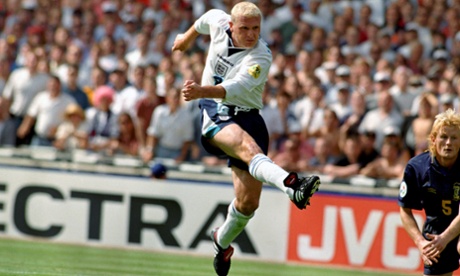
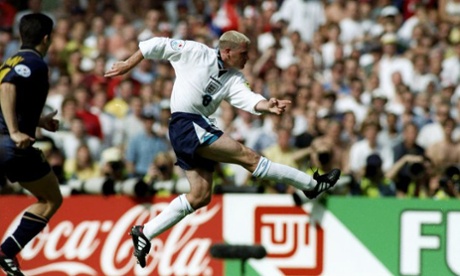
What happened next has been replayed endlessly. Having feinted to shoot, Gascoigne lifted the ball over Colin Hendry in an instant and to perfection; just high enough so it cleared the defender’s head and just low enough so he could volley it before Goram had the chance to properly react. Left foot, right foot, and the cleanest strike you will ever see.
“Poor Hendry,” observed Lacey, “so brave and with such heart, had been drawn and quartered.”
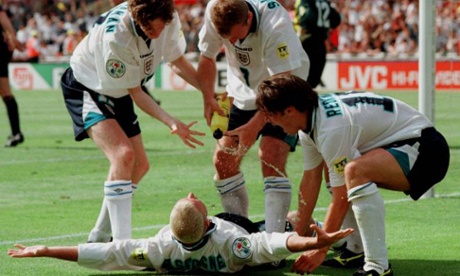
As the majority of the spectators inside Wembley celebrated wildly, Gascoigne ran to the far side of the pitch, lay on his back and waited for his team-mates to spray water in his mouth. The celebration is almost as famous as the goal, referencing the infamous dentist-chair episode of England’s pre-Euro 96 tour to the far east and, in less than subtle terms, shoving two fingers up at the members of the media who had written off the squad as a bunch of boozed-up wasters in the buildup to the tournament.
“Mr Gascoigne: An Apology” read the Daily Mirror’s editorial two days later. All had been forgiven.
The goal itself was Gascoigne’s eighth for England since making his debut against Denmark in September 1988 and while it may not have been a kneed-volley over Peter Shilton from 40 yards it was a moment of perfectly executed ingenuity from a player who had yet again captured the spotlight.
“People often ask me whether that’s the best goal I’ve ever scored. It was one of the best, although I scored one or two in Italy that never get shown on TV which were just as good,” said Gascoigne later. “In terms of what it meant though, you couldn’t beat it. I was playing for Rangers at the time and I’d taken a beasting about the game, so it was really sweet. And to have 70,000 fans singing your name is unbelievable.”
According to Mark Perryman, author of Ingerland: Travels With A Football Nation, the goal was significant from a political as well as sporting point of view. “My friends in the Tartan Army are adamant that if Gary McAllister had scored that penalty, Scotland would’ve won and the entire country would have demanded a vote for independence straight away,” he says. “It would’ve been that big a moment for the country – a source of immense national pride – but instead Gazza deflated an entire country with one brilliant moment.”
Brilliant and the climax of Gascoigne’s career. He would play 17 more times for England, including three more matches at Euro 96, and score two more goals, both of which came in different World Cup qualifiers against Moldova. But there would be no further moments of individual wonder, no single contribution that had an entire nation eating out of his hands. Instead, and perhaps aptly, it ended in tears, with Gascoigne left distraught by Glenn Hoddle’s decision to leave him out of the squad that travelled to France for the 1998 World Cup.
The years since have been characterised by an unfulfilling and occasionally bizarre professional career, both as a player and manager, and a personal life that has descended into despair.
His career highlights, however, can be shown on a loop. Among them those mesmerising first appearances for England, Turin, that free-kick for Tottenham against Arsenal in 1991, all his goals and assists for Rangers and, without doubt, his strike against Scotland. Why wait, however? Watch them all now, over and over again, and in particular that glorious flash from a once-glorious player.