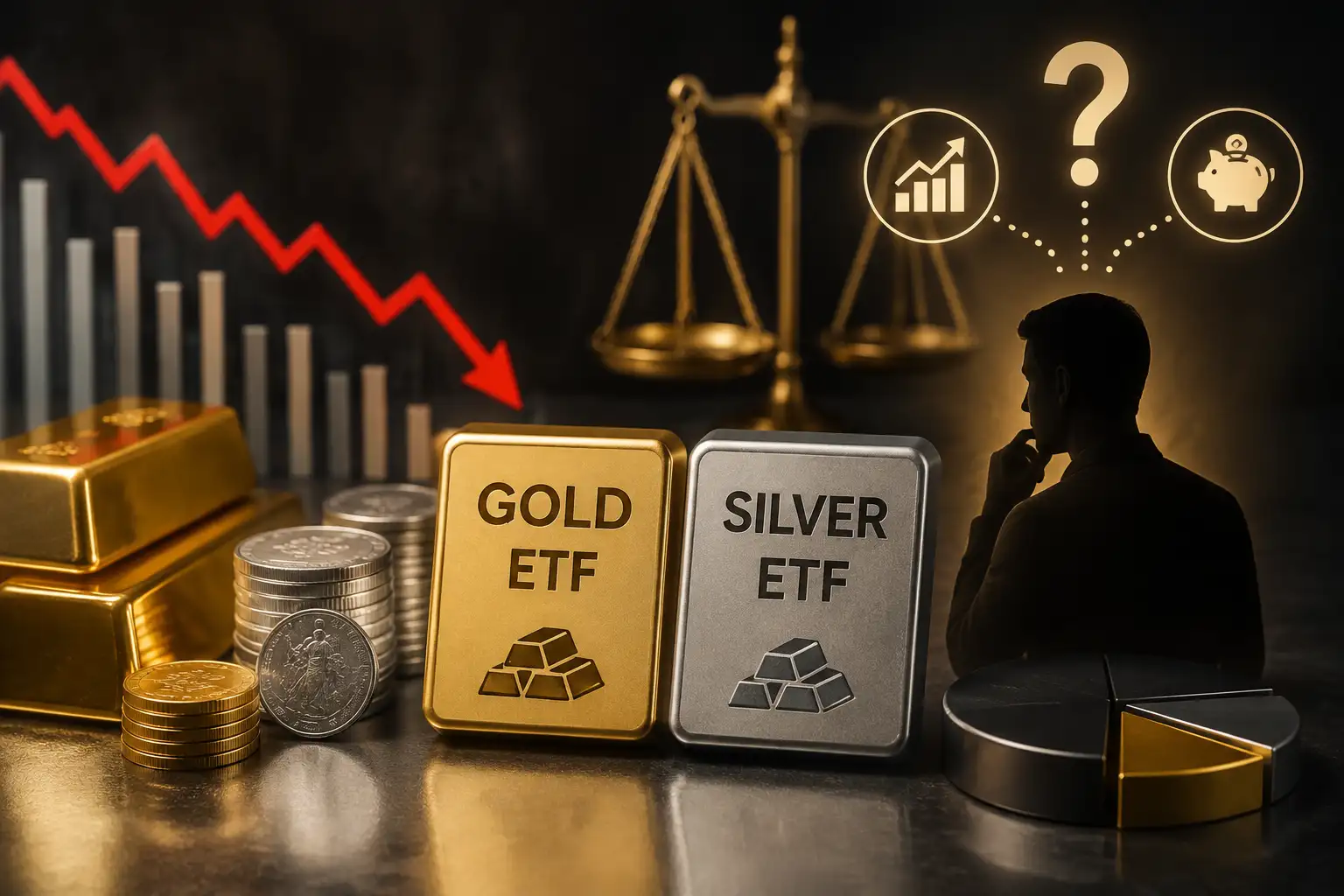
Gold and silver exchange-traded funds (ETFs) saw a sharp moderation in monthly inflows in July, with inflows declining 55% in gold ETFs and 70% in silver ETFs, according to mutual fund industry data released by the Association of Mutual Funds in India (AMFI). The fall in flows comes even as both precious metals have remained at elevated levels, raising questions about whether investors are becoming cautious after the strong rally.
Rajesh Minocha, a Certified Financial Planner (CFP), Founder of Financial Radiance told ETMutualFunds that the sharp decline in July inflows reflects a typical normalisation following strong earlier purchases, elevated prices, and some profit-taking. He further said that investors who bought gold and silver during the previous rally may be less inclined to add at current levels.
Also Read | Equity mutual fund inflows fall 15% to Rs 24,697 crore in July; smallcaps lead inflows
Shivam Pathak, CFP and Founder of Asset Elixir shared with ETMutualFunds the fall in inflows is largely due to profit booking after the strong rally in gold and silver. However, continued positive inflows suggest that investor interest remains intact.
The moderation in flows compared with June may partly reflect some degree of profit-booking following the strong price appreciation in gold and robust inflows witnessed during the first half of the year, said Nehal Meshram, Senior Analyst, Morningstar Investment Research India.
Nevertheless, sustained inflows for a second consecutive month suggest investor appetite for gold remains intact amid continuing geopolitical uncertainties, concerns around global growth, and uncertainty surrounding the trajectory of global interest rates, Nehal further said.
According to the monthly data released by AMFI, gold ETFs received an inflow of Rs 1,558 crore in July, marking the second consecutive month of positive inflows after an outflow of Rs 725 crore in May.
In the similar time period, silver ETFs received an inflow of Rs 1,284 crore marking the second straight month of positive inflow after an outflow of Rs 2,133 crore in May.
Gold, silver ETFs: Continue SIPs or moderate fresh allocations?
With gold and silver prices at elevated levels, investors may be debating whether to continue their existing SIPs or reduce fresh allocations.
While answering to this, Pathak said investors can continue their SIPs, but fresh allocations should be moderate and at current levels, aggressive allocation may not be advisable.
Minocha said investors should continue their existing gold SIPs but avoid making large new allocations at current high prices. SIPs help average out purchase costs and reduce the need to predict market corrections.
For silver, Minocha recommended a more cautious approach because of its higher volatility and significant industrial demand and silver should be treated as a smaller satellite holding rather than a core precious-metals allocation.
Minocha also stressed that investors should focus on asset allocation rather than chasing recent returns or short-term trends and investors who are not comfortable taking direct exposure to precious metals could consider multi-asset mutual funds.
For exposure in gold, Nehal said that the positive flows recorded in July reinforce the view that investors continue to maintain meaningful allocations to gold despite high valuations and the asset class remains an important hedge against macroeconomic and market uncertainties while also providing diversification benefits within broader investment portfolios.
Gold and silver ETFs: Inflows and AUM change
In FY27 so far, gold ETFs received a total inflow of Rs 7,317 crore with just outflow in one month. Silver ETFs received a total inflow of Rs 3,311 crore in FY27 with outflows in two months.
The AUM of gold ETFs went up by 2% to Rs 1.73 lakh crore in July whereas that of silver ETFs declined by 2% to Rs 77,676 crore.
Investors sitting on gains: Hold, book profits or rebalance?
The sharp rally in precious metals has also left many existing investors with significant gains and leaving investors wondering should they continue to hold their investments, book partial profits or rebalance their portfolios.
Minocha said a more effective approach is to rebalance rather than automatically lock in profits, if gold or silver has significantly increased and now represents a larger portion of your portfolio than intended, consider taking partial profits to return to your target allocation.
He further said that gold remains an important portfolio diversifier, especially during geopolitical and economic uncertainty; rebalancing helps manage risk when an asset class becomes overweight after a rally, even if it seems less exciting.
Pathak said that investors should review their allocation; if gold and silver have moved significantly above the desired portfolio weight, partial profit booking and rebalancing can be considered.
Gold vs Silver: Performance
In July, gold ETFs delivered an average return of 1.37% with seven funds delivering 1.38% return, the highest in the category. These seven funds include Aditya Birla Sun Life Gold ETF, DSP Gold ETF, Kotak Gold ETF, LIC MF Gold ETF, Mirae Asset Gold ETF, Quantum Gold ETF, and UTI Gold ETF. The lowest return was 1.35% delivered by seven funds.
Silver ETFs delivered a negative average return of 2.48%. There were 18 funds in the category of which Zerodha Silver ETF lost the most of around 2.59% and Bandhan Silver ETF lost the lowest of around 2.43%.
Time to pick gold and silver ETFs?
For investors who do not currently have exposure to precious metals, elevated prices make the timing of fresh investments an important consideration. With prices surging investors are wondering whether they should enter gold and silver ETFs now, especially the new investors.
Pathak said new investors can consider a staggered entry rather than investing a large amount at once and gold remains useful for diversification, while silver offers higher growth potential but also higher volatility.
Minocha said new investors should avoid making large lump-sum investments after a strong rally. If gold is required in the portfolio, he suggested building the position gradually through staggered investments instead of trying to time the next correction. Multi-asset mutual funds could also be considered.
Also Read | Smallcap, midcap mutual funds see rise in inflows; largecap funds witness first outflow in 30 months
Minocha said he prefers gold over silver for the core allocation because gold serves as a more reliable portfolio diversifier and continues to benefit from central-bank demand and investment interest. Silver, meanwhile, has a potentially attractive long-term outlook because of industrial demand and supply constraints, but its volatility is considerably higher.
“The near-term outlook for both metals could remain volatile. Gold prices remain influenced by interest-rate expectations, the US dollar, geopolitical risks and central-bank demand. Recent market behaviour also highlights how quickly changing expectations around interest rates can affect precious-metal prices,” Minocha said.
(Disclaimer: Recommendations, suggestions, views and opinions given by the experts are their own. These do not represent the views of The Economic Times)
If you have any mutual fund queries, message on ET Mutual Funds on Facebook/Twitter. We will get it answered by our panel of experts. Do share your questions on ETMFqueries@timesinternet.in along with your age, risk profile, and Twitter handle.