

After coiling up for the entire month of July, gold is finally giving technical indications of a breakout, rallying over 2% intraday and moving toward a key resistance level of $4,200.
Although it still remains more than 25% below its all-time January highs, a repeated rejection of $4,000 support has indicated that the next significant test will be on the upside, particularly since the Federal Reserve is out of the way for now.
The central bank has, once again, decided to keep rates unchanged, although the vote was far from unanimous. Higher rates raise the opportunity cost of holding non-interest-bearing bullion, and investors feel unease, especially with an overhang of energy-led inflation threatening to keep borrowing costs up.
However, with the new, reserved communication style under Kevin Warsh, the lack of information only contributes to that anxiety. Meanwhile, President Donald Trump’s opposite communication style, particularly regarding the Middle East as the source of the aforementioned inflation, is, paradoxically, having the same effect.
“The environment is a little bit better in terms of support for gold right now after the Fed meeting,” Samantha Dart, co-head of global commodities research at Goldman Sachs, told Bloomberg News. Still, “tactically, we are not totally out of the woods yet,” she added.
Post-COVID Hangover
Yet the bigger question may be whether gold still offers the protection investors expect when markets sour. A University of Cape Town Department of Finance and Tax study found that gold’s safe-haven and hedging role weakened after the COVID-19 pandemic, particularly against U.S. financial and industrial shares.
By assessing co-movement between commodities and major U.S. sectors, the researchers uncovered that gold’s results became sector-specific.
According to Associate Professor Chun-Sung Huang, gold’s traditional role “quietly deteriorated” after the pandemic.
The metal did well for energy and consumer-discretionary exposure during Covid, but less so for healthcare and consumer staples. Meanwhile, silver and platinum displayed stronger positive interdependence with sectors, lowering their defensive appeal.
Agricultural commodities fared better. Corn and soybeans showed modest safe-haven characteristics, while wheat was less consistent. Livestock, however, lost most of its protective value.
Assessing the Breakout
The daily chart shows the extent of gold’s recent volatility. The price has corrected by more than $1,600 in a matter of months before finding support. SPDR Gold Trust (NYSE:GLD) remains down 6.06% year-to-date.
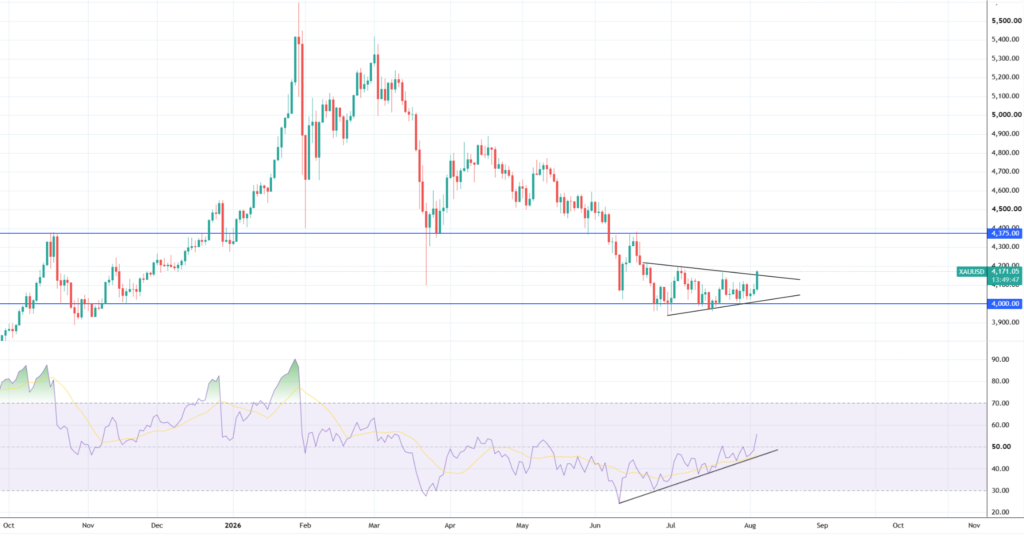
Gold daily chart, Source: TradingView
Meanwhile, the Relative Strength Index indicator showed bullish divergence. Price closed lower on July 16, yet the indicator moved higher – showing the bearish momentum fading.
Looking forward, the first level to overcome is $4,200; but a bigger resistance awaits at $4,375 – the level that has flipped from resistance (last October) to support in March and back to resistance in June.
Photo via Shutterstock
Read Also: China And Stablecoin Issuer Tether Ramp Up Gold Accumulation