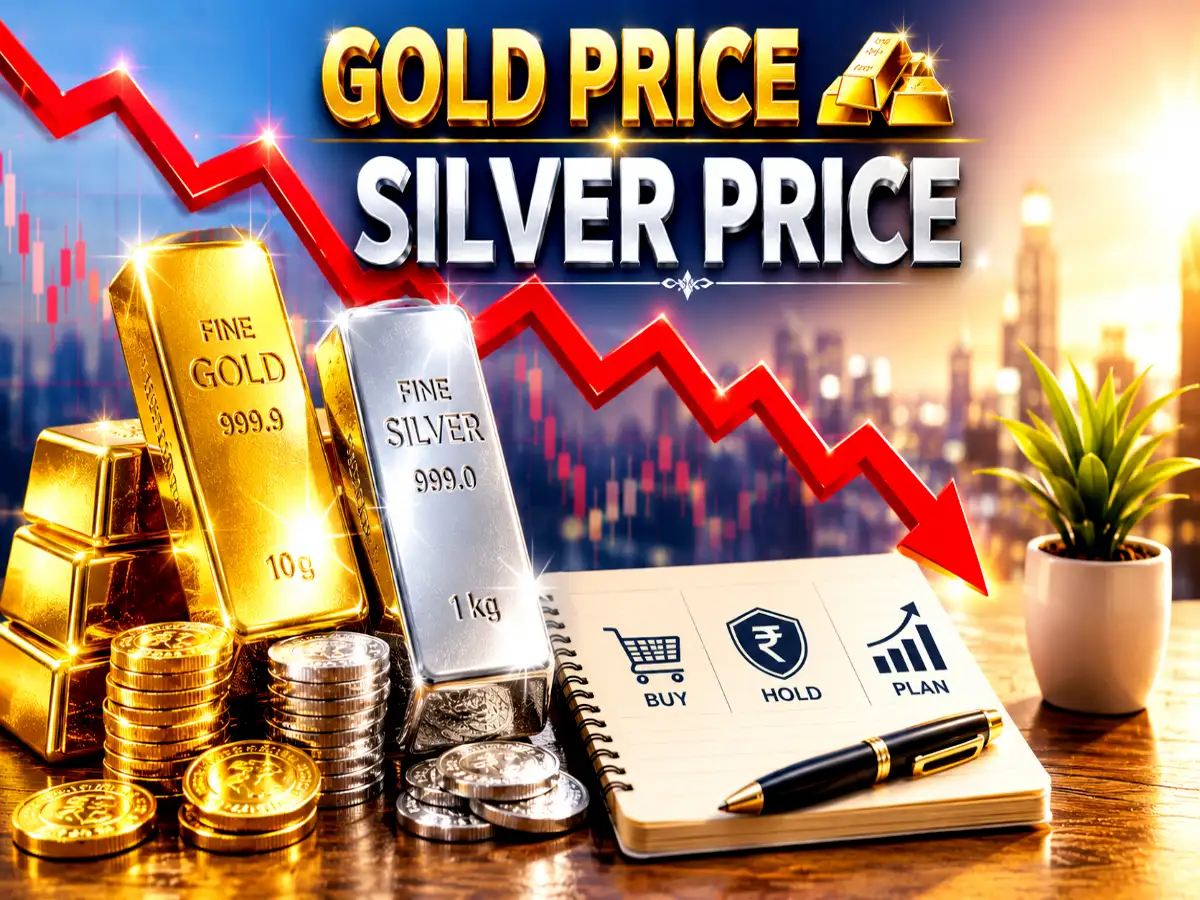
This month, silver and gold prices took a big hit due to the easing of tensions between Iran and the US. According to data from the Multi Commodity Exchange of India (MCX), gold price fell by Rs 10,070/ 10 gram, or 6.50%, from Rs 1,54,908 on June 1 to Rs 1,44,938 on June 19, 2026. Meanwhile, silver saw a decline of Rs 30,448/kg, or 11.56%, slipping from Rs 2,63,458 on June 1 to Rs 2,33,010 on June 19.
While such a drop in asset prices might present new investment opportunities, it could also cause panic among those investors who had bought in at higher prices. So, what should both current and prospective gold and silver investors do in this scenario? Experts explain precious metal strategy for investors.
Also Read: NRE vs NRO income tax rules: How these NRIs, OCIs can save up to Rs 20,500 on $10,000 FD investment
Spot gold rate on MCX showing daily price changes (from June 1-June 19, 2026)
| Date | Spot Price (₹/10g) | Change (₹) |
| 19-Jun-26 | 1,44,838 | -2,839 |
| 18-Jun-26 | 1,47,677 | -2,061 |
| 17-Jun-26 | 1,49,738 | -454 |
| 16-Jun-26 | 1,50,192 | 59 |
| 15-Jun-26 | 1,50,133 | 2,766 |
| 12-Jun-26 | 1,47,367 | 2,637 |
| 11-Jun-26 | 1,44,730 | -1,965 |
| 10-Jun-26 | 1,46,695 | -5,052 |
| 09-Jun-26 | 1,51,747 | 1,512 |
| 08-Jun-26 | 1,50,235 | -3,724 |
| 05-Jun-26 | 1,53,959 | -1,433 |
| 04-Jun-26 | 1,55,392 | 863 |
| 03-Jun-26 | 1,54,529 | -1,584 |
| 02-Jun-26 | 1,56,113 | 1,205 |
| 01-Jun-26 | 1,54,908 | — |
Spot silver rate on MCX showing daily price changes (from June 1-June 19, 2026)
| Date | Silver Price (₹/kg) | Daily Change (₹) |
| 19-Jun-26 | 2,33,010 | -8,320 |
| 18-Jun-26 | 2,41,330 | -6,246 |
| 17-Jun-26 | 2,47,576 | -1,757 |
| 16-Jun-26 | 2,49,333 | -1,994 |
| 15-Jun-26 | 2,51,327 | 10,021 |
| 12-Jun-26 | 2,41,306 | 8,075 |
| 11-Jun-26 | 2,33,231 | -417 |
| 10-Jun-26 | 2,33,648 | -12,009 |
| 09-Jun-26 | 2,45,657 | 4,040 |
| 08-Jun-26 | 2,41,617 | -15,512 |
| 05-Jun-26 | 2,57,129 | -3,126 |
| 04-Jun-26 | 2,60,255 | -1,684 |
| 03-Jun-26 | 2,61,939 | -3,565 |
| 02-Jun-26 | 2,65,504 | 2,046 |
| 01-Jun-26 | 2,63,458 | — |
Why gold and silver rates are falling and when can they recover?
Vedika Narvekar, Research Analyst, commodities & currencies, Anand Rathi Shares and Stock Brokers, told ET Wealth Online that gold and silver prices have been falling for some time due to factors such as elevated oil prices, inflationary concerns, a shift in interest rate expectations, a stronger U.S. dollar, as well as higher bond yields.
In addition, ETF outflows reflected a deterioration in investor sentiment, says Nervekar.
Nervekar expects gold and silver prices to gradually recover in the final quarter and reclaim at least their pre-war peaks.
“The recovery is likely to be supported by renewed central bank buying and a revival in ETF inflows. The trajectory of prices will largely depend on the extent of post-war disruptions, the normalisation of supply chains, and the pace of global economic growth, all of which will influence investment and industrial demand,” says Narvekar.
Prithviraj Kothari, Managing Director at RiddiSiddhi Bullions Ltd., president of India Bullion and Jewellers Association Ltd., says the catalysts for gold and silver price recovery are identifiable.
“We expect inflation pressures to ease after geopolitical tensions conclude, allowing rates to move lower, the dollar to weaken, and the debasement trade to revive — with gold potentially trading above $5,350/oz by Q2 2027,” says Kothari.
What should existing investors do now?
Experts believe a lot of external factors can influence gold and silver prices in the near future. A lot of investors in precious metal, who were lured in by the record rallies in gold and silver prices in the last one and half year, may be undecided whether to exit at a loss or wait for prices to recover and book profits.
Puneet Singhania, whole-time director, Master Capital Services Limited, advises investors already holding gold and silver to avoid reacting emotionally to a correction that arrives after an exceptional bull run.
“Those who entered at higher levels are naturally seeing unrealised erosion, but a correction within an intact structural uptrend is not the same as a thesis breaking down,” says Singhania.
Should new investors invest in gold and silver?
Narvekar believes the recent correction offers an opportunity to gradually build exposure rather than making a lump-sum investment.
Kothari recommends a systematic approach to new investors and avoid any price speculation.
“Stagger entry over 6–12 months via Systematic Investment Plans (SIPs) in Gold ETFs or Silver ETFs rather than deploying lump sums. We are expecting demand to re-accelerate in H2 2026, with central bank buying and ETF inflows as the two key pillars,” says Kothari, advising new investors to allocate 10–15% of their portfolio to precious metals
Which forms of gold and silver should investors prefer?
When we consider precious metals for investors, some key elements are liquidity, holding charges, making charges (in case of jewellery), convenience and taxation. Which forms of gold and silver can investors looking to make good returns from them in the long future choose?
Singhania says for most investors, paper and digital forms are preferable to physical metal, as they eliminate concerns around storage, insurance and making charges, while remaining easier to liquidate.
Singhania suggests investors to invest in gold and silver exchange-traded funds for easy access and transparent pricing, gold and silver fund-of-fund for those investing without a demat account, and sovereign gold bonds as they pay interest and offer tax efficiency on maturity.
Narvekar too believes new investors should invest through gold ETFs, silver ETFs, or silver mutual funds as these instruments offer better liquidity, lower storage costs and greater transparency.
Narvekar says physical bullion may be suitable for consumption or gifting, whereas financial products are generally more efficient for long-term investment purposes.