Writing a memoir is, for many, an acknowledgment that the living has given way to the remembering: a melancholy acceptance. Not for Frederic Raphael. He applies himself with a vengeance. No thresher has been more enthusiastic in reducing the cornfield of others’ reputations to size. Going Up, as its subtitle suggests, has a meaning for this writer far beyond recalling the groves of academe. He started out as a novelist and playwright before he decamped to the cinema and wrote the Academy Award-winning screenplay for Darling (1965), an acidic portrait of celebrity shallowness starring Julie Christie and Dirk Bogarde. The one time I have been at close quarters with him was 20 years ago at the leaving dinner of a literary editor we both wrote for. Freddie, making an impromptu toast, alluded to his Oscar within 90 seconds. But it is not enough for him to assert his own pre‑eminence; his contemporaries – friends as well as enemies – must eat dust in his majestic wake.
It is, I should say, a hugely entertaining book, if not always for the reasons its author might imagine. Coming of age in the 1950s, Raphael saw himself as one set apart from the profanum vulgus (his love of a Latin tag is terribly catching), perhaps from the moment he took to task the headmaster of his hated public school, Charterhouse, for a casual antisemitic slur. He believes the same prejudice disqualified him from a place at Winchester. His antennae for such discrimination twitch throughout the book, not only in the committee rooms of the establishment and the media but in the very pages of the canon. He disdains Pound and Eliot, of course, but also Graham Greene and Dickens, whose creation of Fagin he could never forget.
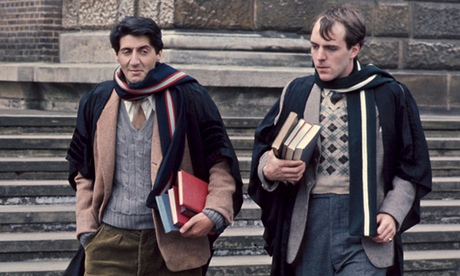
For a bright boy with a facility in Latin and Greek, Cambridge was heaven. How much it still matters to him! And what a prodigious memory he has of it. At his college, St John’s, he seems to have spent less time swotting than playing bridge and honing his skills as a fledgling lyricist and playwright, usually with the composer Leslie Bricusse. Their student musicals wowed audiences in Cambridge (“The applause went on and on”) and, later, at the Phoenix theatre in London. He secretly noted his fellows’ habits of speech and manner, storing them for later use in his novels and the TV series The Glittering Prizes. Bricusse gets off lightly, suffering only the minor whiplash of condescension. Simon Raven, Joan Bakewell, George Plimpton, Mark Boxer and even Michael Winner receive an ironic salute. Others, such as Jonathan Miller, are given a feline swipe: “His hermetic habits never inhibited him from retreating into any available limelight.” On his Oxford contemporary Kenneth Tynan he is less savage here than in his diaries, though not by much. When Tynan offered his hand, “it was as if you were being dared to reach and touch something fishy in a penny arcade”. One senses that here was someone a little too talented and influential for Raphael to like, or forgive.
His relationship with his parents sheds some light on his behaviour. An only child, Raphael was not the anointed princeling that designation often implies. His father, Cedric, who worked for Shell, warned him not to be pushy, to wait for the madding gentile crowd to come to him. His mother, Irene, lived to 100, a longevity that seems to have owed much to the quick-bonding agent of her own solipsism. Late on, the son finally comes clean: “I was sorry for my parents, but good manners had to cover for the small love I felt for them.” It’s a telling moment: if he is this uncompromising about his parents, what chance can there be for anyone else? He hardly seems to realise how insufferable he sounds. Slights, grievances, disobliging remarks – he curates the offences of others as carefully as a lepidopterist collects butterflies while also admitting that “making oneself obnoxious to famous persons is not an unknown form of self-introduction”. The only child never learned to play nicely with others. Urbane and authoritative in one paragraph, he is mean-minded and graceless in the next. You cringe, not at his lack of tact but his lack of self-knowledge.
The central mystery in all this is his wife, Beetle, to whom he has been uxoriously attached for more than 60 years. The beautiful dark-haired girl he fell in love with in his youth remains an enigmatic (and mostly silent) witness to her husband and the tortuous drama of his unedited self. She may be some kind of saint.
“As a writer, I have never imagined myself to be competing against anyone,” he writes – which is fortunate, because as a man he seems to have competed against everyone. Steve Coogan would play him superbly in a biopic, were there an appetite for such a thing. The brilliance of Raphael’s phrasemaking will be his solace, though I wonder if he feels it has gone to waste at Robson Press. His book has no index, no photographs, no notes of any kind. For this his publishers are pleased to charge £25. As a fan I would pay it gladly. Alas, I fear my devotion is not widely shared.
• Anthony Quinn’s Curtain Call is published by Jonathan Cape. To order Going Up for £20, go to bookshop.theguardian.com or call 0330 333 6846. Free UK p&p over £10, online orders only. Phone orders min. p&p of £1.99.
- This article was amended on 13 August to correct a technical editing glitch