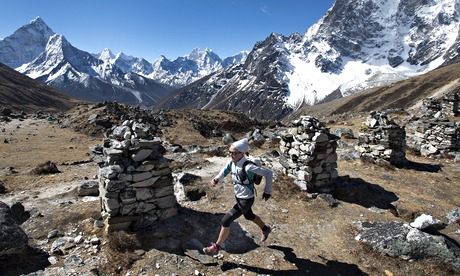
A lot of people will have been thinking about doing some gentle jogging now the new year is here. Some may be thinking about running in a competitive event, even a marathon. But a select few are getting ready to run further. Much, much further.
Welcome to ultra-running, one of the fastest growing sports around, albeit one that still attracts relatively few entrants. And for good reason: while an “ultra” event officially means anything longer than the 26 miles and 385 yards of a marathon, the growing number of UK ultra-races tend to be 50 or 100 miles, or even longer.
Ultra-running, which was popular in the 1970s and 80s, has taken off again in the past few years. Particularly in demand are trail races, where most of the route is off-road, often along bumpy paths and up and down steep inclines.
Marc Laithwaite organises the Lakeland 50 and 100 events, an annual event that takes place in July and, like just about everybody involved in the scene, is a keen competitor.
The popularity of ultra-running was underlined for him on 1 September when online entries for his 2015 races opened, with 750 places available at £70 each for the 50-mile events, and 450 for the 100-mile race, costing £90.
“Entries opened at nine o’clock,” he said. “They were full by 10 past nine.”
Laithwaite said many people got drawn into ultra-running from other endurance events, particularly marathons and Ironmans, souped-up triathlons. A lot of people were drawn by the challenge, he said. While most entrants complete an Ironman inside the 17-hour time limit, only about half the Lakeland 100 competitors finish the course within the designated 40 hours.
“With the cutoffs we have in the 100s there’s only a certain percentage of people who can complete the race,” he said. “I think some of them accept they’re never going to be able to do it.”
Laithwaite perceives a shift away from people running to set personal best times, to running it for enjoyment – as much as they can through the pain. He said: “You rarely get people coming to the end saying: ‘I was hoping for this time.’ They’ve just come to do it.”
Ultra-running is nothing new, even in Britain, which has had an annual London to Brighton run from the 1950s. The Marathon des Sables, a 156-mile event over six days in the Sahara, started in 1986, while California’s Western States 100 dates back to 1974.
The UK scene has its own fledgling magazine, Like the Wind, set up by Simon and Julie Freeman, who devised the idea while running around Mont Blanc for their honeymoon.
Simon Freeman said much of the attraction was the scenery: “There’s people who do 24-hour track races and I think, ‘God, you must be barking mad.’ Instead, it’s all about the experience.”
He said that while there were still more men racing than women, female runners tended to do disproportionately well in longer events, possibly because they were better at pacing themselves. He added: “The gap between the top men and top women diminishes the further you go.”
James Elson began setting up ultra races in Britain after finding he had to travel abroad to compete. He also believes most competitors enter not to win, or to set a certain time, but just to have taken part. He said: “We’re particularly proud at our races of the camaraderie between the volunteers, the organisers and the runners. It’s a really worthwhile, fulfilling thing to do.”