“His last name is Chimbaikar, my last name is Chimbaikar, though we are not related,” says Manish, pointing to Anand. “Well not now, maybe a long time ago we were. Many people here are called Chimbaikar. Sometimes this causes problems that so many of us have the same name, when the navy comes aboard for inspections while we are fishing.”
Despite the Indian navy, coast guard and government referring to the country’s hundreds of fishing communities dotted around its coastline as “the eyes and ears of our security apparatus”, the Koli fishermen of Mumbai’s coast have undoubtedly been affected by the nation’s ring of steel.
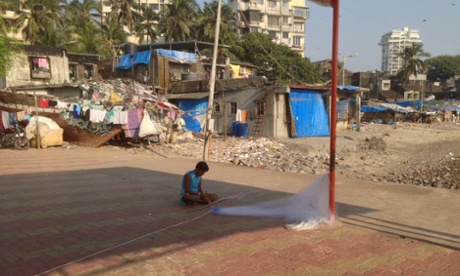
Working up to 10km out to sea in hours after dark and pre-dawn, it is unavoidable to meet those patrolling Mumbai’s sea defences for the Koli. But they have adapted and understand the need for proper checks. “You must have photo ID”, Naresh Putra, 40, tells me, before he will allow me aboard his boat. His vessel, the Bhavna Putra, is one of dozens nestled in the bay bordering the Arabian Sea in this tiny nautical hamlet.
As is it is near the sixth anniversary of the Mumbai terror attacks and there is a heightened sense of impending danger, it is especially important to ensure he does not fall foul of the marine police or military. “Before you could pick up someone from the village if they were on another boat coming back and they wanted to earn some extra money if they did not have a photo id, now you can all end up in a police jail,” says Manish, Naresh’s brother-in-law.
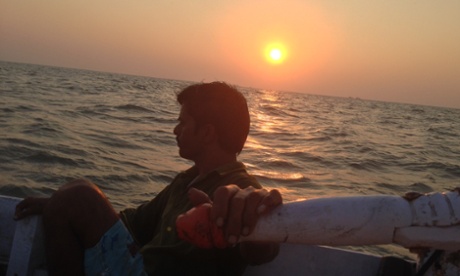
Once out on the night fishing run, when the nets are cast, with tea-tray sized cork buoys topped with diesel-lit, naked flames as markers, we drink warm, sugary chai as the sun sets over the Arabian Sea. I do not in any way feel like I am on the frontline of counter-espionage. Rather, I feel nauseous from the diesel exhaust puttering out hiccups of black smoke, as the Bhavna Putra’s chipped orange and white hull soars and dips like a cistern ball-cock, on the alum-coloured waves.
I feel like I am on a small boat that catches fish in odd hours, with the nets taking a full 25 minutes to cast, a similar amount of time to draw in, and yielding hardly a bucket full of fish at the end of a long night. It’s exhausting work but it’s undeniably serene being so far out to sea on a calm night.
Understandably disappointed at the volume of the haul, Naresh says: “What can you do? God gave us so many fish but he gave us so much ocean.” I cannot argue with this. For seafaring tribes across India this is the reality: backbreaking work for scant reward and being hassled by the authorities while doing it. My three shipmates: Naresh, Promud, 26, and Anand, 41, come from a long line of fishermen or maachiwalla, but all feel things may be changing with the next generation or two. Most in the village seem to agree.
This is a truly historic community - the original inhabitants of Mumbai’s seven islands, the fishing tribe that created the bedrock for the scattershot sprawl of today’s metropolis. The people are in the main Christian and Hindu, but iconography of various religions dots the village. There is no doubt who the supreme ruler is, however: the ocean.
And even though until around 20 to 25 years ago Koli tended not to mix much with mainstream society, I’m still amazed they’ve kept up their traditions for this long. Manish says: “Now because of more education and opportunity many Koli don’t need to rely on the sea.” In recent years, Mumbai officials creatively hit upon the idea of using the Koli’s phenomenal swimming skills and make them lifeguards on the city’s beaches. But ultimately, how long can they remain wedded to the sea? And has the sea had enough?
The waters of course bring their own network beyond this one village. On an earlier run, taking in views of the Mumbai Sea Link suspension bridge, and the lighthouse marking a western entry point to the city, we see a lone figure in a jute hat on a rowboat. Of course they know him, and as we turn and cruise past to say hello to “Bura”, he casually tosses a snake into our boat.
Thankfully it’s a dead one, its head smashed so hard it has split in two, and looks as if it’s having a drunken row with its own reflection. “Very poisonous if it bites you”, says Promud. “Has the poison been drained?”, I ask, as he leaps onto a box, his big toe practically grazing the reptile’s yawning mouth, or mouths, as it seems. “Oh yes, milked”, he nods. “Bura will keep it, it’s very good for back pain.”
Between runs, children come to sit and watch the fishermen mend their nets and talk about great adventures out on the waters. Most homes have TVs and a few carry smartphones, but the pier draws them out each night to play badminton, as crows and red kites cascade overhead, glancing down at the goats, chickens, pigs and dogs that busy themselves around piles of rubbish.
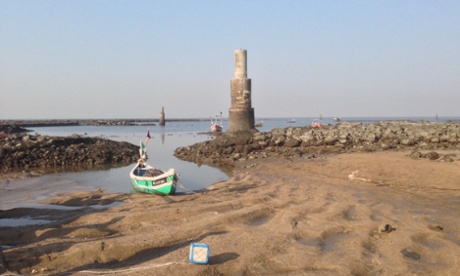
The village as a whole must succeed to survive, generally there’s a shift system that changes each week, of which crew fishes when, and in which waters. When another boat appears, your stint is done. “Sometimes there is confusion and maybe some fighting, but usually it’s ok”, says Naresh. “It is dark in the middle of sea, so when you see lights, you know it’s time.”
Their village, this smidgen of relative calm a mere line-cast away from the thrash on Mumbai’s main streets, sits on prime real estate. Surely all kinds of devious and slimy goondas (criminals) must be trying to find a way to shove them out and put up trendy apartments overlooking the sea? “All the time, every week a property developer comes saying this or that, not even our homes but saying they will buy land and build something,”says Manish. “But if they build, there will be no privacy.”
This is a tribe, in the modern sense as well as the ancient one. I count no less than seven young men wearing various sporting shirts with “Chimbaikar” printed on them. Naresh has one and his surname is Putra, so it’s not an actual identifier, it’s a pride thing. Then again, I spot three Manchester United shirts with Van Persie on the back, so maybe the navy really does have its work cut out.
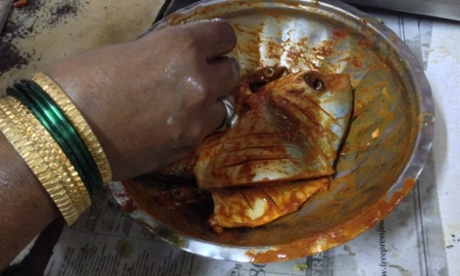
At the end of a long day, Manish’s wife, Savita, whose breakfast serving hatch has a huge queue each morning for her homemade aloo parathas, fries up one of the pomfrets we caught out in the night, with just chilli and haldi (turmeric). The initial idea was to follow a fish from sea to plate to belly, until my day swirled off on another tangent, but I’m happy to complete the mission myself. It’s delicious; of course it is, how could it not be? What do the Koli not know about the sea?
After our first run Naresh kindly invites me into his home to clean up and offers me tea. As I drink and rest, I chuckle as I see he has an aquarium. It’s filled not with goldfish or carp, but “magoor maach (catfish) and rui maach (a fish loved in eastern states like West Bengal) - you are Bengali, you must know rui maach?”, he grins. He asks why I’m laughing, and I say, doing what he does I’m just a bit surprised he has such a reminder in his home. “Of course”, he says. “I love the sea.”