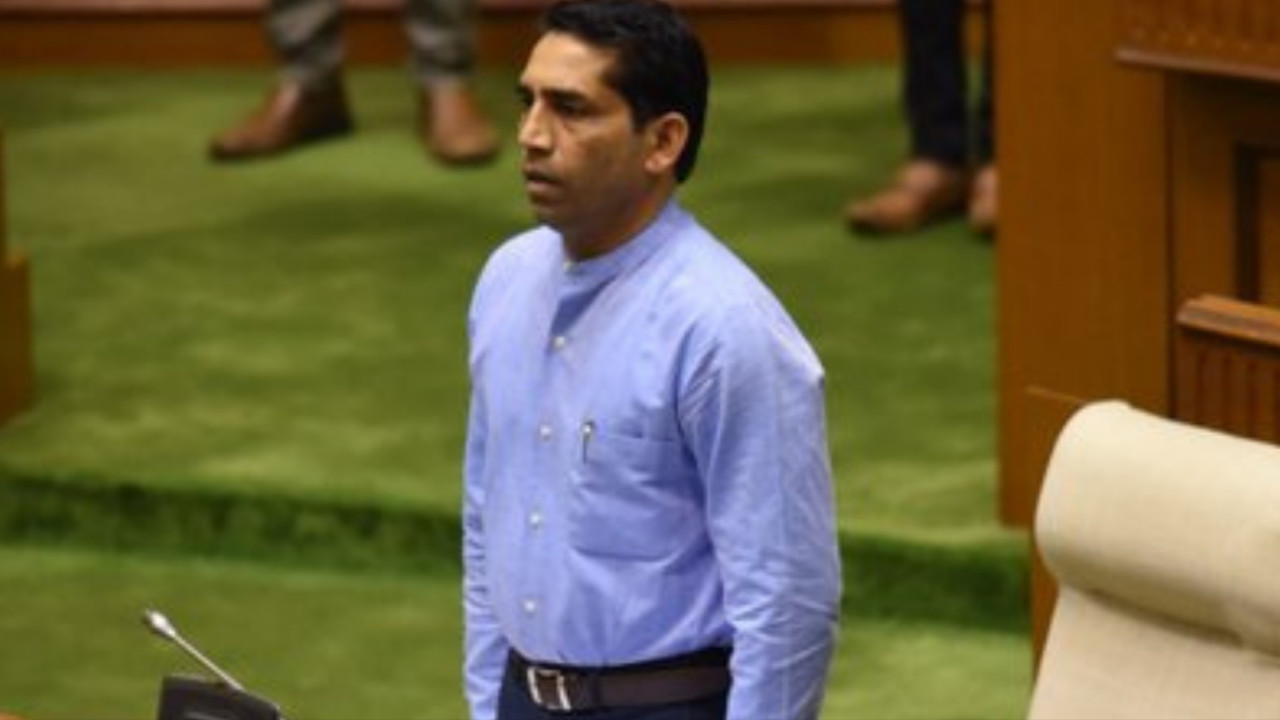
MARGAO: Four months ago, tribal welfare minister Govind Gaude, during his visit to the remote hill-top village of Karla, held aloft a promise of undertaking several infrastructure works under the government’s tribal sub-plan, including an access road to the village.
In the village, located in the inner recesses of the Netravali forests of Sanguem, 94-year old Bhomo Gaonkar, who has been battling sepsis above his left ankle, had then dismissed Gaude’s assurance as a politician’s empty rhetoric.
“We have heard plenty of such assurances in the past,” Bhomo had then told TOI. “We know this is election time, and they will give the same assurances again. Had they made this road as they had earlier assured, I wouldn’t have had to suffer like this. I am now only waiting for the road to Vaikunth (death, figuratively).”
Bhomo wasn’t entirely wrong. When queried over the fate of the promises he had dished out at Karla on an overcast June morning, Gaude told TOI last week that the hotmixing of the road will be taken up soon, now that the monsoon is over. “Once the road is done, other issues related to power and water supply can be taken up,” he said.
TOI, in its edition dated July 4, had highlighted the woes of Karla residents. Though blessed with nature's bounty, Karla lacks any basic modern-day facilities — not even a motorable access road to this village. A roughly 4km-long narrow, steep and winding dirt road from Cajur, situated at a relatively lower height, leads to Karla. However, maneuvering the road is not a mean task — the huge craters that have developed throughout the road make even a motorbike ride a terribly-risky affair.
The nearest hospital is the primary health centre at Quepem or Curchorem, nearly 25km away. With no easy access to healthcare facilities, the nonagenarian Bhomo was compelled to rely on traditional herbal medicine prepared by his wife to treat his sepsis. “The wound is now healing slowly,” says Bhomo, “and I am able to take a few steps with great difficulty, but whatever happened to the promise of the road our sarkar had promised?”
In the absence of a motorable road, villagers are rendered helpless in times of medical emergency as no ambulance can travel up this road.
The nearest primary school for the students here is at Cajur, and the nearest high school at Maina. High school students from Karla, numbering around ten, take an alternative route to get to their school — a pathway through the dense forests that takes them over forty minutes to climb down and an hour-and-a-half to trudge up. It gets riskier during the monsoon, as the pathway invariably gets flooded, and the rocks, slippery.
For higher secondary and college education, as well as for locals travelling for their weekly shopping, they walk along the 4km dirt road to Cajur, from where they get college buses or public transport to Tilamol (20km) or Curchorem (25km).
The totally tribal-inhabited hamlet, which comes under the Caurem-Pirla panchayat, has a population of over 100, and about 20 houses.
Power outages, which are frequent owing to tree falls that snap power lines, last for hours, making studying at night nearly impossible. A distant well is the only source of drinking water for the village.