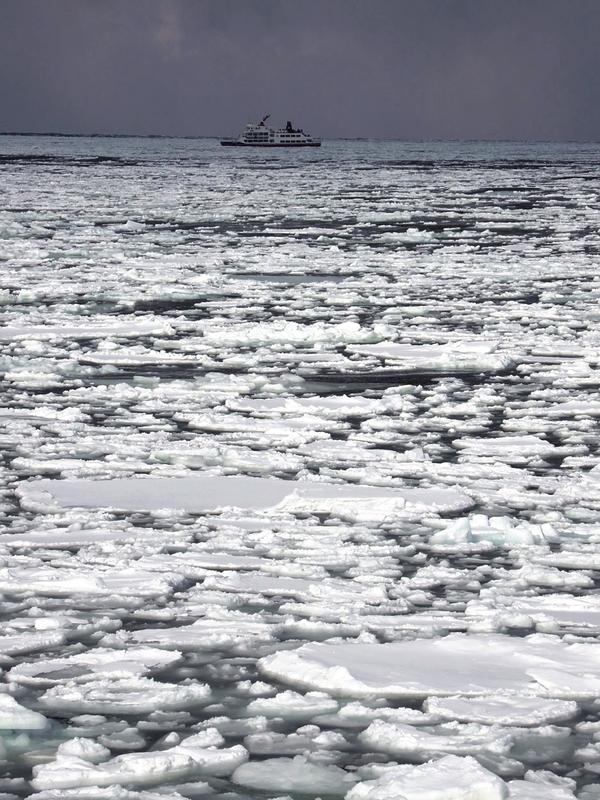
Hokkaido will have only a 50% chance of seeing drift ice if global warming continues and winter temperatures along the Sea of Okhotsk rise 2 C to 4 C higher than current levels, a climate researcher has said in compiling the results of his team's studies.
"Warming is progressing faster than expected and drift ice is now 'an endangered species,'" said Shuhei Takahashi, director of the Okhotsk Sea Ice Museum of Hokkaido based in Mombetsu, Hokkaido.
Drift ice forms along the Siberian coast of Russia and the eastern shore of Sakhalin island, then travels south on the ocean currents to Hokkaido.
Takahashi and his team analyzed the data on ice floes and average temperatures taken by the Japan Coast Guard and the Meteorological Agency annually between January and March over a 15-year period through 2009 at four locations along the Sea of Okhotsk, including Abashiri and Mombetsu. They found that the higher the temperature, the less the amount of drift ice.
The group deduced that if temperatures rise 2.1 C in the town of Esashi, located on the northern section of the coast, and 4.1 C in the town of Shari, located farther south, the drift ice will melt as it heads south. The probability of the drift ice not reaching Hokkaido at all is estimated at 50%, which would put it on pace of being seen only once every two years. If temperatures rise 1 C to 2 C further, the drift ice can be expected to stop arriving almost entirely.
According to the Sapporo Regional Headquarters of Japan Meteorological Observatory, the average winter temperature in Abashiri between December and February has risen 1.3 C every 100 years. An observatory analysis shows that temperature could rise an additional 5.7 C to 8.1 C by the end of this century if countermeasures for global warming are not effective.
In Abashiri, scientific observations began in 1959 and, with the exception of 1989, drift ice has arrived at the shore every year. According to research by Takahashi and his team, drift ice may disappear from the waters off Hokkaido by the end of this century.
"If the drift ice does not arrive, it will have an big impact not only local economies because of the effect on tourism and other sectors, but also on the ecosystem because plankton that is so vital to the ocean food chain will not be transported," Takahashi warned.
Meanwhile, Mombetsu announced on Saturday that it observed the first day of drift ice arrival, noting that it was four days earlier than last year and two days later than the average.
Read more from The Japan News at https://japannews.yomiuri.co.jp/