As the world moves into 2019, there is a consensus that the roughly seven-decade-old rules-based liberal international order no longer works. Either it has to be fundamentally revamped to suit new realities and the international distribution of power and wealth, or it will be increasingly violated and marginalised. In a remarkable parallel, Thailand's hitherto political order that lasted about seven decades also requires adjustment and recalibration.
While what happens outside is largely beyond Thailand's control, what happens at home can be negotiated, brokered, and accommodated. Thailand so far in the 21st century has been volatile and unstable but there is a window of potential adjustment now that could reach a new workable balance in the medium term after tension and turmoil next year emanating from a problematic constitution and the military's crooked designs to stay in power after the Feb 24 poll.
TThitinan Pongsudhirak teaches at Chulalongkorn University's faculty of political science and directs its Institute of Security and International Studies. This article is adapted from his keynote address, entitled 'A Seven-Decade Itch: Global Unravel and the Thai Reset', to the annual Oxford-Cambridge dinner earlier this week.
Seemingly in all directions, the international order as we know it is unravelling. Just two decades ago, Europe appeared as though it was going to defy history by following a linear path of integration towards a complete political and economic union. From the Treaty of Rome to the Maastricht Treaty, the spectre of a United States of Europe seemed imminent not long ago. European integration was supposed to be the crowning achievement and pinnacle post-World War II.
In addition to European integration, a rules-based international order also relied on international institutions and agencies from the United Nations, the World Trade Organisation (preceded by the General Agreement on Tariffs and Trade), the International Monetary Fund, the World Bank, and so on. World trade expanded from successive rounds of trade negotiations and liberalisation. In the financial system, there were periodic crises, such as the US abandonment of the gold standard in 1971 and its far-reaching consequences, but the IMF and central banks were an adequate global monetary coordinator at the time when technology and financial markets could still be regulated.
Fast forward roughly seven decades, and we see fragmentation, de-integration and de-globalisation. In June 2016, the United Kingdom decided to leave the European Union through a referendum. A string of far-right populist leaders bent against openness and the free flow of trade, money and people have been on the rise in certain European countries. The US-led and Western-supported wars in Afghanistan, Iraq, and Syria have produced millions of refugees and asylum seekers who, through geography, end up on European borders.
In the US, the country that underwrote much of the rules-based postwar international order, there is a prevailing sentiment for what we might call "payback time." President Donald Trump may just be a symptom of a trend where the Americans are fed up with shouldering the international system for so long and now wanting something in return. In the 1980s, there was a Republican presidential candidate named Pat Buchanan, who espoused a similar line of unilateralism and mercantilism. It has just taken the Trump camp 30 years to win power. When America no longer supports an international system which it instrumentally organised and underwrote, the future is dim.
Add to this global unravel the rise of the "rest" of the non-Western world. The countries that were emerging are now emergent. Chief among them is China. In 1980, China's GDP in purchasing power parity was just 15% of the US, but by 2015 China had overtaken the US in PPP terms. Other powers are also up and coming, including India, Indonesia, Australia, South Korea. On a good day, Thailand would be counted as a middle power but this country has not had a good day for more than a decade.
The upshot is that the international system no longer fits the distribution of power and wealth among constituent states within it. Some countries need bigger roles and more space, while others who used to be big should act smaller. What is worrisome is that, while this global unravelling unfolds, there is no backstop to it. From the US-China trade war and the South China Sea to the East China Sea and the Korean Peninsula, tensions are up but mechanisms and institutions to manage and mitigate them are down. This is an area where Asean can gain some leverage. Just when it appears weak due to internal divisions, Asean is needed more now than ever as the buffer, broker and bridge among the major powers.
The seven decades of the rules-based international system that worked so well neatly coincided with Thailand's 9th Reign from 1946-2016. During the 9th Reign, Thailand did very well compared to other countries in the region and beyond on two grounds. First, it kept communism away. Let us not forget the threat and dangerous utopia of communism, with a repressive, violent ideology. It sounded good but it turned out bad.
In keeping communism at bay, the Ninth Reign came to rely on the military, the monarchy and bureaucracy as the main organising institutions at home. This period featured a long military dictatorship from 1947 to 1973 and intermittent military rule in different shades mostly since. The end of the Cold War and the end of communism as a proselytising ideology undermined military-authoritarianism. This is why the international community generally favours human rights, democracy and elections.
The second ground that stood Thailand apart from other parts of Asia ravaged by war and conflict was economic development. Somehow from the 1960s to the 1990s, Thai economic development proceeded apace at a relatively fast pace. But this development sowed the seeds of future challenges. As people had more information, education and income, they wanted more of a voice and representation. These popular demands on the development and rising income side coincided with the end of the Cold War. With no communists to fight and with people wanting more in terms of voice and presentation, Thailand had to find an electoral system suiting a kind of democratic rule that could be brokered among old and newer political forces. It has not been able to do so.
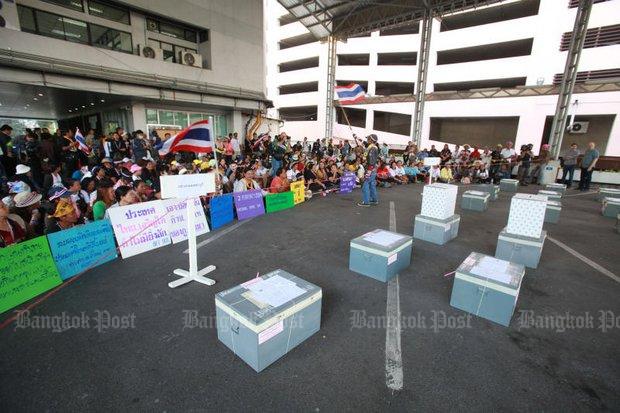
The past 13 years, in fact, show Thailand's inability and unwillingness to find a compromise through voice and representation. It has been all about having elections and ejecting elected governments, only to end up with more elections. The Ninth Reign that remarkably lasted seven decades was so glorious for keeping Thailand away from communism and for enabling economic development. Yet the twilight of the reign was marred by societal polarisation, street protests, mayhem, turmoil, violence.
The window of adjustment for Thailand is that the kind of instability associated with the twilight of the Ninth Reign may well not be recurrent under the 10th Reign. There could be a more level playing field in the offing because the monarchy may now be situated in a less coded place where colours have no role. In this way, it is possible that a kind of a Thai political reset could be under way in the medium- and longer-term after some tension and turmoil next year. In turn, the Thai reset can prepare Thailand for the coming global headwinds, as the international system is likely to become more volatile and unsettled in a circular historical pattern that many once thought was avoidable.