
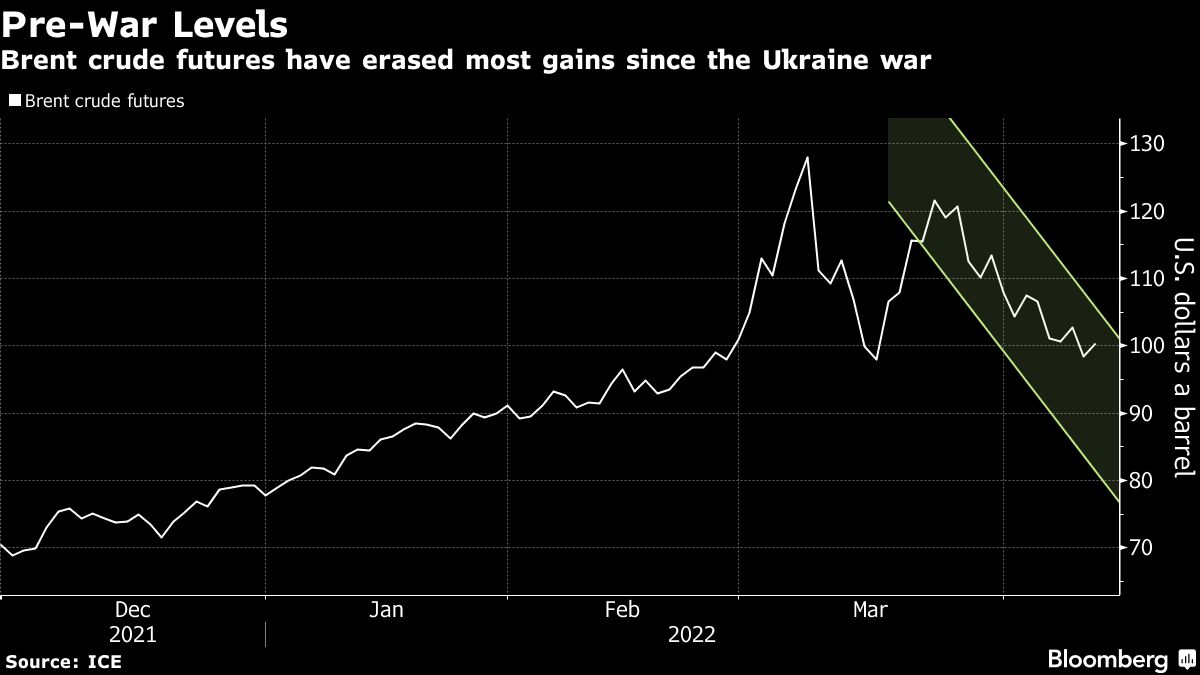
Global crude markets have swung from chaos to calm in just a few weeks as frenzied trading and a run-up in prices triggered by Russia’s invasion of Ukraine gives way to a return to more normal conditions.
The shift can be seen in everything from a roller-coaster ride in futures to big fluctuations in spot differentials, which ballooned when the crisis erupted, then narrowed. The premiums for varieties from the Middle East to West Africa have come back down as some Russian flows continue, a virus outbreak hurts Chinese demand, and the U.S. and allies tapped stockpiles, traders said.
The world’s most important commodity hit almost $140 a barrel in early March as the war stoked concern the OPEC+ producer would be unable to deliver any cargoes. That didn’t happen as a dependent Europe continued to take barrels of Russia’s Urals crude, and more flows got snapped up in Asia. At the same time, the U.S. and its allies agreed to deliver an unprecedented release of strategic reserves, dragging prices back toward $100.
“Physical prices have suffered,” said Giovanni Staunovo, a commodity analyst at UBS Group AG’s global wealth-management unit, citing Russian exports not falling as some expected and releases of reserves. In addition, there’s been weaker demand in China and Russia on mobility curbs and sanctions, he said.
Spot differentials for the many grades pumped from the world’s far-flung fields are one of the physical market’s key metrics, reflecting the additional amount, or discount, traders pay compared with regional benchmarks. As calm has returned, the premium for Abu Dhabi’s Murban has sunk by as much as $10 a barrel on-month, while Upper Zakum’s fell by over $4 a barrel, traders said.

Beyond subsiding concern over Ukraine, China’s virus outbreak has been a factor, too. With lockdowns hurting demand in the biggest importer, refiners haven’t had much appetite for spot purchases, traders said. That’s been a core part of what’s driven the plunge in differentials even as refining margins -- especially for diesel -- have remained elevated, they added.
Light, sweet crude grades in Europe have also shown signs of weakness even with firm processing margins. North Sea’s Forties dropped to a discount of 70 cents a barrels against the Dated Brent benchmark on Friday on a pricing window run by S&P Global Platts. That’s the lowest in 23 months. Just a month earlier, it was at a premium of more than $3 a barrel.
While Russian oil will be shut out from the U.S. and the U.K. over time, the nation’s crude hasn’t yet been officially sanctioned by the European Union, so there’s no legal impediment in the bloc from its import and use.
West Africa has seen a similar pattern in pricing. Djeno crude from Congo for April loading was sold $2 a barrel lower than earlier in the monthly trading cycle as Chinese demand was muted, according to traders. China, India and Europe are the three biggest customers of oil from the region.
©2022 Bloomberg L.P.