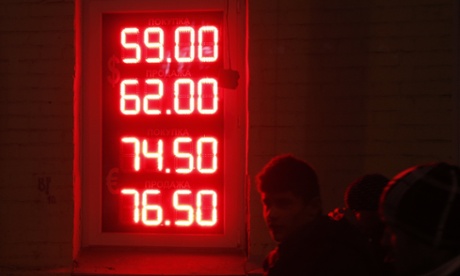
Afternoon summary: Rouble tumbles, markets slide, Belgium strikes
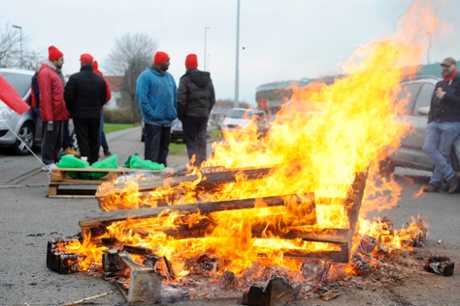
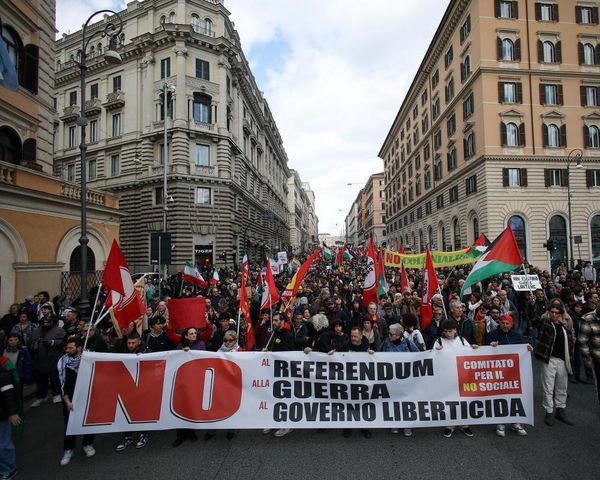
Belgium has been hit by one of the biggest strikes in years, as European protests against austerity pick up pace.
Flights and train services have been cancelled, while schools and government offices were shut, as unions protested against plans to raise the retirement age, cut services and cancel a regular pay increase. Coverage starts here
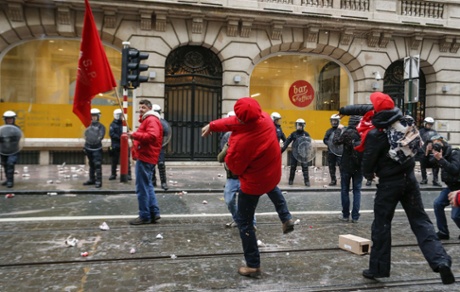
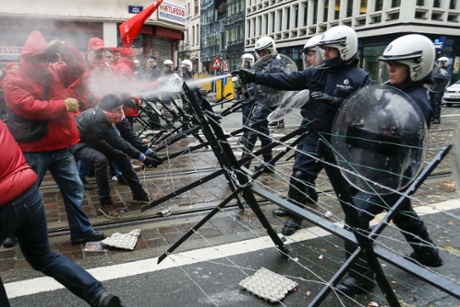
Strikers blockaged roads from dawn, and there have been clashes with riot police in the capital today (photos).
Marie-Helene Ska, the head of the Christian CSC union, declared:
“There has never been a strike this strong,”
Full story: Belgium cut off from world by national strike
Russia’s economic crisis has deepened, as the rouble crashed to record lows agains the US dollar (see here onwards).
The selloff forced the Russian central bank to intervene in the markets again, traders say, after last week’s interest rate rise failed to calm the situation.
Yes, yes, too many ruble charts on here today. But this monthly chart is a peach. pic.twitter.com/vUxUxolThw
— Katie Martin (@katie_martin_FX) December 15, 2014
But in late trading, the rouble is down over 9% at 63.8 to the $1.
The scale of the slump could prompt the Kremlin into capital controls, analysts believe.
Fears over companies’ ability to service their debts hit corporate bond prices today, and wiped over 6% off the RTS index of leading shares. Details here
Stock markets have been volatile – Asian markets hit a nine-month low, while a late selloff in Europe wiped another 118 points off the FTSE 100.
European Closing Prices: #FTSE 6182.72 -117.91 #DAX 9334.01 -260.72 #CAC 4005.38 -103.55 #MIB 18078.97 -521.86 #IBEX 9903.9 -241.10
— IGSquawk (@IGSquawk) December 15, 2014
Thailand, meanwhile, suffered a remarkable tumble and rebound:
RT @TheStalwart: Crazy session in Thailand. Market totally crashed at one point, then came back. pic.twitter.com/YfAZbHzhkR
— Joe Bond (@Joe_Trading) December 15, 2014
And over in Greece, EC commissioner Pierre Moscovici has been meeting with the prime minister to discuss the road ahead.
In #Athens, discussing with Antonis Samarás @PrimeministerGR Greece's reforms for economic growth and jobs pic.twitter.com/uoifT58mtn
— Pierre Moscovici (@pierremoscovici) December 15, 2014
The latest opinion poll has shown Samaras’s New Democracy party lagging behind the left-wing Syriza, but the gap is narrowing....
And in the UK.... a fare-dodging fund manager has been banned from the City, and the former boss of JJB Sports has been jailed for four years for fraud.
It looks like the FTSE 100 just set its lowest close of the year:
#FTSE100 down 118 points at new 2014 CLOSING LOW of 6182.72. Has fallen 559 points (8.3%) in last 6 days. GRIM DECEMBER
— Equity Development (@equity_research) December 15, 2014
European markets suffer another day of falls
Fears over the state of the world economy, Russia’s deepening currency crisis and the weakening oil price have combined to send European markets deep into the red tonight.
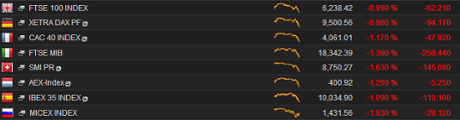
The FTSE just closed down 117 points at 6182, a decline of 1.89%.
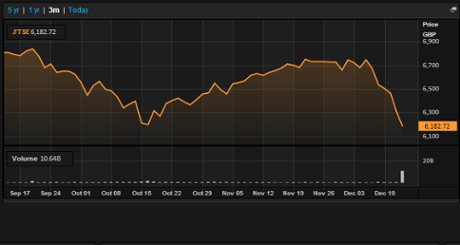
After an early rally this morning, the Footsie ended up taking another kicking to add to last week’s selloff.
Chris Beauchamp, market analyst at IG says the traditional pre-Christmas rally has been cancelled.
We’re evidently still in a ‘sell the rally’ kind of mode.
Santa rallies might be the norm, but blindly rushing is a bad idea at any time of the year and there will be a few overeager buyers nursing losses this afternoon.
There were even deeper falls across Europe; Germany’s DAX shed 2.7%, France’s CAC fell 2.5%, Italy’s FTSE MIB dropped 2.8%.
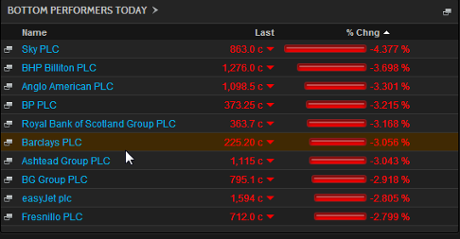
Energy and mining companies led the selloff in London, reflecting concerns about global growth and the decline in the oil price this afternoon (Brent crude is now down 1% tonight at $61.36/barrel).
Updated
The rouble isn’t the only currency in trouble – the Turkish lira has hit an 11-month low.
This follows the arrest of 23 people yesterday, including journalists, producers, scriptwriters, directors, police officers and two former police chiefs.
Europe’s markets are a sea of electronic red as trading grinds to a close.
Rouble down 7.5%!
The rouble has now suffered a staggering selloff, down around 7% against the US dollar.
That’s an astounding drop for a currency.
USDRUB > 63 - RUB drop of over 7.5%
— Steve Collins (@TradeDesk_Steve) December 15, 2014
The declines deepened after the Russian central bank warned of a deeper recession, with higher inflation, if the oil price does not recover.
Updated
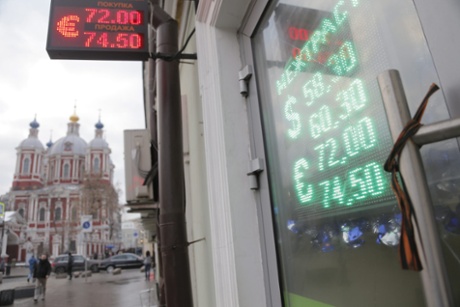
The slump in the rouble is likely to have prompted Moscow insiders to ponder implementing capital controls to stop capital fleeing the country.
Neil Shearing, analyst at Capital Economics, reckons that Kremlin hardliners are pushing for controls:
There is already a growing debate within some circles of government over the merits of a more isolationist model of economic development. Some commentators have argued that, in the extreme, capital controls could be accompanied by a restructuring (i.e. default) of external debts by major quasi-public enterprises.
Shearing reckons Russia could impose “low-level” capital controls, such as forcing Russian companies to convert half of their export revenue into roubles.
But a widescale clampdown on the movement of money is unlikely, for three reasons:
First, controls to prevent outflows have a history of being porous. If money wants to get out, it tends to find a way......
Second, legislation to compel a certain proportion of export receipts to be switched into rubles is likely to have limited impact, since we suspect that most revenues are already switched into local currency. Around two-thirds of exports are oil and related products and high marginal tax rates on these sectors mean that most revenues are switched into rubles in order to pay the government.
Finally, the imposition of capital controls would eliminate any remaining credibility that Russia has in international markets. Admittedly, credibility is already in short supply. But it is wrong to assume that all investment into Russia has now been cut off – inflows of FDI totalled $24bn in the first half of this year.
More fundamentally, with lower oil prices having eroded the current account surplus, Russia will need to attract increasingly large inflows of foreign financing to fund investment and thus growth over the long-run.
So, capital controls would inflict substantial long-run pain, Shearing concludes....
Updated
The selloff in the rouble is accelerating - it’s just hit 62 to the dollar, a new record, down from the 58/$1 on Friday night.
RUBLE!! pic.twitter.com/of2zgjOPnt
— Joseph Weisenthal (@TheStalwart) December 15, 2014
It’s taken a while, but Europe’s stock markets are finally showing the sort of losses we were predicting before dawn broke over the City eight hours ago.
The FTSE 100 is down 45 points, or 0.7%, and the French CAC and German DAC are showing similar falls.
The unexpected rally in energy stocks has petered out, and that’s because the oil price has now surrendered today’s gains. Brent crude is flat, and US crude is down 1% at $57.17 per barrel.
The Russian central bank has warned that next year’s recession will be deeper than feared, unless the oil price recovers, reports Reuters:
- RUSSIAN CENTRAL BANK SAYS ECONOMY COULD CONTRACT BY AROUND 4.5% IN 2015 IF OIL PRICES ARE AT $60 A BARREL - DOCUMENT
Updated
Better economic news from America: industrial output across the country rose by 1.3% last month, the biggest rise in over four years.
Industrial production surges 1.3% in November http://t.co/lYHlMio2d4
— MarketWatch (@MarketWatch) December 15, 2014
That’s a remarkable contrast with the disappointing Empire state survey 45 minutes ago, which showed a slowdown this month.
The slump in the rouble has sparked a sell-off on the Moscow stock exchange.
The RTS index (priced in dollars), has tumbled by 6.6% today, to its lowest level in over five years:
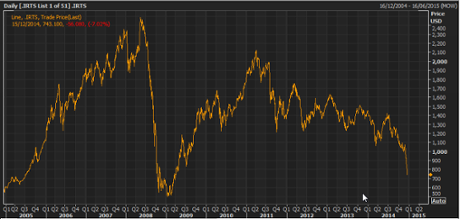
Concern is swirling that the weakening ruble will wreck havoc on the Russian economy, which is heading into recession.
Russian corporate bonds have also fallen sharply today, reflecting fears that firms will struggle to repay debt priced in dollars.
Back to Belgium, and photos of clashes between union members and riot police in Brussels have landed:
US manufacturing survey misses forecasts

Breaking: America’s factory sector has suffered an unexpected setback.
The closely-watched US Empire manufacturing survey showed a drop in activity, new orders index and shipments in December.
This dragged the Empire index down to -3.6, the first negative reading of this year. This is going to raise new fears about the state of the US economy, and beyond.
European stock markets have already reacted - the FTSE 100 is now down 11 points, as this morning’s surprise rally fades
Ouch! RT @IGSquawk US Empire manufacturing (Nov) -3.58 vs 12.0 exp. AB
— Shaun Richards (@notayesmansecon) December 15, 2014
#NYEmpireSurvey slides into the deepfreeze in December on broad-based weakness
— Carl Riccadonna (@Riccanomix) December 15, 2014
Updated
And speaking of Greece, the latest opinion polls show that the opposition left-wing Syriza party’s lead has narrowed, to just over 3%.
Syriza had held a five-point lead, before the government raised the prospect of early general election by rushing forward the vote to elect Greece’s next president to this month.
#Greece MRB poll: Syriza 24.2, ND 21, To Potami 5.7, Pasok 5.5, KKE 5, GolDawn 4.5, IndGreeks 2.8, Antarsya 1.8, DIMAR 1.5, undecided 21.4
— Efthimia Efthimiou (@EfiEfthimiou) December 15, 2014
Over in Athens, European Commissioner Pierre Moscovici has arrived for talks with the prime minister, Antonis Samaras.
So @pierremoscovici a bit late to meeting w/#Samaras, but smiles all around. #Athens pic.twitter.com/d83M9EzP5S
— Peter Spiegel (@SpiegelPeter) December 15, 2014
As explained this morning (8.04am), Moscovici’s visit has been attacked by opposition politicians, who aren’t convinced that the former French finance minister is really here to show solidarity.
Here’s a Christmas party game: Spot the emergency intervention....
Russian Ruble Intraday: pic.twitter.com/aRGTKqYYx2
— Michael McDonough (@M_McDonough) December 15, 2014
The fall in the value of the rouble is turning into a rout; it just hit a record low of 61 (!) roubles to the US dollar as fears swirl over the stability of the Russian economy.
But then it bounced back - perhaps an intervention by the Central Bank?
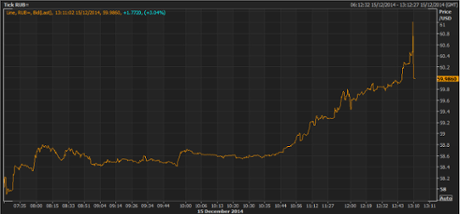
This Reuters newsflash that it was clamping down on certain market speculation may have also calmed the situation:
RUSSIAN CENTRAL BANK SAYS HAS SENT ORDER TO MOSCOW EXCHANGE TO HALT TRADING IN CERTAIN INSTRUMENTS TO PREVENT POSSIBLE MANIPULATION OF EQUITY FUTURES MARKET
Updated
This chart shows how the rouble is poised to overtake the yen as the worst-performing currency of 2014:
#Russia's #ruble well on track to become the world's ugliest currency of 2014, beating #Ukraine pic.twitter.com/5OTzsnPf8y
— jeroen blokland (@jsblokland) December 15, 2014
One US dollar now buys 60 roubles
POP. The rouble has just hit another unenviable milestone - sliding to 60 to the US dollar for the first time ever.
RUBLE WEAKENS BEYOND 60 VS DOLLAR FOR FIRST TIME ON RECORD ^KB #FX #Russia
— FOREX.com (@FOREXcom) December 15, 2014
BREAKING: USDRUB RISES ABOVE 60 pic.twitter.com/YefzqrCPDR
— Joseph Weisenthal (@TheStalwart) December 15, 2014
Just a number, of course, so nothing to get too excited about. It’s the broad trend that is important. The rouble is down another 3% today.
The Wall Street Journal’s Moscow bureau chief is also struck that the rouble hasn’t felt any benefit from the rising oil price today.
Ruble's troubles today all the more striking since oil is actually up a bit (Brent $63) but ruble down to 59.9/$
— greg white (@whitegl) December 15, 2014
Clearly last week’s interest rate hike, from 9.5% to 10.5%, hasn’t restored any confidence in the rouble.
The ruble’s on the cusp of hitting the 60/$1 mark....
59.9!
— Joseph Weisenthal (@TheStalwart) December 15, 2014
Back in the markets, the Russian rouble is racking up fresh record lows.
It has lost more than 2% today to hit 59.7 roubles to the US dollar, its weakest rate on record.
As flagged up earlier, the prospect of America imposing tougher sanctions is hurting the rouble.
Moscow must be worried that the rouble has not benefitted from the recovery in the oil price this morning.
Rouble/$ and Brent crude now heading for rendezvous at 60? pic.twitter.com/jikJiVmqog
— Mike Dolan (@reutersMikeD) December 15, 2014
On 1 March 2013, £1 was 46.2 roubles. Today it is exactly double that: 92.4 roubles.
— Shaun Walker (@shaunwalker7) December 15, 2014
Biggest strike in years in Belgium
AFP have filed a good take on today’s protests in Belgium:
Belgium cut off from world by national strike
Belgium ground to a halt in its biggest strike in years Monday as trade unions grounded flights, cut international rail links and shut sea ports to protest the new government’s austerity plans.
In the climax to a month of industrial action against new Prime Minister Charles Michel’s policies, striking workers stopped all public transport while most schools, businesses and government offices shut down.
Pickets also blocked traffic outside the Brussels headquarters of the European Union, a 28-nation bloc that has seen years of protests against austerity aimed at cutting debts that threatened the euro currency.
The Belgian strike came days after a day of protest in Italy against Prime Minister Matteo Renzi’s ambitious reform plans, while there have been similar demonstrations in Spain and Greece in recent months.
“There has never been a strike this strong,” Marie-Helene Ska, the head of the Christian CSC union, was quoted as saying by the Belga news agency.
Belgian trade unions launched their movement last month with a march of more than 100,000 people in Brussels, which ended in violent protests that left dozens of police officers injured.
- PM won’t budge -
Unions went ahead with Monday’s general strike after premier Michel’s right-of-centre government refused to budge on plans to save €11bn ($13.7bn) over five years.
His coalition, which took office in October, intends to raise the retirement age from 65 to 67 from 2030, scrap plans for a usually automatic cost-of-living raise next year and introduce public sector cutbacks.
French-speaking Michel - who at 38 is Belgium’s youngest prime minister since 1840 - heads a coalition of three Flemish-speaking right-leaning parties and his own Francophone liberals.
The government formed five months after elections had hoped to calm a nation deeply divided between the richer Flanders and the poorer French-speaking Wallonia, but instead has led to weeks of industrial action.
The last national strike in Belgium was in 2012 against the government of socialist prime minister Elio di Rupo.
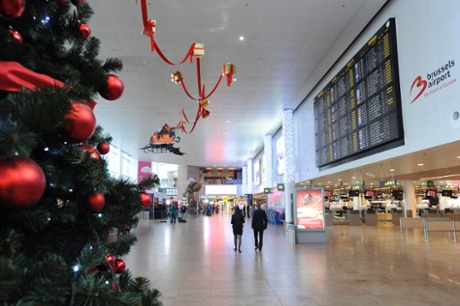
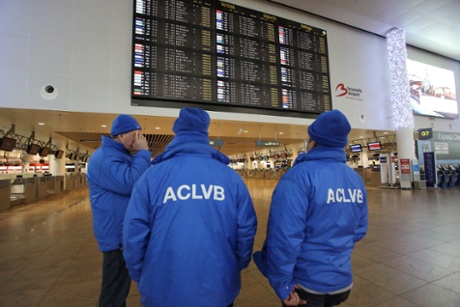
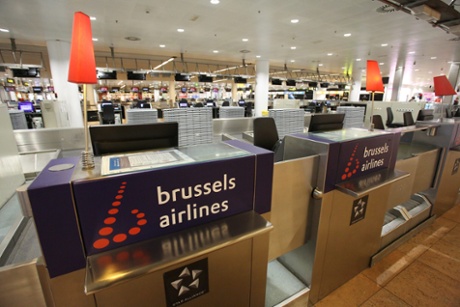
Belgian airspace was closed after air traffic controllers joined the strike, preventing flights from landing or taking off from airports in Brussels, Charleroi, Liege, Antwerp and Ostend for 24 hours from 2100 GMT Sunday.
Some 50,000 passengers have been affected as a total of 600 incoming and outgoing flights have been cancelled at Brussels international airport, spokeswoman Florence Muls said.
- ‘A real disaster’ -
“All flights are cancelled. Everything is immobilised,” Muls told AFP, adding that it had affected some travellers trying to get away early for the Christmas holidays.
“It’s a real disaster” for the airports and passengers, Jean-Jacques Cloquet, managing director of Charleroi said on the RTBF news website, adding there would be a knock-on effect during the busy holiday period.
Eurostar rail services from Brussels to the British capital London and trains to the French capital Paris, Amsterdam in the Netherlands and the German city of Cologne have also been halted until early Tuesday.
Belgian rail SNCB said domestic inter-city train services were cancelled and trams, buses and metro services were all cancelled, leading many people to take the day off work and stay home.
The strike is also likely to affect post offices and rubbish collections, prisons and the courts.
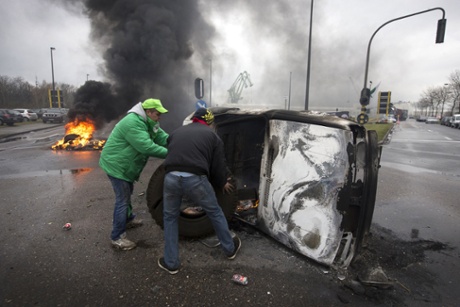
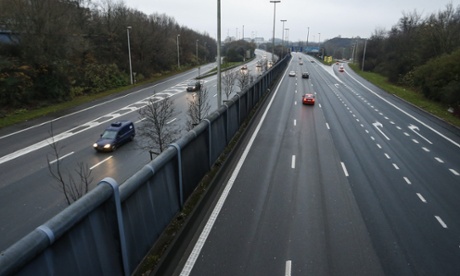
Protesters erected road barriers that snarled traffic in Brussels and other cities, and could be seen warming their hands by flaming braziers while brandishing banners and handing out leaflets.
Union leader Ska denied that they wanted to bring down the government.
“The government was elected democratically. We do not challenge it at all,” Ska said on Belgian television.
“What we want is to know where Belgium will be in five years on social matters.”
A former fund manager at investment management firm BlackRock has been shunted out of the City, for fare-dodging.
The Financial Conduct Authority has ruled that Jonathan Paul Burrows failed its “fit and proper” test, meaning he is banned from performing any regulated activities.
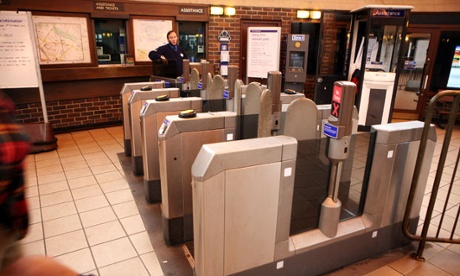
In November 2013 Burrows was caught at Cannon Street Station without a valid purchase for his journey from East Sussex. He admitted evading his rail fares on a number of occasions, the FCA says.
Tracey McDermott, the FCA’s Director of Enforcement and Financial Crime, said such behaviour can’t be tolerated:
“Burrows held a senior position within the financial services industry. His conduct fell short of the standards we expect. Approved persons must act with honesty and integrity at all times and, where they do not, we will take action.”
Burrows was able to avoid the full fare because his East Sussex station didn’t have a ticket gate, and he could ‘tap out’ at Cannon Street using an Oyster card - paying £7.20 rather than £21.50. Which adds up, after a while....
The FCA has banned the former Blackrock Asset Management Managing Director. Paul Burrows evaded £43,000 of train fares over a 5 year period
— Guy Harding (@GuyHardingSky) December 15, 2014
Today’s general strike has left Eurostar unable to run services to Brussels - passengers can only travel between London and Lille today.
European markets rally, lead by oil
Back in the financial markets, the oil price is staging a decent recovery...and dragging European markets up with it.
Brent crude has gained almost 2%, or $1.12 per barrel this morning, reversing some of its whopping losses since September.
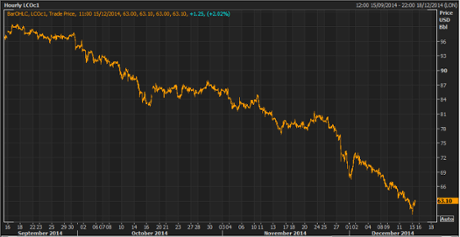
The rare sight of crude oil going UP has sent investors racing to buy shares in energy companies.
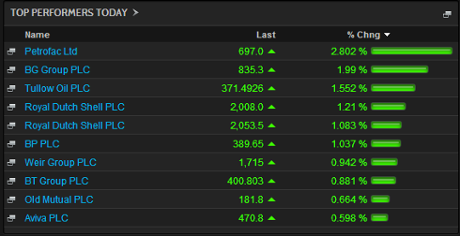
Tullow Oil have jumped 5%, BG Group and Weir Group are up 3%, and Royal Dutch Shell has gained 2.5%.
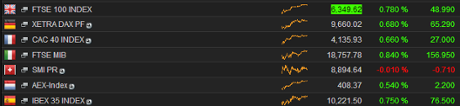
This has sent the FTSE 100 up by 50 points, dashing those fears that we might see another selloff.
Tamas Varga, energy analyst at London brokerage PVM Oil Associates, reckons there’s some speculative buying after last week’s slide:
“The market may just have moved down too far too quickly today,”
Last week, the falling oil price helped to wipe 342 points off the FTSE 100 last week, so some optimism is overdue.
Most other European markets are showing gains today:
Today’s Belgium strike comes just three days after a big anti-austerity protest in Italy, and a pick-up in demonstrations in Greece recently. European unrest is on the rise.
General strike in Belgium today over govt austerity measures, huge strikes in Italy on Friday. Tension in Europe ratcheting up again.
— Dominic Smith (@domsmithy89) December 15, 2014
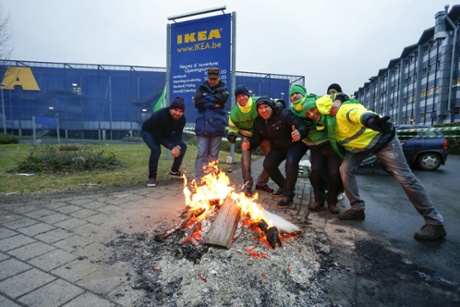
With the mercury bobbing around 5°C, and rain in the air, it’s not the best day to be demonstrating in Belgium.
These strikers outside an IKEA store in the municipality of Sint Pieters Leeuw have knocked up a small fire to keep warm (not burning IKEA stock, we trust)
Frazer Goodwin, senior advocacy adviser at Save the Children’s EU Office in Brussels, reports that the roads are unusually quiet:
@graemewearden Very few cars on the road this morning for my bike to work - felt like a Sunday!
— Frazer Goodwin (@FrazerGoodwin) December 15, 2014
Photos: Belgium hit by general strike
Today’s general strike in Belgium is expected to be the biggest in years.
Unions are ratcheting up the pressure on prime minister Charles Michel by taking the country’s infrastructure offline for a day, starting at 10pm last night.
As these photos show, demonstrators were out in force before dawn broke:
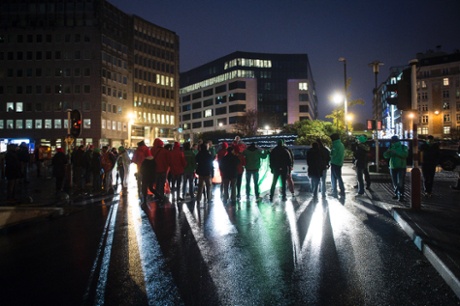
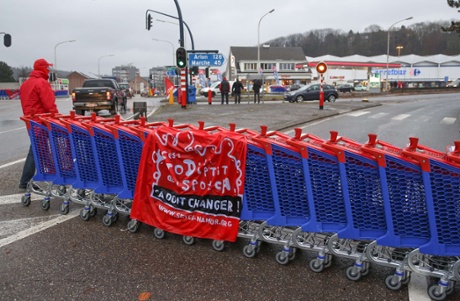
#Belgium grinds to a halt as 24h general strike kicks in at 22h00, Sunday. No public transport, no flights, no schools, no administration.
— Konsiczky Zoltán (@KonsiczkyZ) December 15, 2014
#Belgium hit by national strike: http://t.co/vmnC8ZkXCA -video
— Alberto Allen (@albertoallen) December 15, 2014
Austerity protests bring Belgium to a standstill
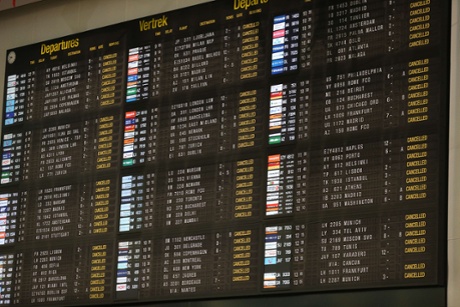
European anger over austerity is on display in Belgium today, where workers are holding a massive general strike.
Air and rail services, schools, businesses and government offices are all affected as unions show their opposition to the government’s budget for 2015.
Around 600 flights are expected to be cancelled; the managing director of Brussels Charleroi Airport has called it a “real disaster”.
Thousands of hospital operations have been cancelled. There are reports that some motorways could be blockaded – something business groups have said would be unacceptable.
Unions are protesting against the Belgium government’s plans to save money by scrapping a cost-of-living increase next year, raising the retirement age from 65 to 67, and cutting social services.
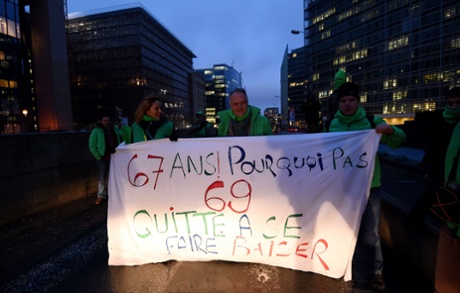
Those austerity measures are meant to help Belgium hit the deficit targets demanded by the European Commission.
Protestors are also targeting the EC’s offices in Brussels.
Schuman (EU quarters) is beeing blocked at the start of #Belgium national #strike pic.twitter.com/ssRtv7KAW9
— Wiktor Dabkowski (@Brussels_PJ) December 15, 2014
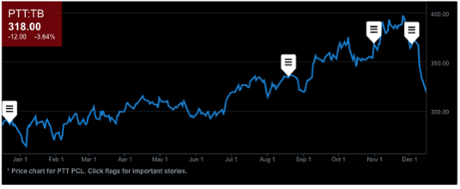
There are some huge losses on the Thai stock market today. Here’s the biggest fallers in today’s rout:
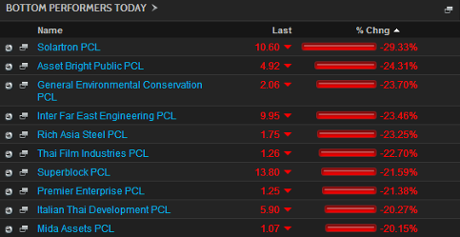
And Malaysia’s market is down 2%, also helping to pull Asian markets to a nine-month low today.
I am glad to say the equity futures market forecasted the opening of the European markets horribly wrong - FTSE +11 at 6311 at 8.35am
— David Buik (@truemagic68) December 15, 2014
Thailand stock market tumbles
Thailand’s stock market is suffering a huge fall today, the biggest since the collapse of Lehman Brothers six years ago.
Thai Stock Index Falls 7.5%, Set For Biggest Drop Since 2008
— Steve Collins (@TradeDesk_Steve) December 15, 2014
The selloff appears to be driven by a selloff in energy firms, and fears that valuations have simply got too high.
Bloomberg reports:
“Thai stocks have been hit by foreign selling as investors pull out from emerging markets,” said Mixo Das, an Asia ex-Japan equity strategist at Nomura Holdings Inc. in Singapore.
“A large listed oil-and-gas sector and expensive valuations relative to history are adding more pressure.”
Economists have been warning that money may flow out of emerging markets once the US Federal Reserve begins to tighten its very loose monetary policy (which had driven money into emerging economies in search of decent returns)
Quite a contrast with Europe, where the major markets are pretty flat at the open (so far....)
Updated
Rouble hits another record low
The Russian rouble has begun the week by shedding more value, as Moscow traders fear the impact of new Western sanctions.
The rouble fell 0.7% to a new record low, hitting 58.79 roubles to the US dollar.
Reuters explains why:
After Russian markets closed last week, the U.S. Congress passed a bill setting out tougher sanctions on Moscow and authorising the supply of military aid to Ukraine.
The bill “will be negative for market sentiment,” analysts at Sberbank investment research wrote in a note.
http://t.co/KFGoYKof1o *Russian Rouble Hits Record Low Of 58.69 Against U.S. Dollar http://t.co/As4d6EiJ87 #news #live #forex #trading
— Форекс Insta Forex (@instaforex_ws) December 15, 2014
Europe’s stock markets are open..... and shares are doing rather better than expected.
Energy stocks in London are staging a surprise recovery, helping to keep the main indices flat in early trading.
The FTSE 100’s list of top risers is dominated by oil firms:
And that’s because the crude oil price is, finally, staging a small rally.
Brent crude is up 0.7% today at $62.42 per barrel.
Commissioner Moscovici visiting Greece
Pierre Moscovici, Europe’s economic and financial affairs commissioner, is heading to Greece today for talks with the government.
He arrives in Athens two days before MPs hold the first ballot to elect (or more likely reject) a new president.
Moscovici has claimed he is showing ‘solidarity’ with Greece, telling the Kathimerini newspaper in an interview that:
I have always said that we need Greece in the eurozone and we need a strong Greece.
But his visit has angered the leader of the Syriza party, who fears EC officials are trying to subvert the democratic process.
Alexis Tsipras declared yesterday:
“An operation of terror, of lies, is underway...
An operation whose only aim is to sow terror among the Greek people and MPs, and to thrust the country ever deeper into the poverty and uncertainty of the memorandum [bailout agreement].
Full story: Greece election: EU finance chief flies into Athens as Grexit fears mount
I will be in Athens on Monday 15 and Tuesday 16: solidarity of the @EU_Commission with #Greece and its people http://t.co/FyyntkKcEO
— Pierre Moscovici (@pierremoscovici) December 13, 2014
IG predicts that the main European markets will fall by around 1% at the open, following Asia’s lead:
Their Stan Shamu says:
Greece will remain a main point of focus this week with the first round of presidential elections taking place on December 17. Given Greece was a big source of volatility last week, this should be a key event for fixed income and in turn the single currency and equities.
Here’s IG’s opening calls:
-
FTSE 100: down 61 points at 6240
-
German DAX: down 51 points at 9544
-
French CAC: down 36 points at 4073
-
Spanish IBEX: down 67 points at 10078
-
Italian MIB: down 61 points at 18540.
Updated
Asian markets hit nine-month low
Asian traders didn’t take much comfort from Japanese prime minister Shinzo Abe’s election win yesterday.
The main index of Asia-Pacific shares, calculated by MSCI, hit its lowest level since March at one point, with Japan’s Nikkei dropping by 1.6%.
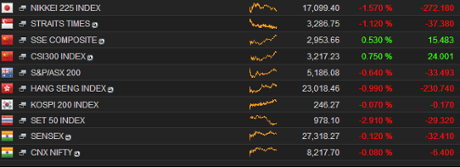
The selloff came after the oil price hit a new five-and-a-half year low at the start of trading (before rallying a little), underlining global growth concerns.
There was also gloom in Tokyo after the Bank of Japan’s Tankan survey showed that confidence among Japan’s big manufacturers worsened in the last three months.
Marcel Thieliant, Japan economist at Capital Economics, says:
“Today’s Tankan survey suggests that Japan’s economy stabilized in the fourth quarter, but a rapid recovery is not on the cards.”
Abe wins unnecessary #Japan election. Now he has renewed mandate, will he actually reform? I’m not optimistic.
— Robin Bew (@RobinBew) December 15, 2014
The agenda: Markets weighed down by fears
Good morning, and welcome to our rolling coverage of the financial markets, the world economy, business and finance.
It’s a new week, but the old fears that sparked the biggest decline in over two years last week haven’t abated.
European markets are expected to fall again this morning, with investors fretting about a range of issues. They include:
-
Greece’s political crisis, with presidential elections starting this week.
-
The oil price rout, and its impact on energy companies
- The eurozone’s stagnation, and uncertainty over
- The prospect of US interest rates rising in 2015, the US Federal Reserve could tweak its forward guidance on Wednesday.
- The state of the global economy, given recent disappointing data from China
- Japan’s prospects, now prime minister Shinzo Abe has won re-election
So, no excuse for party hats on the City trading floors.
Ian Williams, analyst at Peel Hunt, comments:
The final month of 2014 is proving much more eventful than investors expected, and not in a good way.
Last week saw a surge in volatility measures and a renewed flight to safe havens across most asset markets; a timely reminder, as the (primarily bullish) previews of the outlook for 2015 begin to emerge, that markets still face a wide range of economic and political challenges moving into the new year.
The European economic calendar is rather bare today, but we do get a survey of British factories this morning, and various US data this afternoon:
-
11am GMT: CBI industrial trends survey
-
1.30pm GMT: US New York Federal Reserve’s manufacturing survey
-
2.15pm GMT: US industrial output for November.
-
3pm GMT: US NAHB housing market index
I’ll be tracking all the main events through the day...