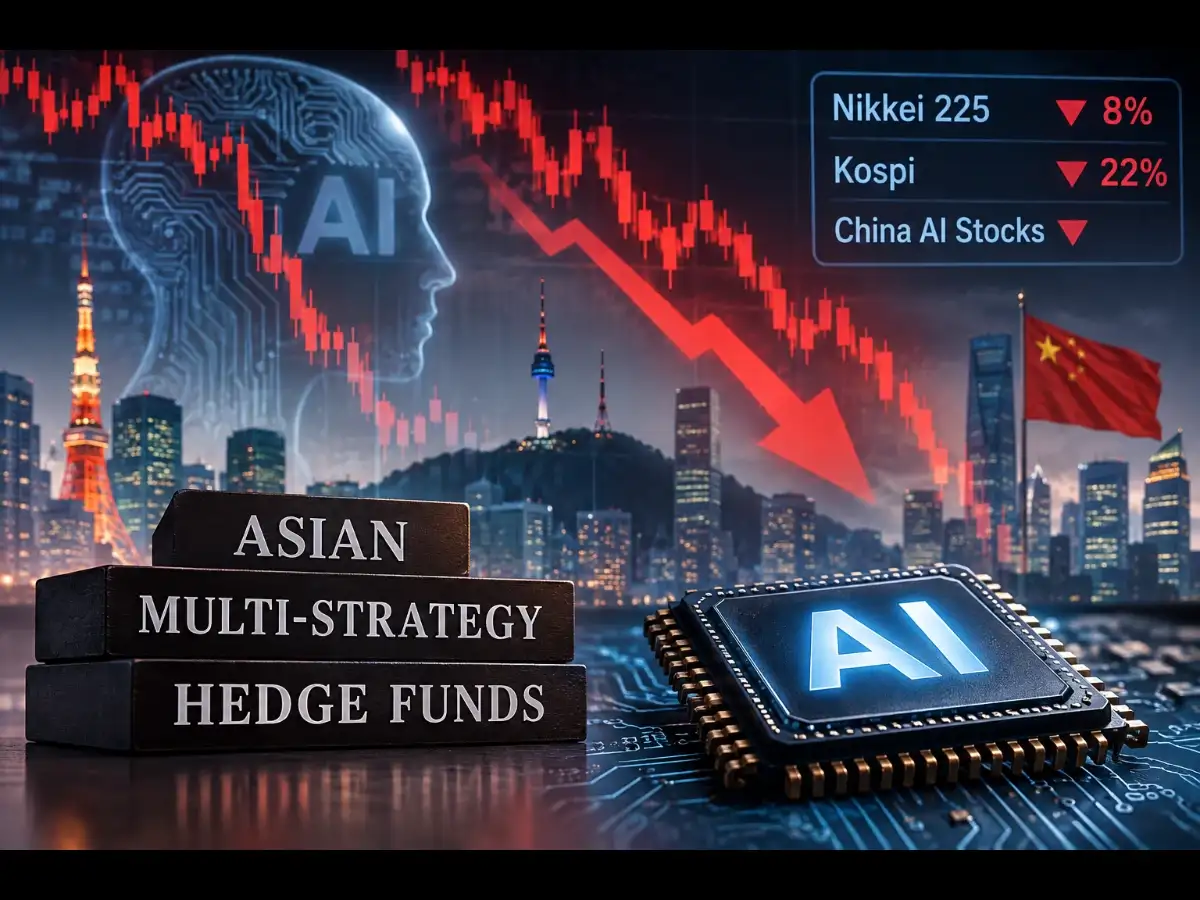
Some of Asia's largest multi-strategy hedge funds posted their steepest monthly losses of the year in July as a sharp selloff in artificial intelligence-linked stocks across Japan, South Korea and China wiped out gains built during the first half of 2026, according to Reuters, citing sources familiar with the funds' performance.
The decline came as investor sentiment towards AI-related companies weakened amid concerns over technology spending and rising geopolitical tensions in the Middle East. The resulting selloff in semiconductor stocks hit major Asian chipmakers, reversing one of the year's strongest investment themes.
AI winners turn into biggest drags
According to Reuters, positions that had driven strong returns earlier in the year became the primary source of losses in July. Semiconductor stocks, which had benefited from the global AI boom, came under intense pressure as investors reassessed earnings expectations and exposure to the sector.
Despite the setback, multi-strategy hedge funds generally outperformed the broader Asian hedge fund industry. Reuters reported that several of the region's largest platform funds recorded monthly declines ranging from 3% to 9%.
By comparison, Goldman Sachs estimated that Asia's primary stock-picking hedge funds lost an average of 15.2% during July, marking the worst monthly performance on record for the segment.
Why multi-strategy funds matter
Multi-strategy platform funds are designed to reduce volatility by allocating capital across multiple investment teams and asset classes, including equities, fixed income, macro strategies and commodities. Their diversified approach typically aims to generate steady returns with limited dependence on overall market direction.
As a result, investors consider a monthly loss exceeding 5% to be significant for these funds, highlighting the severity of July's market correction.
Polymer Capital sees strong annual gains narrow
Hong Kong-based Polymer Capital Management, one of Asia's top-performing multi-strategy funds during the first half of the year, was among those affected.
According to Reuters, the firm, which manages more than $6 billion in assets, lost 6.9% in July, reducing its year-to-date gain to 11.5%.
Sources told Reuters that part of the decline stemmed from the firm's equity exposure in Japan, where markets came under heavy selling pressure.
Regional markets face sharp declines
Asian equity markets endured steep losses during July.
South Korea's benchmark Kospi index plunged 22% over the month, while Japan's Nikkei 225 declined 8%, reflecting the broad retreat from technology and semiconductor shares.
The market weakness weighed on hedge funds with significant exposure to these regions.
Other major funds also report losses
Reuters reported that Singapore-based Dymon Asia's $9 billion multi-strategy fund fell 6.5% during July, trimming its gains for the January to July period to 7.5%.
Singapore-based Arrowpoint Investment Partners posted a comparatively modest decline of 2.6%, while Hong Kong-headquartered Pinpoint Asset Management's flagship multi-strategy fund fell 9% during the month, according to sources cited by Reuters.
Risk management helped limit losses
Arrowpoint's comparatively resilient performance was aided by a decision to reduce overall portfolio risk before the July market downturn.
According to Reuters, the firm identified signs of excessive leverage building across markets, particularly in South Korea and Taiwan. Sources said banks had become increasingly reluctant to provide additional leverage for certain positions, prompting the fund to lower exposure before volatility intensified.
That move helped cushion the fund's performance during one of the toughest months of the year for Asian hedge funds.
Divergence in performance may continue
Market participants told Reuters that performance differences across hedge funds are likely to persist as AI-driven market shifts and a prolonged high-interest-rate environment continue to create winners and losers.
Managers capable of adapting quickly to changing market conditions and controlling portfolio risk may be better positioned, while concentrated bets on technology and AI-related sectors could remain vulnerable to sharp swings in investor sentiment.