Editor’s note: This essay originally appeared in Innovation Matters, the first publication of Innovation Countdown 2030, a new PATH-led initiative to identify and showcase lifesaving innovations with great promise to transform global health by 2030.
A remarkable opportunity for global health transformation is now at our fingertips.
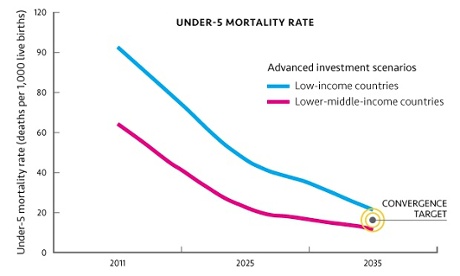
If we make the right health investments — to scale up existing health interventions and delivery systems and to develop and deliver new tools — we could see a “grand convergence” in global health within our lifetimes. Within one generation, we could reduce the rates of infectious, maternal, and child deaths in nearly all low and lower-middle-income countries down to the low levels seen today in richer countries like Turkey, Chile, and Costa Rica (Figure 1).
One in ten children in poor countries dies before his or her fifth birthday; by 2035, we could reduce that rate down to one in fifty. We could prevent 10 million maternal, child, and adult deaths each year from 2035 onward. But this grand convergence cannot be achieved without innovation to discover tomorrow’s disease control tools.
We had the privilege of serving as members of The Lancet Commission on Investing in Health, chaired by Lawrence Summers and Dean Jamison. The commission published an ambitious yet feasible road map for achieving convergence, called Global Health 2035. The road map has three key components.
The first is mobilising financing. The “price tag” for low and lower-middle-income countries to achieve convergence is an additional $70bn per year from now to 2035. Fortunately, these countries are on course to add $10tn per year to their GDP over that time period. Public investment of less than 1% of this GDP growth could therefore fund the grand convergence. Some countries, of course, will still need external assistance to finance their health programs.
The second is targeting this financing toward the most cost-effective health interventions. Early investment in scaling up modern methods of family planning, antiretroviral medication, and childhood vaccinations would have a particularly large and rapid payoff.
The third is increasing funding for R&D. Our modeling found that even with aggressive scale-up of today’s tools to 90% coverage levels, convergence would not be achieved. Low-income countries would get only about two-thirds of the way. To close the gap, new technologies will be needed. Countries that adopt new tools experience an additional 2% per year decline in their child mortality rate over countries that do not — an “acceleration” that is crucial for reaching convergence.
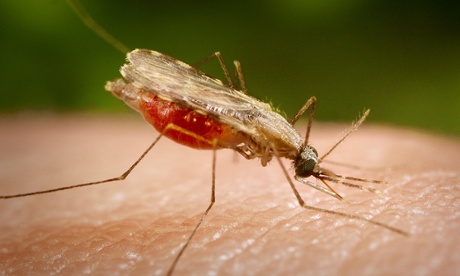
The most important way that the international community can support the grand convergence is by funding the discovery, development, and delivery of the next generation of medicines, vaccines, diagnostics, and devices. International funding for R&D targeted at diseases that disproportionately affect poor countries should be doubled from current levels (US$3bn per year) to $6bn per year by 2020. Game-changing technologies that could help achieve convergence include a single dose radical cure for vivax and falciparum malaria and highly efficacious malaria, tuberculosis, and HIV vaccines.
The public health and economic benefits of achieving convergence would be profound. Every $1 invested from 2015-35 would return $9-20, an extraordinary return on investment.
We have at our fingertips one of the greatest opportunities available to improve human welfare. The question is: will we seize it?
Gavin Yamey, MD, MPH, MA, MRCP, is a physician and Associate Professor of Epidemiology and Biostatistics in the School of Medicine at the University of California, San Francisco (UCSF), where he teaches global health policy. He leads the Evidence to Policy initiative in the UCSF Global Health Group.
Agnes Binagwaho, MD, MPed, PhD, is a pediatrician and the Minister of Health of Rwanda. She was previously Permanent Secretary of the Ministry of Health and Executive Secretary of Rwanda’s National AIDS Control Commission. She cochaired the MDG Project Task Force on HIV/Aids and Access to Essential Medicines.
Content managed and produced by PATH