As world leaders prepare to formally adopt a roadmap to a fairer and safer world, there is growing concern that the drive to end extreme poverty and inequality will fail without major changes to the way aid is delivered and a massive push to improve the data used to measure progress and drive policies.
The 2030 agenda, centred on 17 sustainable development goals, is meant to define a new era when all nations will work to improve the lives of their most vulnerable citizens while safeguarding the future of the planet.
Also known as the global goals, the SDGs build on the millennium development goals, which were narrower in scope but hailed by the UN as the “most successful anti-poverty movement in history”.
However, extending the gains made since the MDGs were introduced in 2000 will require a firm commitment to official aid flows, a shift in national poverty reduction strategies, and a revolution in data collection, according to a new report on the SDGs and their possible impact.
In Investments to End Poverty, the research group Development Initiatives says the headline goal of ending extreme poverty by 2030 will be more challenging than halving poverty. The latter target was reached, with the number of people living on less than $1.25 a day falling from 1.9 billion in 1990 to 836 million in 2015.
In sub-Saharan Africa, where poverty increased in 18 countries over the past decade, poverty levels would need to be reduced at a faster rate than they were in south Asia over the past 15 years, the report said.
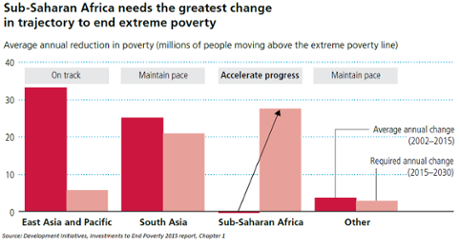
“Progress has been very uneven to date, with poverty becoming increasingly concentrated in a number of priority countries that now need a significant shift in their current trajectories if they are to end poverty by 2030,” the report said, noting that policies must focus on people as well as countries.
“Business as usual will not be enough.”
Despite “huge progress” globally, the number of people living in extreme poverty increased in 30 countries during the MDG era, added the study’s authors, who noted that even where countries appeared to be doing well nationally, the devil could be in the detail. For example, while India reduced poverty in 10 states by 10% a year over the past 15 years, eight smaller states experienced an increase, according to Development Initiatives.
“Extreme poverty is increasingly concentrated in complex and challenging contexts, and efforts will need to be intensified and better focused if poverty targets are to be met. Our research shows that the proportion of people living in extreme poverty in fragile states has risen from around 20% in 1990 to 62% in 2015,” said Harpinder Collacott, executive director at Development Initiatives.
The report warned that previous progress could even be reversed in politically fragile or environmentally vulnerable countries.
“Today, 96% of people living in poverty are in countries that are politically fragile, environmentally vulnerable, or both. Addressing fragility, conflict and crisis will be essential in the fight against poverty,” Collacott said.
Financing the SDGs will cost trillions of dollars, and the UN has urged national governments to mobilise their own resources – through better and more widespread tax collection, for example – as well as calling on private finance to step up to the plate, particularly in areas like infrastructure.
However, Development Initiatives warned that where poverty is deepest, governments lacked the kind of revenue needed to turn the SDGs into reality. Aid was still key, said the report’s authors.
In 24 of the 33 countries where the depth of poverty is highest, daily government revenues are less than $1.37 a person, compared with $34 a day in high income countries, claimed the study. This can skew data on government spending: for example, although sub-Saharan Africa spends the second highest proportion of revenues on health among all regions, spending per person is the second lowest.
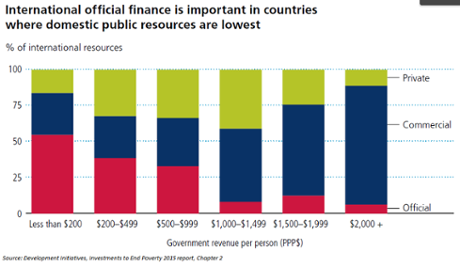
For this reason, official development assistance (ODA) remains critical, but it must be clearly directed towards the most vulnerable countries.
“Donor agencies with a stronger mandate for targeting poverty allocate their resources more effectively: over 90% of ODA from agencies with a legal mandate to target poverty go to countries with the lowest government revenues … compared to 50% from agencies that do not have a specific objective for targeting poverty,” the report said.
Another fundamental problem is the lack of accurate data to measure where the world stands, and to inform where it needs to go. The report said that current data was simply “not fit for the purpose of ending poverty”.
It noted that just 12 out of 55 African countries had comprehensive birth registration while a quarter had not conducted a poverty survey since 2008.
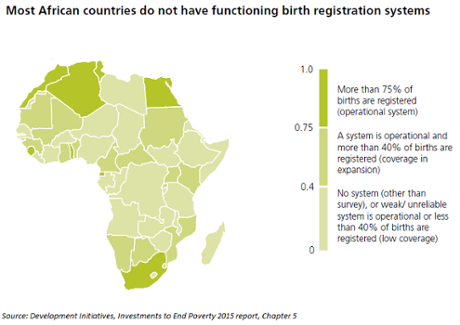
Development Initiatives said data was needed on where people in poverty were living, their quality of life and the impact of resources on their wellbeing.
“This data is lacking – we don’t accurately know where the world’s poorest people are, or how many of them are women, for example,” the report said. “To inform investments toward the end of poverty, data must be disaggregated, timely, open, comprehensive and joined up.”
- This article was amended on 24 September. The original incorrectly stated that the MDG target on halving poverty by 2015 was narrowly missed. This has been corrected.