Sept. 15 marked 10 years since U.S. investment bank Lehman Brothers went bankrupt, sending shock waves across the globe. IT companies in the United States have since made rapid progress, but the manufacturing industry has declined. What have these significant changes to the U.S. industrial structure meant for the rest of the world?
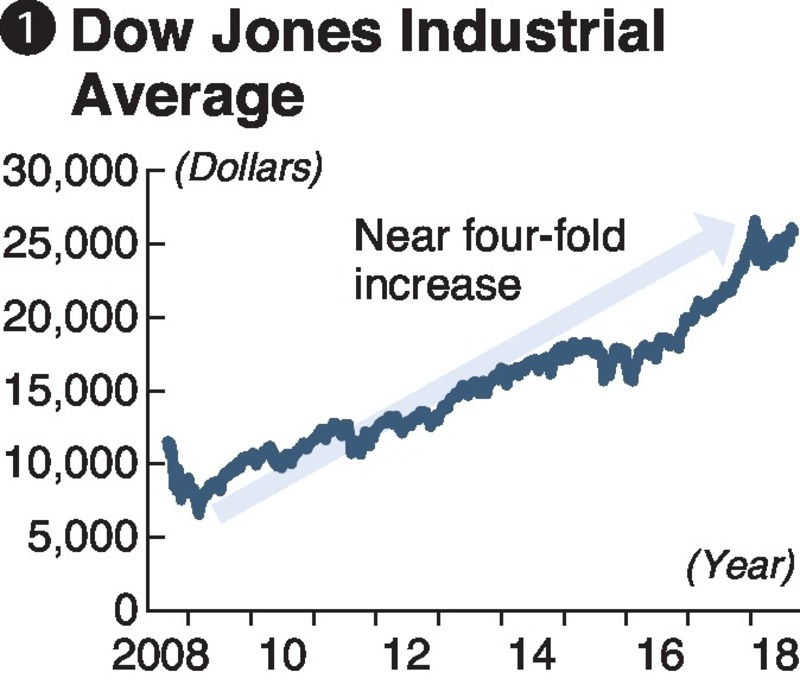
Stock prices are currently performing quite well in the U.S. economy, which has rebounded after the Lehman crisis. The New York Stock Exchange's Dow Jones Industrial Average shows that stock prices have risen to nearly four times what they were in 2009, soon after the crisis (see chart 1).
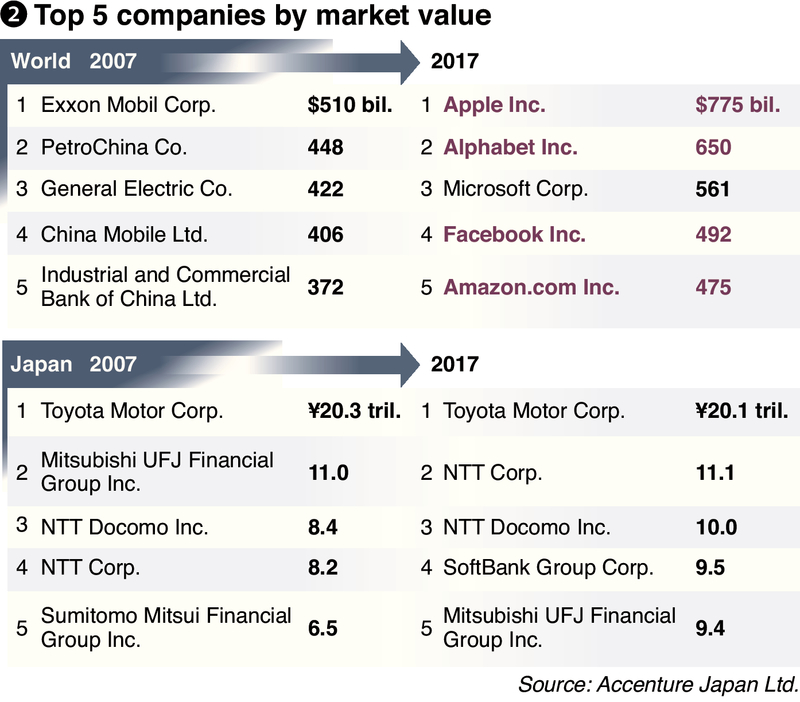
The surge in stock prices has been led by the IT industry. In particular, the rise of the four companies that make up GAFA (see below) is striking. When a world stock market capitalization ranking from 2007 is compared with one in 2017, the difference is obvious (see chart 2).
Exxon Mobil Corp. and General Electric Co. -- which were among the top five in 2007 -- had dropped out of the top-five ranking by 2017. The upper spots are now occupied by GAFA and other tech companies. This represents a stark contrast with Japan, where most of the same companies continually dominate the ranking.
In August of this year, Apple Inc.'s market value topped 1 trillion dollar, equivalent to about 110 trillion yen, which exceeds Japan's government budget. Amazon.com Inc.'s market value also briefly surpassed the 1 trillion dollar line this month. The U.S. economy can be said to have achieved its structural transformation to growth sectors by leveraging the Lehman crisis.
"After the existing economic system fell, what generated new value was information. GAFA led the trend," said Akio Makabe, a professor at Hosei Graduate School of Regional Policy Design.
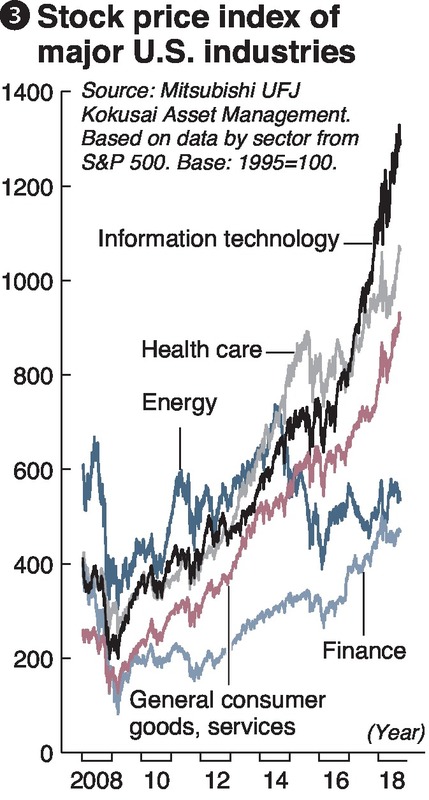
As the monetary easing policy employed to deal with the crisis produced an overflow of money, investors looking to make a profit focused on IT firms, further encouraging the growth of the tech industry. An examination into the U.S. stock price index of key industries shows that the index figure for the IT industry has increased at a rate far higher than other industries (see chart 3).
GAFA's presence is significant in the world economy, which is experiencing a fourth industrial revolution brought on by innovations in such fields as big data and artificial intelligence. Alphabet Inc.'s Google has entered the autonomous vehicle market, and Apple has launched a service that allows users to pay for goods and services with their iPhones. Amazon has offered loans to businesses that sell their products on its website. These companies are getting their feet wet in fintech (see below), a fusion of IT and finance.
This large-scale economic transformation may even enable the United States to cement its position as the sole winner.
Manufacturing hard-hit
It should be remembered that the Lehman shock -- which was initially considered a crisis in the financial sector -- dealt a large blow to the manufacturing industry. The crisis was followed by a credit crunch due to banks' capital and funding shortfalls, making it difficult for companies to finance their business. Investment and consumption took a dive, immediately widening the impact to the manufacturing industry.
General Motors Co. -- a symbol of American manufacturing -- was restructured with a government bailout after it went bankrupt in 2009. The now-defunct Chrysler LLC also went bankrupt in the same year, and has become a subsidiary of Fiat Chrysler Automobiles NV.
At the beginning of the crisis, even in Japan, where the impact to the financial sector was predicted to be minimal, Toyota Motor Corp. and Hitachi Ltd. recorded massive losses for the fiscal year ended March 2009. This illustrates the power of a crisis to dry up global demand.
The U.S. manufacturing sector has continued to struggle. The prestigious General Electric Co., in which famous inventor Thomas Edison was involved, has been forced into major restructuring, such as selling its appliance division in 2016 and announcing in July of this year its intention to withdraw from lighting operations -- a business that dates back to the company's start.
Hurdles for job creation
The U.S. economy as a whole appears to have undergone a smooth structural shift. However, these sudden changes have also brought distortions.
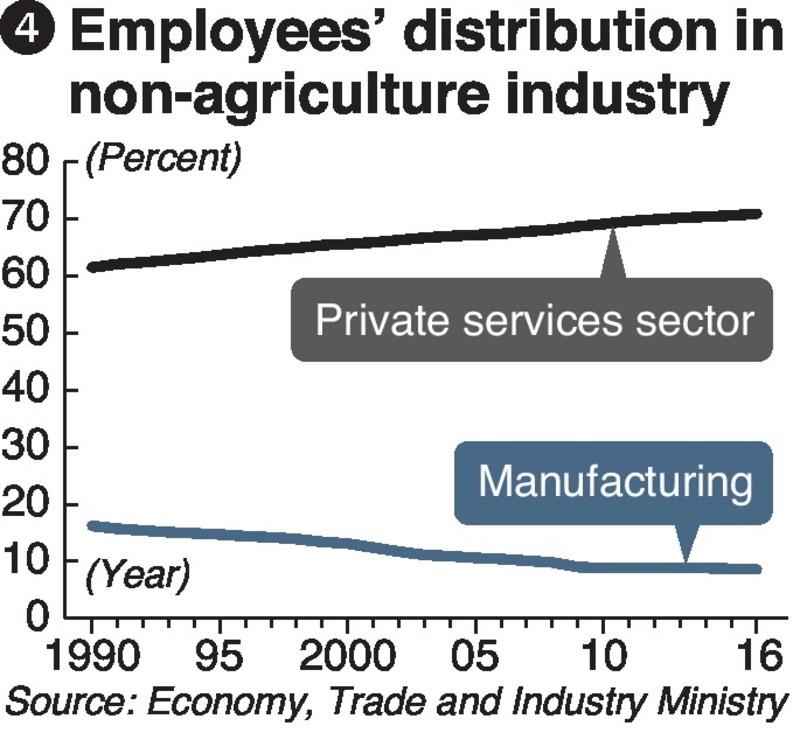
While the American job market improved after the Lehman crisis, many of the new jobs created were not in manufacturing but the less well-paid service industries, such as education and health care. The proportion of workers employed in the manufacturing industry, among all non-agricultural sectors, has been decreasing (see chart 4).
Meanwhile, some observers point out that GAFA has not created jobs proportionately to their market value.
Scott Galloway, a professor at New York University Stern School of Business, pointed out in his book "The Four: The Hidden DNA of Amazon, Apple, Facebook, and Google" that while Facebook Inc. employed 17,000 people, Walt Disney Co. -- which has half the market value -- employed 185,000 and such firms as General Motors and IBM Corp. also had hundreds of thousands employees. He argued that while tech giants' very high productivity creates growth, it will not necessarily lead to prosperity.
A driving force for the election of U.S. President Donald Trump was support from regions affected by the decline of the manufacturing industry, known as the Rust Belt. While the U.S. unemployment rate has dropped to around 4 percent, many workers remain discontented, as they are unable to return to their manufacturing jobs. It can be argued that these structural changes in U.S. industries have indirectly sewn seeds of widening global concern over trade frictions bred by the "America First" policy.
Some wary of IT giants
Some are also turning stern eyes on the too-powerful GAFA.
In March, Facebook's stock plunged after a scandal was revealed in which the data of up to 87 million users was accessed improperly. The number of the service's users has also stagnated.
The European Union has been increasingly wary of GAFA. Its executive arm, the European Commission, has moved to strengthen taxation of these corporations, squarely treating tax avoidance by Apple, Amazon and other firms as a problem. In July, the commission ordered Google to pay a considerable fine for violating the EU competition law by forcing manufacturers of devices running its Android operating system to pre-install the tech giant's own apps.
Hideshi Aratake, chief economist at Mitsubishi UFJ Kokusai Asset Management, sounded a warning: "The speed at which [the price of ] U.S. tech company stocks soared seems too fast. If antipathy and disappointment toward GAFA spreads, the foundation of the bullish stock market could collapse and even reverse" the upward movement.
The bursting of bubble economies -- such as the IT bubble in the early 2000s -- has often resulted from excessive expectations of new technology and innovative services followed by disappointment. Now more than ever, it is vital to keep a close eye on the cracks appearing in the U.S. economy.
-- GAFA
An acronym for Google, Apple, Facebook and Amazon. Google, under its parent company Alphabet Inc., provides search services. Apple develops products such as iPhones, as well as a range of services. Facebook manages a social networking website, while Amazon is a global pioneer of online shopping.
-- Fintech
An abbreviation of "financial technology." It includes a variety of services, such as payment, remittance and asset management with the use of internet and artificial intelligence.
Read more from The Japan News at https://japannews.yomiuri.co.jp/