Trade friction between the United States and China has begun to take on the appearance of a battle for hegemony over the future of high-tech fields. With the rapid rise in China's high-tech capabilities, there is a distinct sense of impending danger in the United States. How is U.S. President Donald Trump's administration countering a rising China?
Manufacturing strengthens
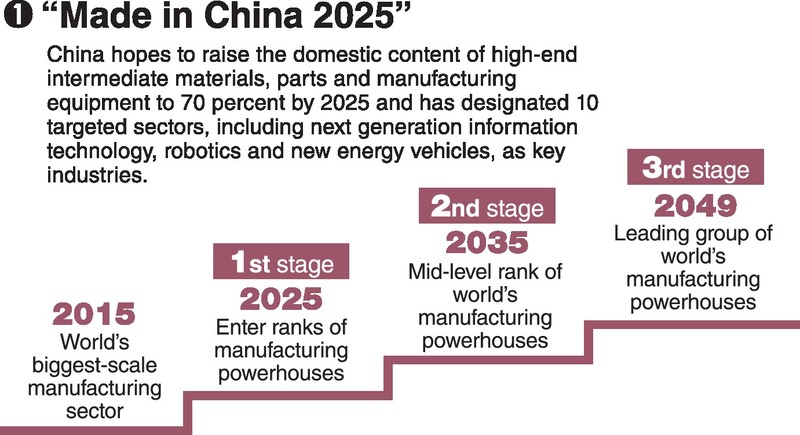
In trade discussions with China concerning Section 301 of the U.S. Trade Act, the United States has strongly pushed for revisions to "Made in China 2025," Beijing's blueprint for upgrading its manufacturing industry, which was released in 2015 (see chart 1).
The plan focuses on facilitating the development of 10 industries, including next-generation information technology, robotics and automobiles powered by alternative energy. With a three-stage vision for growth, China is aiming to become a leading industrial power by the year 2049, the centenary of the People's Republic of China.
U.S. concerns about the plan stem from the means China is using to achieve its realization.
The United States believes that in order for China to increase the percentage of key technologies it manufactures domestically, Beijing is pressuring entities including U.S. corporations into signing technology licensing agreements, and bending the rules of fair competition by providing subsidies via government-run investment funds. Meanwhile, the United States also has deep-seated concerns about its technology being stolen in cyber-attacks, a claim the Chinese government has dismissed.
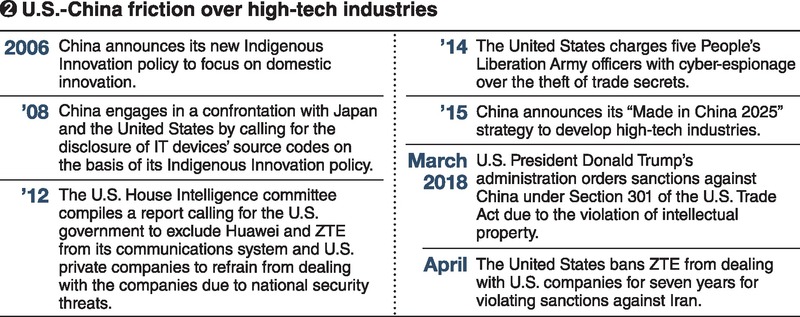
The U.S.-China battle over the high-tech realm dates back to the previous U.S. administration of President Barack Obama (see chart 2). One clear illustration of the defensive posture of the U.S. business community at that time is provided by a report published by the U.S. Chamber of Commerce in 2010, titled "China's Drive for 'Indigenous Innovation.'" The report was written by James McGregor, an American writer with substantial business experience in China who also served as the China bureau chief for The Wall Street Journal.
In this context, "Indigenous Innovation" means independent technological innovation by Chinese companies. A catchphrase for Chinese industrial policy, it was put forth in 2006 as a plan for the development of a high-tech industry in the country. The current "Made in China 2025" initiative, which has been spearheaded by Chinese President Xi Jinping, could be called an expanded successor to the "Indigenous Innovation" policy.
Industrial espionage
In the U.S. Chamber of Commerce report regarding China's telecommunications infrastructure, including its integrated circuits and encryption systems, the analysis was made that policies were in place to replace foreign technology with domestic technology. The report also criticized the "Indigenous Innovation" policy as one "considered by many international technology companies to be a blueprint for technology theft on a scale the world has never seen before."
These concerns would later become realities. In May 2014, the U.S. Justice Department charged five members of the Chinese People's Liberation Army with cyber-attacks on major U.S. companies and the theft of trade secrets. This was the first-ever case in which the U.S. government indicted foreign government personnel for industrial espionage related to cyber-attacks.
Behind China's efforts to promote "Made in China 2025" is its frustration with the tightening grip on key technologies in the high-tech field that has been exercised by the advanced nations of Japan, the United States and countries in Europe.
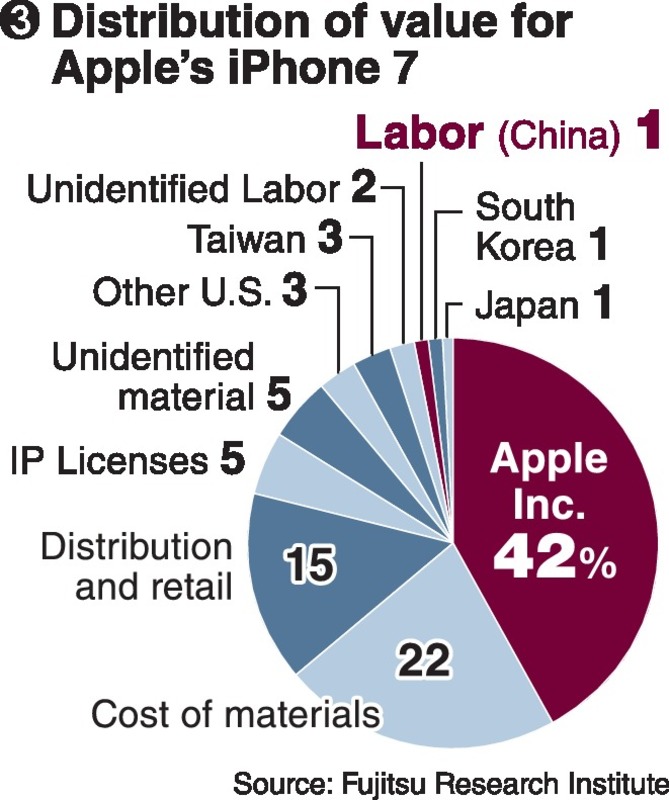
According to the Fujitsu Research Institute's analysis of the distribution of value associated with Apple's iPhone 7, Apple itself accounts for 42 percent, while the corresponding figure for Chinese labor, which is responsible for the assembly of the device, is only 1 percent (see chart 3).
A report titled "2017 Top 100 Global Innovators" by U.S.-based research company Clarivate Analytics listed 39 Japanese companies, including Toyota Motor Corp., and 36 U.S. companies, including Apple Inc. However, only one company from China made the list: the telecommunications equipment manufacturer Huawei Technologies Co. (see below).
"China's manufacturing industry has been confined to the role of importing materials and equipment from advanced countries, and assembling and exporting products," says Jin Jianmin, senior fellow at the Fujitsu Research Institute. "There is a strong sense that a crisis is imminent."
U.S. levies sanctions
Along with Huawei, another company that has been identified as a potential indicator for the outcome of the U.S.-China battle for high-tech dominance is state-owned ZTE Corp. (see below).
Within the United States, there have long been serious concerns that if Chinese companies with close ties to the ruling Communist Party were to gain control of any U.S. telecommunications infrastructure, the country would be exposed to security threats, including hacking and the interception of communications by the Chinese government.
Since this year began, actions to shut out products by Huawei and ZTE are gaining strength. In April, the Trump administration levied sanctions against ZTE for reasons including the company's violation of sanctions against Iran. U.S. companies were prohibited from exporting to ZTE.
Also in April, Huawei issued a statement that contained the following section: "In 30 years, not a single operator has experienced a security issue with our equipment. This includes U.S. operators." ZTE also expressed its adamant opposition to the U.S. government's decision.
Battle over 5G
A senior official from Japan's Economy, Trade and Industry Ministry notes that 5G, the next-generation telecommunications standard, is behind the firm U.S. stance. 5G is the high-speed, high-capacity telecommunications standard that will serve as the foundation for the internet of things (IoT), where everything is connected to the internet.
Although China has fallen behind the advanced nations in fields such as automobiles, aviation and semiconductors, the country's technological prowess is growing rapidly in the domain known as the "new economy," which encompasses technologies including artificial intelligence, drones, cashless payments, big data and cloud computing. If synergies emerge between 5G and these fields, China will instantly gain the upper hand in the battle for hegemony in the high-tech realm.
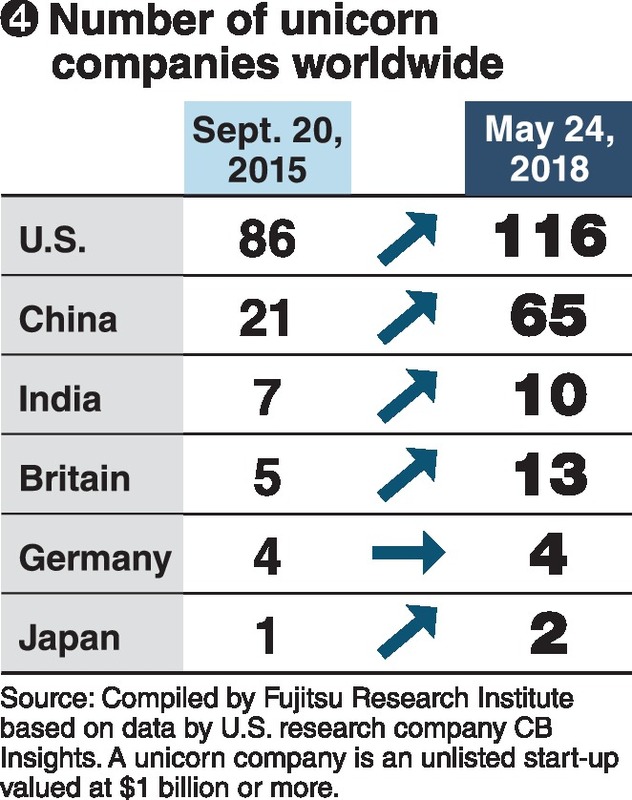
According to U.S.-based research company CB Insights, China's 65 unicorn companies -- start-ups valued at 1 billion dollar or more -- put it second only to the United States's 116, with the two pulling far ahead of the rest of the advanced nations (see chart 4). China's potential is significant.
It is widely assumed that the United States will not permit China, a proponent of state capitalism, to gain an advantageous position in the battle for hegemony in high-tech fields.
"We are headed into a very disorganized and dangerous period when it comes to technology," McGregor says.
While there are signs that the Trump administration is working on a deal involving a reduction in the trade deficit and the softening of sanctions on ZTE, such a deal would be nothing more than a stopgap measure.
--Huawei
A private Chinese company established in 1987. Globally, ranked first in telecommunications equipment and third in the number of smartphones shipped. Its 2017 revenue was 603.6 billion yuan, or about 10 trillion yen. It is ranked first among corporations in the number of international patent applications in 2017, according to the World Intellectual Property Organization.
--ZTE
A Chinese state-owned enterprise and global telecommunications equipment giant that began operating in 1985. It is strong in telecommunications equipment including smartphones and other mobile phones. Its 2017 revenue was 108.8 billion yuan, or about 1.8 trillion yen. In April, the U.S. Federal Communications Commission reached a decision to effectively prohibit U.S. telecommunications companies from procuring telecommunications equipment from foreign companies for which there are security-related concerns. The move is thought to have been made with ZTE and Huawei in mind.
Read more from The Japan News at https://japannews.yomiuri.co.jp/