Amid recent summit talks between the United States and North Korea, and Seoul's attempt to mend ties with Pyongyang, South Korea's strong economy has shown signs of faltering. A climbing unemployment rate, particularly among young people, and the prospect of a U.S.-China trade war continue to cast a shadow over the South Korean economy.
South Korean President Moon Jae In's left-wing ruling party scored a landslide victory in local elections on June 13. Although Moon maintains a high approval rating due to his pursuit of reconciliation with North Korea, how have his economic policies fared in the year since his inauguration?
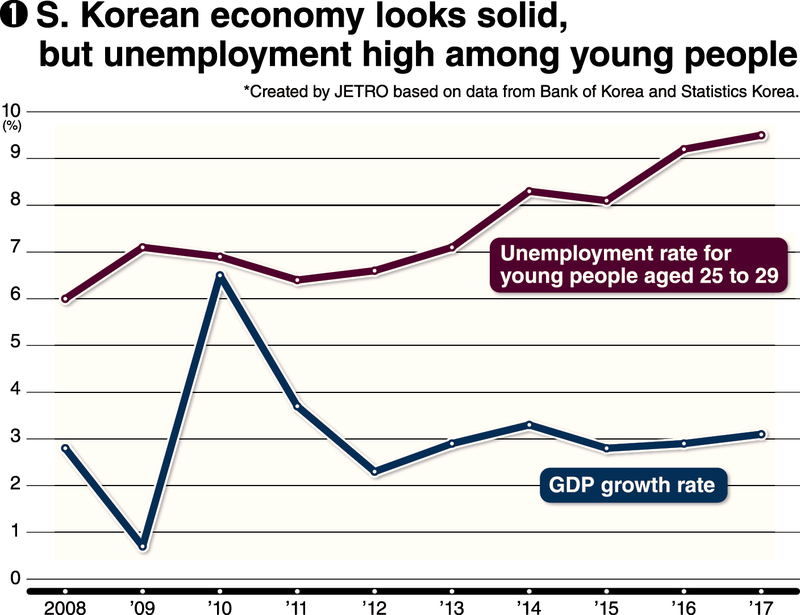
According to South Korea's central bank, the Bank of Korea, the real economic growth rate in 2017 was 3.1 percent, the first time in three years the figure topped 3 percent (see chart 1). The growth rate for 2018 is also forecast to be 3 percent.
The brisk market for semiconductors -- one of South Korea's strengths -- has buttressed the country's favorable economic conditions. According to World Semiconductor Market Trade Statistics, the global market for semiconductors grew to 412.2 billion dollars (about 45 trillion yen) in 2017, up 22 percent from the previous year. This marked the first year the figure has exceeded 400 billion dollars.
The growth in demand has been driven by a need for semiconductors not only in smartphones, but for the "internet of things," which connects products through the internet and big data processing. The market for DRAM (see below), the memory used in computers, smartphones and other products, is dominated by South Korean heavyweight firms. The largest of the firms, Samsung Electronics Co., and the second largest, SK Hynix Inc., together command more than 70 percent of the market.
In its consolidated settlement of accounts for the January-March 2018 period, Samsung Electronics' operating profits increased by 58 percent from the same period the previous year. The operating profit for the company's core semiconductor sector continues to set record highs.
South Korea is highly dependent on exports, which account for about 50 percent of its gross domestic product. Semiconductors' share of total exports climbed from 8 percent in 2011 to 16 percent in 2017, demonstrating their importance to the economy.
Robust investment in construction has also shored up the economy. In addition to the special demand generated by the Pyeongchang Winter Olympics in February, investment in housing has also greatly increased due to such economic measures as the deregulation of housing loans.
Wage hike side effects
On the other hand, the employment situation, which is often referred to as "South Korea's weak point," has not improved. The May unemployment rate announced by Statistics Korea was 4 percent, 0.4 percentage points higher than the figure in the same month of the previous year.
Youth unemployment is particularly high, with the unemployment rate for people aged 25 to 29 -- the age around which men finish their military service -- on the rise (see chart 1).
One of the highlighted causes has been the progression of automation in the production process of semiconductors as part of the apparatus industry. Even if a company is achieving favorable results, it is still difficult to increase its employment.
Furthermore, Kazuhiro Momomoto, a Japan External Trade Organization official, said, "It is a major reason that there is also a mismatch between job vacancies at companies and jobs that young people actually want to get."
In South Korea, the wage difference between large corporations, such as Samsung Electronics, and small and midsize companies is very large. It is said that there is a gap of about double the amount from the starting salary stage. This is why young people tend to pursue jobs at large corporations, delaying when they find a job.
The Moon administration has put forward an "income-led growth policy" (see below) and hiked the minimum wage as a means of increasing incomes and reducing disparities. The minimum wage in January 2018 rose by 16 percent from the previous year.
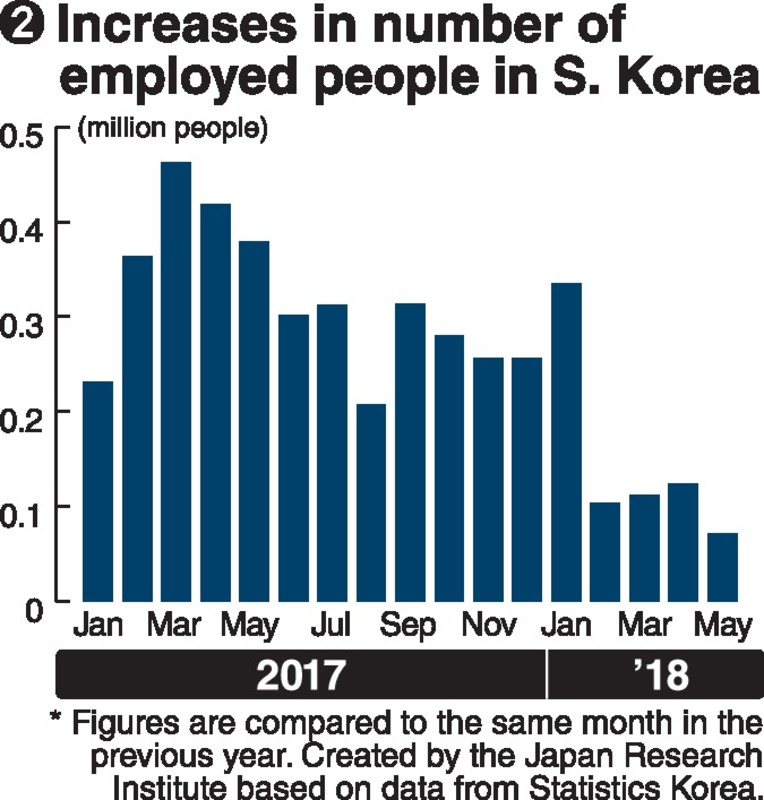
However, this has greatly increased the burden for companies. Retailers and service industry enterprises, such as restaurants and hotels, have reacted negatively and have begun to curb employment. The increase in the number of employees across all companies has hit a ceiling (see chart 2). The policy's emphasis on income growth has also been criticized as actually harming employment.
Further deterioration in youth employment could hinder South Korea's future economic growth due to a reduction in the vocational abilities of future generations.
A lot to lose
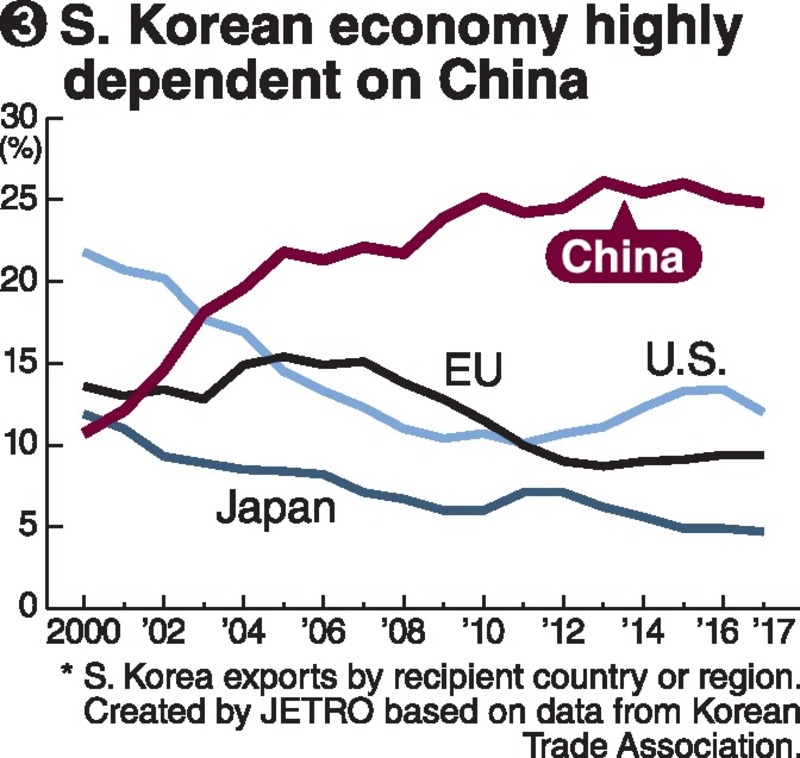
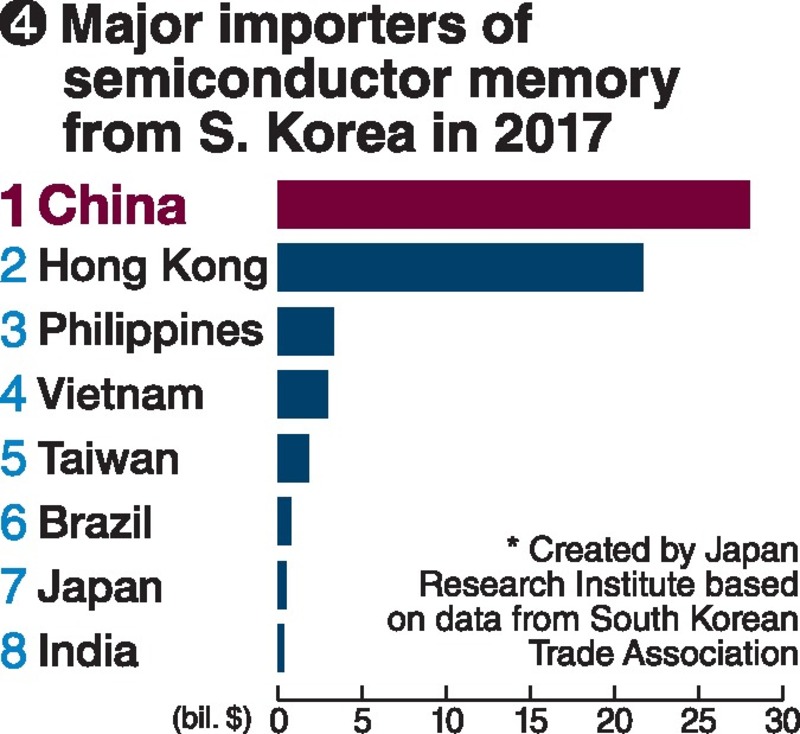
South Korea is also likely to suffer from the intensifying trade friction between Washington and Beijing. When we look at South Korean exports by recipient country or region, China is the top destination, accounting for a quarter of the total (see chart 3). The value of semiconductor memory exports from South Korea, which boasts strength in the sector, to China and Hong Kong is also very high (see chart 4).
The administration of U.S. President Donald Trump has declared that it will impose steep tariffs from July on 50 billion dollars worth of Chinese imports, citing violations of intellectual property rights. It is possible that this could expand in the future to include electronic devices that use large quantities of semiconductors
As the global division of labor driven by supply chains progresses, any damage incurred by China will spread to other countries. A South Korean news outlet reported the view of an expert who said South Korea's economy will be the biggest victim in a global trade war.
"South Korea needs to create new industries through innovation. It is especially important to cultivate the service industry in order to escape from the dependence on semiconductors and increase employment," said Hidehiko Mukoyama, a senior researcher at the Japan Research Institute.
Japan-South Korea cooperation
Historically, South Korea has continued to develop with support from Japan, such as through Japanese economic and technical cooperation. The two countries are now seeking new areas of cooperation.
One such area relates to youth employment. In Japan, even large companies strongly feel there is a labor shortage due to the shrinking labor force, creating a seller's market for job seekers. As a result, more companies are seeking to employ South Korean students. Should cooperation in the field of human resources expand, a "win-win" situation could emerge in which South Korean youth confronted with a job shortage could work for Japanese companies, who face a shortage of job applicants. The problems of both sides would be solved with one stroke.
In 2017, the amount of direct investment from Japan to South Korea rose by 48 percent on a year-on-year basis, the first increase in five years. Japanese companies that supply advanced materials and components to South Korean companies are seen to have upgraded their local production facilities. It is also possible to further enhance the supply chain's complementary relationship.
Japan and South Korea are similar in that free trade contributed to economic growth in both countries. There appears to be further room for cooperation in pushing back against the Trump administration's protectionism. South Korean participation in the Japan-led Trans-Pacific Partnership trade pact would also enhance their cooperation. Even in the economic realm, the development of a future-oriented cooperative relationship is desirable.
-- DRAM
An acronym for Dynamic Random Access Memory. This is a type of semiconductor memory used for storing data on electronic devices, such as computers, and reads and writes data over and over again. When the power is shut off, the data disappears. In recent years, the demand for use in smartphones has increased. At one time, Japanese manufacturers dominated the global market, but now three companies -- South Korea's Samsung Electronics Co. and SK Hynix Inc., and Micron Technology Inc. from the United States -- command more than 90 percent of the market.
-- Income-led growth policy
An economic policy championed by the administration of South Korean President Moon Jae In. Its purpose includes creating jobs mainly in the public sector, and converting non-regular public sector employees into full-time employees. It aims to reduce disparities, which have generated a great deal of dissatisfaction among South Koreans, by significantly increasing the minimum wage, among other measures.
Read more from The Japan News at https://japannews.yomiuri.co.jp/