Crude oil prices are rising. This is a result of coordinated production cuts by major oil-producing nations, such as the Organization of the Petroleum Exporting Countries (see below) and Russia, which have been ongoing since January 2017. However, if prices continue to rise, it could put a damper on the robust world economy, resulting in decreased oil consumption. Oil producers are discreetly searching for an exit from production cuts.
Threefold rise
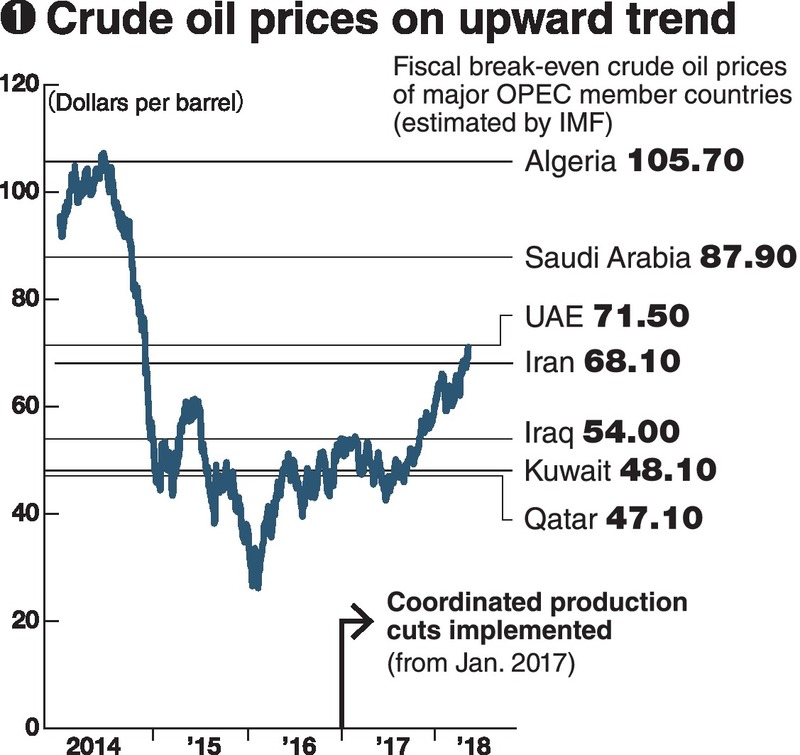
U.S. West Texas Intermediate (WTI) crude futures have risen to about 70 dollars per barrel, nearly triple the bottom price seen in February 2016 (see chart 1).
The largest factor for the turn toward rising prices is the deliberate cut in production, amounting to a reduction of 1.8 million barrels a day, by major oil-producing nations including OPEC members, such as Saudi Arabia, Iran and Iraq, and non-OPEC member countries such as Russia, Oman and Azerbaijan. Greater than expected dips in production by nations such as Venezuela, which is racked by political instability, and Mexico, with its obsolete equipment, have also served to push up prices.
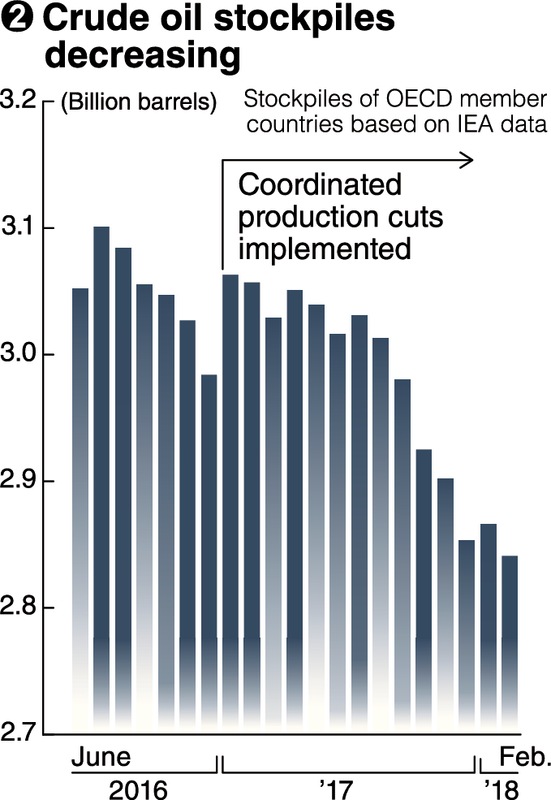
The production cuts have caused crude oil stockpiles held by consumer nations to shrink. According to the International Energy Agency (IEA), crude oil stockpiles held by the Organization for Economic Cooperation and Development nations declined from about 3.1 billion barrels in July 2016 to about 2.8 billion barrels in February 2018 (see chart 2).
The announcement by the United States of its withdrawal from the Iran nuclear deal and the preparations to resume its economic sanctions have also spurred higher oil prices. Giovanni Staunovo, an analyst at major Swiss banking firm UBS, predicts that over the next three months, crude oil prices will range from "65 dollars to 80 dollars" per barrel.
For OPEC, this is desirable in the short term, as higher oil prices result directly in an improvement of national finances.
According to the International Monetary Fund (IMF), in order for Saudi Arabia, which boasts the highest oil production in OPEC, to achieve a fiscal surplus, a crude oil price of 87.90 dollars per barrel is necessary. That is more than 10 dollars higher than the current price. In the case of Algeria, it will not achieve a fiscal surplus unless the price rises to 105.70 dollars.
However, viewed from a longer-term perspective, rising crude oil prices also have many drawbacks for OPEC.
One of these is that higher prices will bring about profits for companies exploiting shale oil (see below) deposits in North America. This will profit the United States and Canada, which are not members of OPEC.
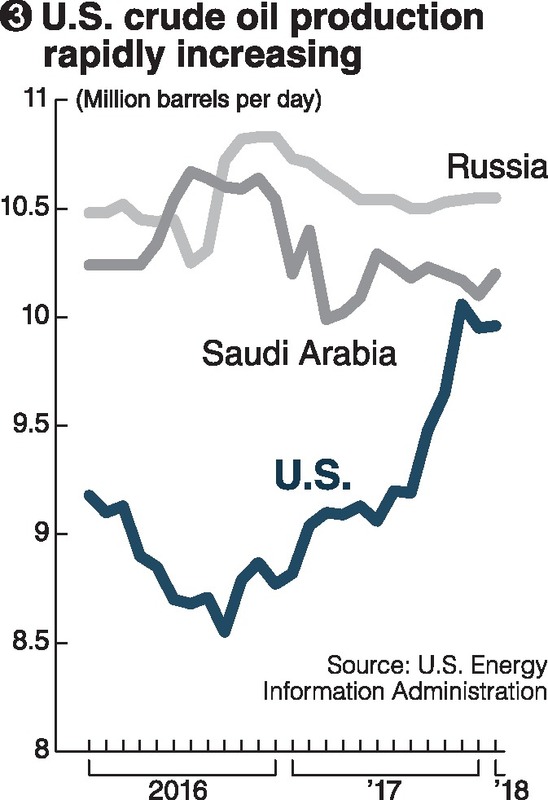
According to the U.S. Energy Information Administration, U.S. crude oil production is nearing that of world-leading oil producers Saudi Arabia and Russia (See chart 3). If high oil prices continue, development capital will flood into the United States, which could lead to a smaller share of the oil market for OPEC.
Another drawback is the impact on the global economy. High crude oil prices lead to price increases for a variety of goods and services by way of rising gasoline prices, running the risk of adverse effects on economic conditions. If there is a slump in economic activity, it will have the reciprocal effect of reduced oil consumption.
It will also increase the risk of encouraging the use of alternative energy sources, such as natural gas or renewable energy. If prices of 100 dollars per barrel or higher were to become entrenched, oil might be abandoned by the market, having lost its selling point of being cheap and easy to use.
Carbon emissions reduction
Signs of the abandonment of oil are already visible amid growing environmental awareness internationally. Takayuki Honma, a chief economist at Sumitomo Corporation Global Research Co., notes, "The tide has changed with the announcement by Britain and France of a ban on the sales of gasoline and diesel vehicles by 2040."
The world's major automakers, led by European manufacturers, are all devoting their efforts to developing electric vehicles. German automaker Volkswagen AG, which was embroiled in an emissions scandal in 2015, was prompted by the revelations to change its course largely toward investment in electric vehicles. The company has set a target to increase the proportion of new car sales made up of EVs and other low-carbon models to 25 percent, or 3 million units per year, by 2025.
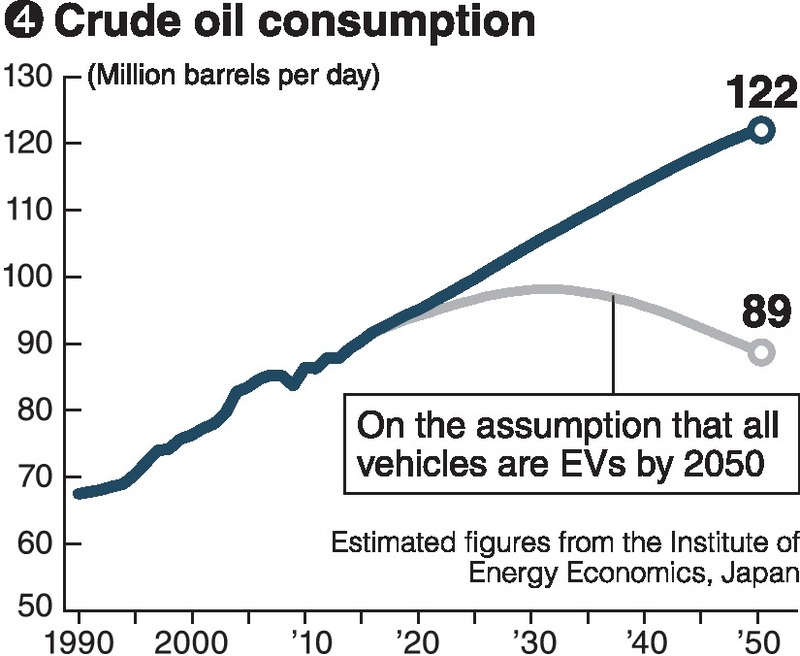
The Institute of Energy Economics, Japan estimated long-term trends in oil consumption in October 2017. The estimate is based on two scenarios -- one in which the ownership rate of zero-emission vehicles, or electric vehicles, plug-in hybrids and fuel cell vehicles, stalls at 9 percent in 2030 and 20 percent in 2050, and another in which the ownership of such vehicles increases rapidly to 30 percent in 2030 and 100 percent in 2050. According to the estimate, in the case of rapidly increasing ownership, oil consumption would peak around 2030 (See chart 4).
Ken Koyama, managing director of the institute, said, "Oil-producing nations like OPEC, and oil companies as well, have forecast that oil consumption will continue to grow, but they are quite conscious of the trend in the automobile industry."
Difficult choice
Prolonged high oil prices may induce consumers to move away from gasoline, accelerating the adoption of electric vehicles and other alternatives. If they cease coordinated production cuts and decide to increase production to avert this, it may cause oil prices to crash, once again causing national fiscal conditions to deteriorate. OPEC and Russia are forced to make a difficult choice between securing short-term profits and a survival strategy from the mid- to long-term perspective.
OPEC will hold a meeting in Vienna on June 22 to discuss its response going forward. Depending on how it develops, they could choose to end the coordinated production cuts that are set to continue until the end of 2018 or reduce the scope of the production cuts.
Saudi Arabia, as the leader of OPEC, holds the key. According to Reuters and other sources, Saudi Arabia has indicated its intention that if economic sanctions on Iran are resumed by the United States, resulting in a steep decline in Iranian oil exports, it will make up the production shortfall and increase its production. The aim is to avoid a sharp rise in oil prices.
Over the last few years, Saudi Arabia has been transitioning to an economic framework not solely dependent on crude oil. The establishment of a 10 trillion yen fund in collaboration with SoftBank Group Corp. is one part of these efforts.
According to an Economy, Trade and Industry Ministry official, Saudi Arabia "is looking ahead to the end of the age of oil."
All eyes are focused on Saudi Arabia's next moves as it embarks on reforms.
OPEC
The five nations of Saudi Arabia, Kuwait, Iran, Iraq and Venezuela formed the Organization of the Petroleum Exporting Countries in 1960 to oppose the major international oil companies. At present, there are 14 member nations. OPEC accounts for 40 percent of global oil production and 80 percent of the world's oil reserves.
Shale oil
Crude oil trapped in layers of shale deep beneath the Earth's surface. As it is very costly to extract, it has been considered difficult to exploit commercially. With the development of new technologies, exploitation of deposits in the United States and Canada grew rapidly beginning around 2010. Many operations have struggled because of low crude oil prices since the autumn of 2014, but the recovery of prices has been making shale oil exploitation attractive again.
Read more from The Japan News at https://japannews.yomiuri.co.jp/