Japan's manufacturing industry, which took a leap forward during a period of rapid growth and high product quality, was so well known that "Made in Japan" virtually became a brand of its own. But since the 2000s, labor productivity has fallen, and Japan seems to have lost its superiority. What happened, and can the situation be turned around?
International competition
Improving labor productivity in Japan's service industry is a common theme, but in recent years, manufacturing has also seen slumping labor productivity compared to other countries.
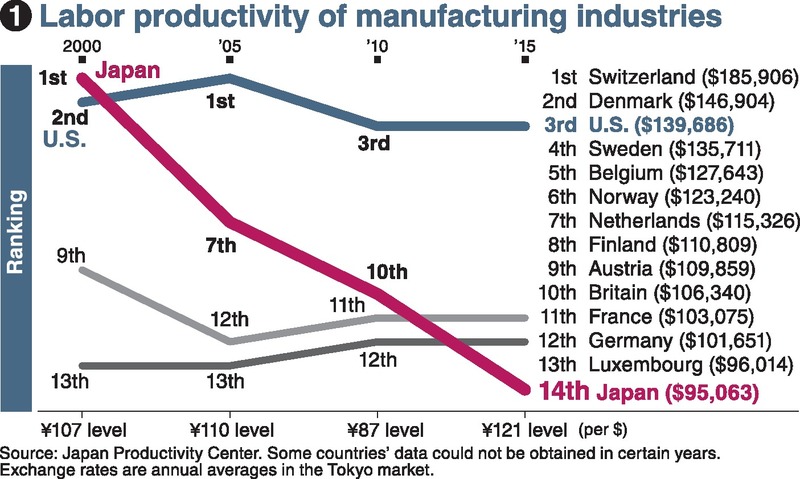
The Japan Productivity Center carries out an international comparison of labor productivity -- a measure of how efficiently workers produce added value for products or services. Japan's labor productivity in manufacturing per worker in 2015 was 95,063, dollars or about 10 million yen, ranking 14th among the 29 Organization for Economic Cooperation and Development countries for which such data is available. (The OECD has 35 members in all.)
Japan's figure is half that of Switzerland, which topped the list, and 70 percent that of the United States (see chart 1). Japan topped this ranking in 1995 and 2000.
The 2000s saw major Japanese electronics manufacturers such as Hitachi, Ltd., Sony Corp., and Panasonic Corp. facing fierce international competition, due to spreading modularization (see below), or assembling standardized parts to manufacture products.
This made it possible to manufacture products in any country. Price competition among companies became increasingly fierce, with low-wage China and Taiwan, among others, causing prices to fall. As it grew more difficult to make a profit, Japan's productivity dropped. Moreover, as Japanese companies moved their factories overseas, the added value created there was not reflected in Japan's labor productivity.
The smiling curve
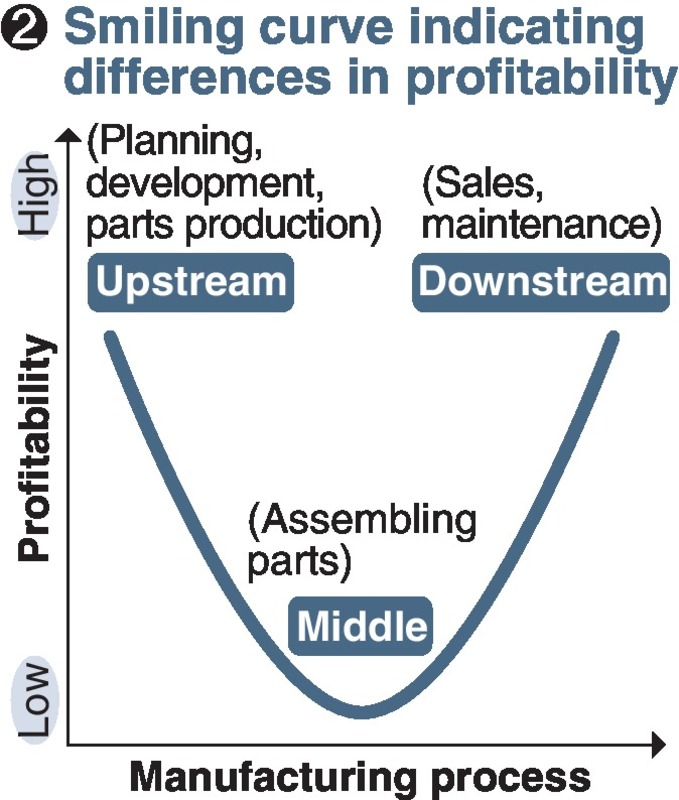
The difficult situation facing Japan's electronics industry is often explained by a theory called the smiling curve.
When you graph profits that can be gained at each phase -- from production to sale -- the line looks like a smile (see chart 2). The smiling curve indicates that the upstream phase involving product development and parts manufacturing, as well as the downstream phase involving maintenance and customer service, are highly profitable. However, the manufacturing phase in the middle of the process does not generate much money.
The main reason the United States' labor productivity in the manufacturing industry is so high is because reform has been carried out to increase profits in both the upstream and downstream phases, which is different from Japan where an integrated-manufacturing approach is taken.
Apple Inc., known for its success with the iPhone, is a good example. Apple outsourced its manufacturing to other companies while developing a variety of services such as iTunes.
In its operating profit in the period ending in September 2017, profits generated by each worker stood at 500,000, dollars or about 53 million yen. The company has about 123,000 employees.
The American company Nvidia Corp. has been growing rapidly with products such as semiconductors for artificial intelligence. The company does not have its own plants, and about 70 percent of its about 10,000 employees belong to its research and development division. Focusing on product development makes it possible to generate substantial profits, with profit per employee reaching as much as about 190,000 dollars.
Meanwhile, in Japan, Hitachi's consolidated operating profit for March 2017 was only about 1.93 million yen per employee. Sony's was about 2.25 million yen per employee.
Underestimation
However, some are doubtful about interpreting labor productivity figures as real economic power.
Japan's manufacturing industry has placed priority on retaining its employees, even during the recession brought on by the strong yen. Among countries with high labor productivity, including the United States, there are many countries where a lot of companies are weeded out and employment is fluid. Japanese companies may have sacrificed productivity to maintain a certain level of employment.
It should be kept in mind that productivity statistics tend to be higher than the actual level, especially in countries where there are many illegal immigrants who are not counted as workers -- the denominator of labor productivity calculation. Yasuhiro Kiuchi, a senior researcher at the Japan Productivity Center who worked on an international comparison of labor productivity, said southern European labor productivity statistics are substantially influenced by illegal immigration and that the figure is inflated.
From a viewpoint of different measurements, however, some analyses suggest Japan's manufacturing industry still has strengths.
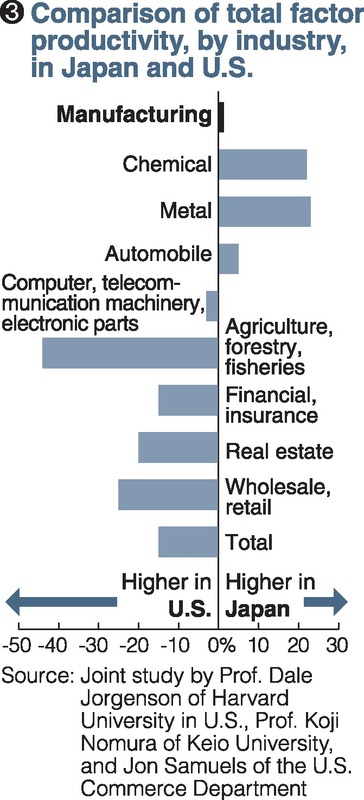
Keio University Prof. Koji Nomura worked with Harvard University Prof. Dale Jorgenson to make a comparison of Japanese and U.S. productivity that assessed total factor productivity (TFP, see below), including factors other than labor, such as equipment and facilities. Their detailed research also included price differences for products and services between the two countries.
The productivity of Japan's manufacturing industry exceeded that of the United States by 10 percent to 15 percent around 1990, and in 2015 it still had a 1.2 percent advantage, according to their report. By sector, Japan's productivity surpasses that of the United States by 21.9 percent in chemicals and 23.2 percent in metals (see chart 3).
"Labor productivity based on simple calculations cannot accurately assess the production volume of Japan's manufacturing industry, leading to undervaluation," Nomura said. Because the international productivity ranking is also influenced by calculation methods, it can be said that Japan does not have to be too nervous about its position.
Opening for reform
Aside from international comparisons, Japan's manufacturing industry is certainly having difficulty increasing productivity.
One possible answer is the expansion into services by the manufacturing sector. For example, major tire manufacturer Bridgestone Corp. earns profits by providing not only tires for sale, but also maintenance services for bus and truck makers.
As Director Hisashi Yamada of the Japan Research Institute points out: "Japan is on the cutting edge in precise manufacturing. It has organizational strengths, and if it earns profits from things like services, it is possible to increase productivity."
The world is now seeing the era of the fourth industrial revolution, driven by technology such as AI and the internet of things, in which more and more devices are connected via the internet. Japanese companies will not be able to survive unless they thoroughly carry out reform to create high added value.
The arrival of this new age should be seen as an opportunity to reform business management.
--Modularization
A production technique that designs and manufactures products using standardized parts. A computer is a typical example. It is easy to assemble a computer by putting together a central processing unit, memory and a storage device. Liquid crystal display TVs can be assembled the same way. Modularization makes obsolete the fine integration of processes from design to production that has been a traditional strength of Japanese companies.
--Total factor productivity (TFP)
An index of production efficiency that takes into account all factors necessary for production, including raw materials, machinery and tools. It is said this more accurately measures the real state of productivity than labor productivity, which is calculated by dividing nominal gross domestic product -- a total sum of added values -- by the number of workers. However, it is complicated to compute.
Read more from The Japan News at https://japannews.yomiuri.co.jp/