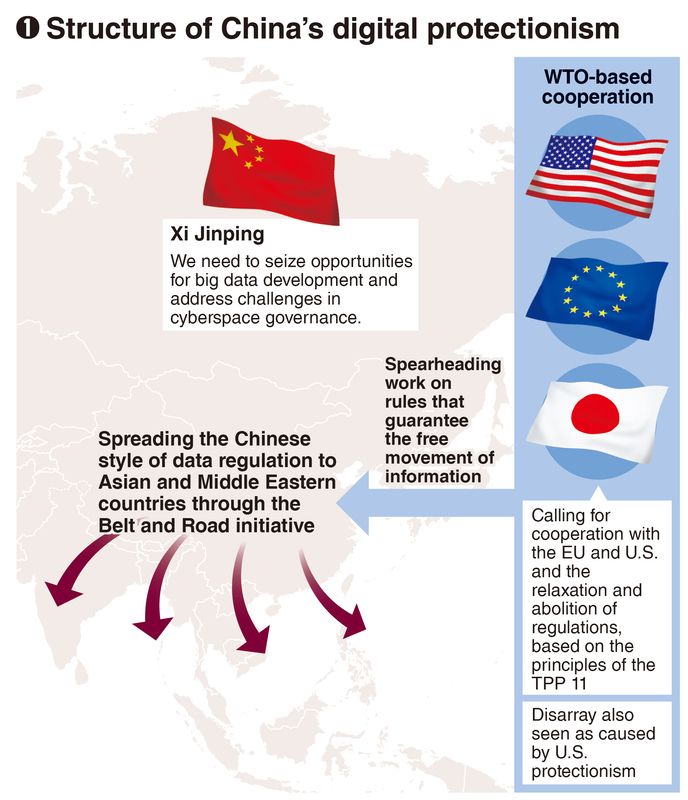
In response to the succession of protectionist trade policies issued by U.S. President Donald Trump, Chinese President Xi Jinping has cast himself as a defender of free trade. However, he has actually promoted digital protectionism, in which China has tightly managed the distribution of big data.
New oil
The China International Big Data Industry Expo was held in late May in Guiyang, the capital of the southern Chinese province of Guizhou. About 400 companies took part, including China's big three internet companies, collectively nicknamed BAT: internet search engine giant Baidu Inc., e-commerce firm Alibaba Group Holding Ltd., and social media giant Tencent Holdings Ltd.
Xi sent a celebratory message, emphasizing, "We need to seize the golden opportunities in the development of big data, promote the healthy development of the big data industry and address challenges in areas such as cyberspace governance" (see chart 1).
Big data is a data resource, such as individuals' online browsing and purchase histories, referred to as "the new oil." Xi aims to build a powerful country that will rival the United States by the middle of the 21st century. With an eye toward the development of a "digital China," he is poised to battle the United States for control of these data resources.
In addition to establishing big data pilot zones for such purposes as research and development and the improvement of big data-related infrastructure, the Chinese government this year approved the introduction of big data departments at over 200 educational institutions, including universities, with the aim of training personnel.
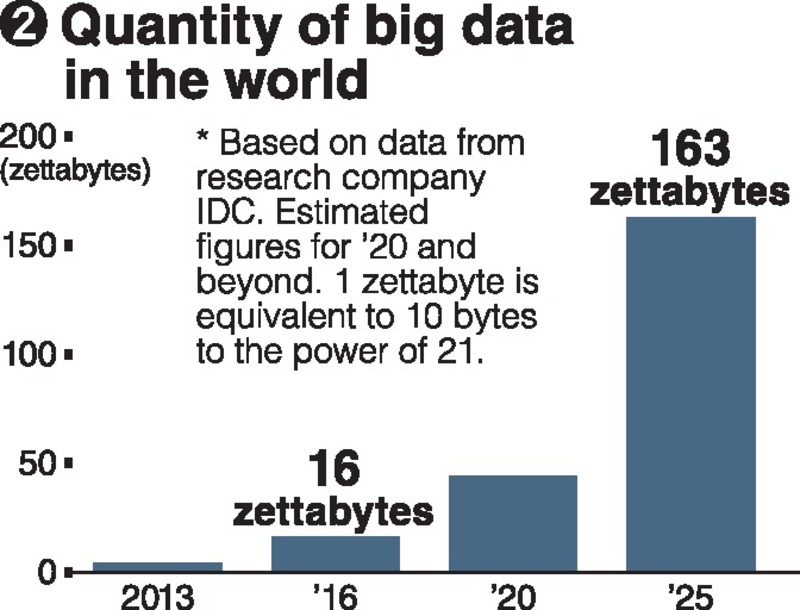
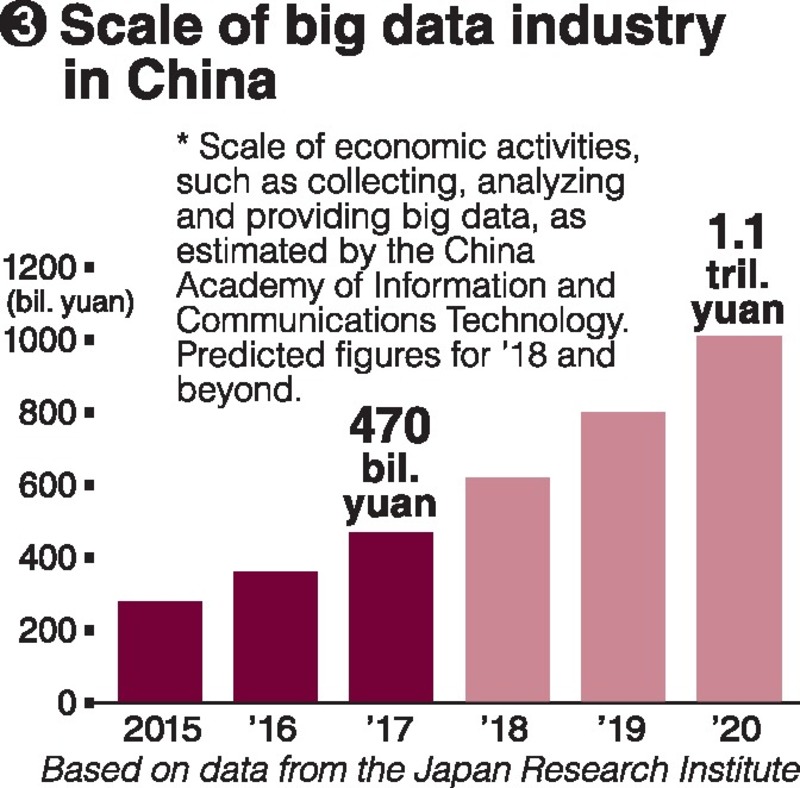
The quantity of big data in the world is on the rise (see chart 2). According to Xinhua News Agency, China is expected to account for 20 percent of the world's data capacity by 2020, at which point it will possess more data than any other country. The industry will reportedly exceed 1 trillion yuan (about 17 trillion yen) in size (see chart 3).
'Personal data' pretext
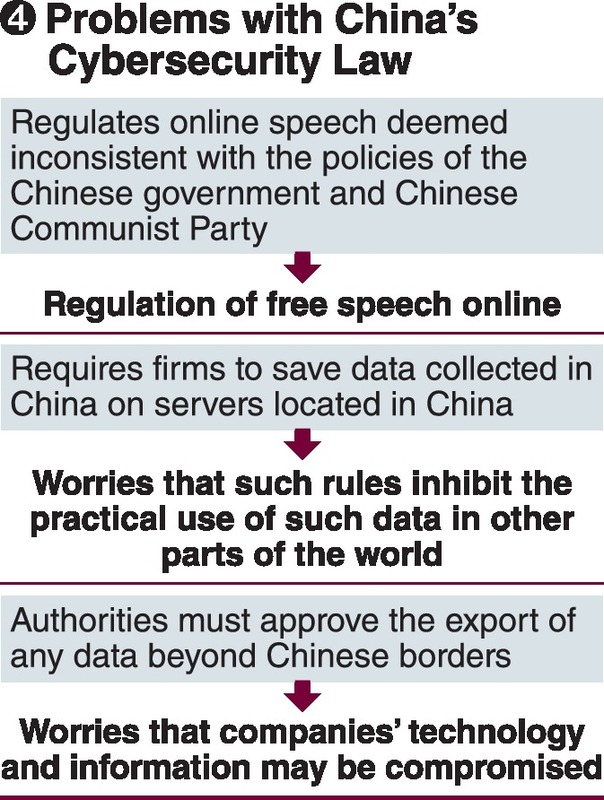
One problem, however, is the digital protectionism promoted by the Xi administration, which is in the process of walling off big data to achieve its goals. The country's Cybersecurity Law, which was enforced in June 2017, plays a central role in this policy (see chart 4).
Under the pretexts of "national security" and "protection of personal information," the law requires, in principle, companies that collect personal information and other important data within China to save such data on servers in China. If a company wishes to transfer data outside of the country, the transaction must first be reviewed by the authorities. Limits are imposed on the transfer of information across the country's borders. The "cyberspace governance" Xi speaks of means controls such as these.
Although Chinese authorities are currently working on implementing detailed regulations, the law contains many ambiguous expressions, and there is concern that the law may be applied in an arbitrary manner. It is thought that the impact of the law will inevitably extend to foreign-owned companies, including Japanese firms.
Shinichi Seki, vice senior economist at the Japan Research Institute, notes that the Xi administration's aims are: 1) to reinforce value-added industries and upgrade industry in general through the collection and use of big data, 2) to protect domestic companies from competition against major foreign information technology companies, and 3) to maintain social stability with more robust monitoring.
In May, the European Union enacted its own General Data Protection Regulation, which obliges companies to maintain controls on personal information. Although there are concerns about the possible detrimental effects of excessively strict regulations, the prevailing view in Japanese business circles is that the EU regulations differ in intent from those of China. According to this view, the EU aims to protect the human rights of individuals, while China emphasizes strengthened regulations and its operations are regarded as opaque.
It is natural that governments and other institutions around the world have heightened their vigilance in response to China's Cybersecurity Law, viewing it as a trade barrier that will serve to exclude foreign companies.
Xi said at an international conference in late June, "Economic globalization has made important contributions to world economic development. We must not move backward toward protectionism," as part of his argument for the importance of free trade. However, Xi's claims are not persuasive as long as he himself strengthens digital protectionism.
One-way traffic
Another point of concern is China's "Digital Silk Road" campaign, through which it seeks to spread aspects of its own model, such as regulatory clampdowns and protectionism. Such efforts target countries connected to its Belt and Road Initiative, through which it aspires to build a massive economic zone. In December 2017, six countries including Laos and Saudi Arabia came to an agreement with China on economic cooperation in the digital sphere.
According to the Japan Business Federation (Keidanren), efforts to build systems for policing the cross-border movement of data are underway in several Southeast Asian countries, including Brunei, Vietnam and Indonesia. These could also be viewed as efforts to emulate China's digital protectionism.
"China has its Cybersecurity Law that, for security reasons, prohibits information from being moved out of the country. At the same time, information from outside of the country can freely be collected in China. It's a system of one-way traffic."
This assertion was part of an address by Akira Amari, former minister in charge of economic revitalization, in early May at the Brookings Institution in Washington. He expressed wariness over China's efforts to cordon off both domestic and foreign data. Amari also noted the need for rules like those established in the Trans-Pacific Partnership to end such unfair actions, calling for the United States to return to the trade pact.
The TPP includes a prohibition on excessive regulation, for the purpose of ensuring that business is not obstructed by digital protectionism. In partnership with Europe and the United States, Japan has spearheaded voluntary meetings on digital trade at the World Trade Organization, in hopes that formulating rules will ensure the free movement of data and ban the forced transfer of technology.
G-7 out of step
There are concerns over discord among the Group of Seven advanced nations in relation to Trump's import restrictions on steel and aluminum. Trump has even hinted that the United States could leave the WTO. This could relieve pressure on China, and ultimately benefit Beijing as it further pursues digital protectionism.
Japan must not only utilize multinational frameworks such as the Group of 20 summit meeting, but also steadily drive the efforts of the TPP 11 (see below) countries, which include Japan and Australia. It must also continue to press for the relaxation and abolition of regulations.
--TPP 11
A trade agreement officially named the Comprehensive and Progressive Agreement for Trans-Pacific Partnership. Although participation decreased from an initial 12 countries to 11 following the United States' withdrawal, the new agreement retains the majority of the progressive trade rules that characterized the original TPP, such as the lowering and elimination of tariffs, and rules on the growing realm of e-commerce, including online shopping. The agreement also includes a guarantee that information will move freely across borders; a ban on requirements for the local installation of computer equipment, including servers; and a ban on access requirements or the transfer of source code, which is considered confidential information relating to software.
Read more from The Japan News at https://japannews.yomiuri.co.jp/